Forex reserves buffer currency stability. While restricting imports conserves forex, it suppresses consumption and hampers growth. Sustainable management instead demands boosting domestic productivity and export competitiveness.
Why In News?
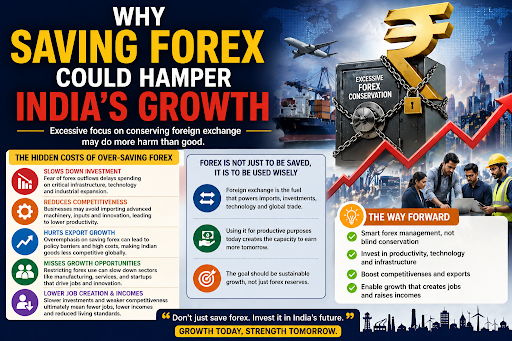
Aggressively cutting core imports like oil and fertilizers to save forex can harm industrial output, lower demand, and slow India's GDP growth.
What are Foreign Exchange Reserves?
Foreign exchange reserves consist of four major components: foreign currency (FX) assets, gold, Special Drawing Rights (SDRs), and the Reserve Tranche Position with the International Monetary Fund (IMF).
Significance
Major Reasons Behind Forex Conservation Policies
Governments initiate forex conservation to curb a widening current account deficit caused by high import bills for commodities like crude oil, gold, and edible oils.
Heavy reliance on external energy sources, such as importing over 85% of the nation's oil needs, triggers massive dollar outflows that rapidly deplete national reserves.
Heavy household consumption of imported gold directly drains dollars from the economy and weakens the Rupee.
Over-reliance on imported chemical fertilizers drains foreign exchange, prompting governments to advocate for alternative agricultural practices like natural farming to conserve currency.
Authorities seek to suppress the demand for dollars to prevent the Rupee from depreciating further against foreign currencies, which would make future imports even more expensive.
Large-scale sell-offs by foreign investors force governments to conserve forex to mitigate the rapid exit of foreign capital and stabilize the balance of payments.

How Excessive Forex Conservation Slows Economic Expansion?
Import substitution policies designed to cut imports kill competition and can decrease the annual GDP growth rate by up to 2% points. (Source: NITI Aayog)
Suppressing domestic consumption to save dollars directly reduces sales for businesses dependent on imported raw materials, which disincentivizes investment and stalls overall economic growth.
Blocking foreign products eliminates market competition, which degrades the quality of domestic goods and prevents local industries from accessing the latest technology and best practices.
Weaker consumption deters foreign investors, turning a capital account surplus into a deficit as foreign capital flees an economy that is deliberately rolling back demand.
Limiting essential capital goods imports traps domestic industries in low-value-add fabrication, preventing them from moving up the value chain to boost the manufacturing sector.
Why Managing Forex Without Hurting Growth is Difficult?
India depends heavily on imports like crude oil, fertilizers, and capital machinery, forced self-reliance directly increases production costs and slows the economy.
When the Reserve Bank of India (RBI) defends the currency by selling forex in the spot market, it absorbs domestic liquidity, which drives up interest rates and strains the domestic financial system.
Restricting imports denies domestic manufacturers access to cheaper, technologically advanced intermediate inputs, which lowers their export competitiveness and integration into production networks.
A terms-of-trade shock (like a collapse in oil prices) artificially appreciates the real effective exchange rate (REER), triggering the Dutch Disease phenomenon that destroys the tradable sector's competitiveness.
What Should Be the Way Forward?
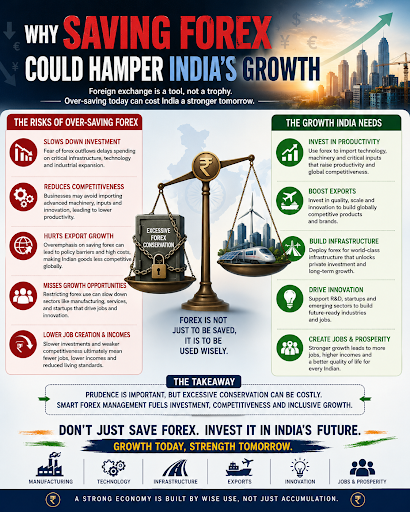
Boost domestic production and productivity rather than relying on unsustainable cuts to domestic consumption.
Implement supply-side reforms to improve the ease of doing business, attract stable Foreign Direct Investment (FDI), and organically generate foreign exchange.
Domestic industries must forge technical collaborations and invest in R&D to seize the projected $30 billion annual revenue opportunity in the capital-goods sector. (Source: McKinsey)
India needs to improve total factor productivity and assimilate into global value chains to capture a larger market share of global exports.
The RBI must allow the exchange rate to adjust organically to external shocks, while the government ensures that expansive fiscal policy does not offset necessary real depreciations.
Conclusion
Sustainable expansion requires shifting from restrictive forex conservation and import substitution toward aggressive export promotion, technological integration, and productivity-driven growth.
Source: INDIANEXPRESS
|
PRACTICE QUESTION Q. Evaluate the macroeconomic implications of import substitution policies on the global competitiveness of India's manufacturing sector. 150 words |
Central banks accumulate forex reserves to maintain an undervalued exchange rate, which aggressively promotes export competitiveness against trading partners.
Import substitution policies kill market competition and decrease the annual GDP growth rate by up to 2 percentage points.
Import intensity signifies the exact extent of imported raw materials and intermediate inputs that domestic producers embed into exported goods to integrate into the global production network.





© 2026 iasgyan. All right reserved