Recent studies show that expanding Protected Areas alone has not halted biodiversity loss. Many remain “paper parks” with weak management, poor funding and limited community involvement. Climate change and invasive species worsen impacts. Conservation must shift from area-based targets to outcome-focused, adaptive strategies that empower local custodians.
Copyright infringement not intended
Picture Courtesy: DOWNTOEARTH
The Journal Nature published research suggesting that the rapid expansion of protected areas worldwide gives a misleading picture of progress, as biodiversity continues to decline inside many designated protection sites.
The Kunming-Montreal Global Biodiversity Framework (GBF), adopted in 2022, set an ambitious goal known as the '30x30 target'—to conserve and manage 30% of the world’s land and oceans by 2030.
Rapid designation of new Protected Areas meets targets but often fails to deliver genuine ecological protection, raising concerns about current conservation effectiveness.
The "Paper Parks" Phenomenon
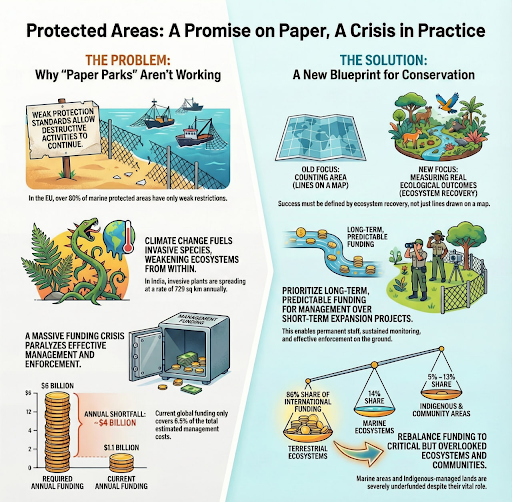
Many PAs, particularly Marine Protected Areas (MPAs), lack the legal teeth or field presence to stop industrial activities.
Climate Change and Invasive Species
Warming climates destabilize ecosystems, favoring invasive species that outcompete native biodiversity.
Systemic Governance Failures
Management remains reactive rather than adaptive, failing to keep pace with dynamic environmental shifts.
Conservation Financing Crisis
Achieving the global "30x30" target is hindered by a massive funding gap.
Concern about current funding models
Way Forward
Focus on Quality over Quantity
Ecological outcomes (e.g., stable species populations, ecosystem health) must measure success, not just the area designated as "protected." This requires clear, non-negotiable standards for protected area qualification.
Embrace Adaptive Management
PA management needs to be flexible, dynamic, and science-driven, with continuous monitoring and adaptive strategies for threats like climate change and invasive species.
Strengthen On-the-Ground Capacity
Effective conservation needs sustained funding for trained staff, strong enforcement, and rights-based engagement with local communities.
Reform Conservation Finance
Funding models must be redesigned to be long-term, predictable, and sufficient for recurrent management costs. Donors should better balance establishing new Protected Areas (PAs) with strengthening existing ones.
Empower Local Custodians (IPLCs)
Increase direct, flexible, and long-term funding for Indigenous Peoples and local communities. Recognizing their land rights and using their traditional knowledge is an equitable and effective conservation strategy.
Achieving the 30x30 target requires prioritizing the quality of protection, adaptive management, sustainable finance, and the empowerment of local communities to move beyond 'paper parks' and safeguard biodiversity.
Source: DOWNTOEARTH
|
PRACTICE QUESTION Q. The term 'Paper Parks', often seen in news related to environmental conservation, refers to: (a) Areas designated for the recycling of paper products to promote a circular economy. (b) Protected areas that exist only on official documents but lack adequate on-ground management. (c) National parks that are established primarily to protect specific species of flora used in the paper industry. (d) A digital databas e and mapping initiative for all protected areas globally, led by the UNEP. Answer: B Explanation: A paper park is a legally established protected area (such as a national park or marine reserve) that has designated conservation status but receives little to no actual implementation of management or protection measures. |
The '30x30' target is a key goal of the Kunming-Montreal Global Biodiversity Framework. It commits signatory countries to effectively conserve and manage at least 30% of the world's land and 30% of its oceans by the year 2030.
A 'paper park' is an area that is officially designated as protected on paper (i.e., in law and on maps) but lacks the resources, management, and enforcement on the ground to actually protect the biodiversity within its boundaries. Damaging activities like industrial fishing often continue within these areas.
IPLCs are critical custodians of biodiversity, managing over 80% of the Earth's biodiversity with often better conservation outcomes than state-run parks. However, they are severely underfunded, receiving only a small fraction of international conservation finance. Empowering them is seen as crucial for effective conservation.

© 2026 iasgyan. All right reserved