The Mission for Cotton Productivity (2026–2031) is a Rs 5,659.22 crore initiative to boost India's cotton yield, promote Extra Long Staple cotton, mitigate pest vulnerabilities, and align the textile industry with global standards through the 5F vision.
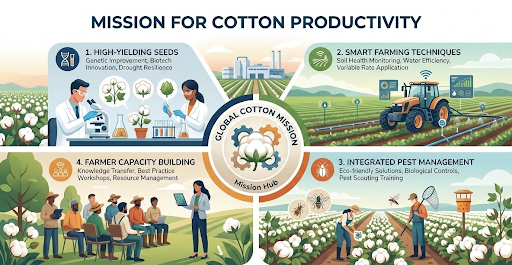
The Union Cabinet has approved an outlay of Rs. 5,659.22 crore for the Mission for Cotton Productivity (2026–27 to 2030–31).
The initiative aims to address stagnant yields, mitigate pest-related challenges, improve quality, and make India self-reliant in cotton production while enhancing competitiveness in global textile markets.
Cotton Cultivation in India
India is the world's second-largest producer and consumer of cotton (after China) and holds the largest cultivation area globally.
It is a subtropical, Kharif crop requiring a warm, sunny, frost-free climate.
It grows well in deep alluvial soils in the North, black clayey (regur) soils in Central India, and red-black mixed soils in the South.
Species Diversity: India is the only country that cultivates all four cultivated species of cotton: Gossypium arboreum and G. herbaceum (Asian cotton), G. barbadense (Egyptian/Extra Long Staple cotton), and G. hirsutum (American Upland cotton).
Implementing Agencies: The mission is jointly implemented by the Ministry of Agriculture & Farmers Welfare and the Ministry of Textiles.
Institutional Support: It involves 10 institutes from the Indian Council of Agricultural Research (ICAR), one CSIR institute, and 10 centers of the All India Coordinated Research Project (AICRP) on Cotton operating across State Agricultural Universities (SAUs).
Coverage: In its initial phase, the mission focuses on 140 districts across 14 major cotton-growing states.
5F Vision: The mission aligns with the Government of India's integrated vision for the textile sector: Farm to Fibre to Factory to Fashion to Foreign.
Production & Yield: Increase total cotton production to 498 lakh bales (170 kg lint each) and boost stagnant lint productivity from 440 kg/ha to 755 kg/ha.
Beneficiaries: Directly improve the livelihoods of approximately 32 lakh cotton farmers.
Technological Upgrades: Upscale improved production technologies like the High-Density Planting System (HDPS), Closer Spacing (CS), and Integrated Cotton Management.
Promoting ELS Cotton: Focus on Extra Long Staple (ELS) cotton, which is considered the gold standard in premium textiles due to its superior fiber length (≥30 mm). Currently, India heavily relies on importing ELS cotton from Egypt and the USA.
Kasturi Cotton Bharat: Promote branding initiative to ensure traceability, certification, and high-quality processing, targeting a trash/contamination reduction to <2%.
Fiber Diversification: Diversify fiber base by promoting natural complementary fibers such as flax, ramie, sisal, milkweed, bamboo, and banana.
Low Productivity: Despite holding 21% of global area, India’s 440 kg/ha yield is far below the 770 kg/ha global average.
Pest Resistance: Pink Bollworm and Whitefly have developed resistance to Bt Cotton, increasing crop losses and costs.
Climate Risk: With 65% of cultivation being rainfed, modern methods like HDPS are risky without assured micro-irrigation.
Small Landholdings: Fragmented farms hinder capital-intensive mechanized harvesting and HDPS.
Soil Health: Decades of monocropping and chemicals have depleted organic carbon, affecting new variety performance.
Irrigation Convergence: Integrate with schemes like the Pradhan Mantri Krishi Sinchayee Yojana (PMKSY) - Per Drop More Crop to provide necessary micro-irrigation support for HDPS adoption in rainfed zones.
Next-Gen Integrated Pest Management (IPM): To prevent pest resistance from over-reliance on GM seeds, the mission must mandate Integrated Pest Management (IPM), including biopesticides, pheromone traps, and refuge crops.
Mechanization & Cooperatives: Parallel subsidies and support for mechanized cotton harvesters are essential. Establishing robust Custom Hiring Centers (CHCs) or FPO-led cooperative models will solve the issue of labor shortages during the picking season.
Digital Agriculture (Agri-Stack): Leveraging AI and satellite data can provide farmers with hyper-local, real-time advisories regarding soil moisture and early pest attack warnings directly on their smartphones.
Extension Services: The success of the mission ultimately relies on "Lab to Land" transfers. Krishi Vigyan Kendras (KVKs) and SAUs must train farmers and support through these transitions.
Source: PIB
|
PRACTICE QUESTION Q. With reference to cotton cultivation in India, consider the following statements: 1. India is the only country in the world that cultivates all four known cultivated species of cotton. 2. Cotton is primarily a Kharif crop that requires at least 210 frost-free days. 3. More than 65% of cotton cultivation in India is done under assured irrigation. Which of the statements given above is/are correct? A) 1 and 2 only B) 2 and 3 only C) 1 and 3 only D) 1, 2, and 3 Answer: A Explanation: Statement 1 is correct: India is the only country in the world to grow all four commercially cultivated species of cotton: Gossypium arboreum (Desi Cotton), G. herbaceum, G. hirsutum (American Cotton), and G. barbadense (Egyptian/Sea Island Cotton). Statement 2 is correct: Cotton is a tropical Kharif crop in India, typically sown during the monsoon (June–July). It requires high temperatures and a long frost-free period of 180 to 210 days for the bolls to mature properly. Statement 3 is incorrect: Approximately two-thirds (65-67%)—of cotton cultivation in India is rain-fed, not irrigated. Only about one-third of the area has assured irrigation, making the crop highly susceptible to monsoon fluctuations. |
It is a central initiative with a budget of Rs. 5,659.22 crore aimed at increasing India's stagnant cotton yield from 440 kg/ha to 755 kg/ha and bringing total production to 498 lakh bales by 2031.
ELS cotton (Gossypium barbadense) has a superior staple length of 30 mm or more, making it the gold standard in premium textiles. India currently relies heavily on importing it from Egypt and the USA.
It is a branding, traceability, and certification initiative embedded within the mission to position Indian cotton as a premium global product, specifically targeting a trash/contamination reduction to below 2%.




© 2026 iasgyan. All right reserved