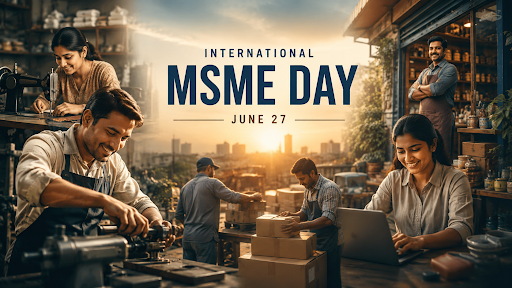
The UN MSME Day (June 27) highlights the vital role of small businesses in achieving SDGs. In India, MSMEs drive 31.1% of GDP and 48.5% of exports. Recent initiatives like the ₹10,000 crore SME Growth Fund, TReDS, and Udyam formalization aim to bridge credit gaps and foster AI-driven, human-centered entrepreneurship.
Why In News?
The United Nations observed MSME Day on June 27, 2026, to highlight the sector's role in achieving Sustainable Development Goals (SDGs).
What is UN MSME Day?
Origin: The United Nations General Assembly (UNGA) adopted Resolution A/RES/71/279 in 2017, officially designating June 27 as MSME Day.
Objectives: The day raises global awareness regarding the contribution of MSMEs to poverty reduction and equitable employment while encouraging financial institutions to expand access to green technologies and global value chains.
2026 Theme: The International Forum focuses on "Human-Centered Entrepreneurship in an AI-Driven Future," ensuring that Artificial Intelligence empowers rather than displaces small businesses.
UN Role: Agencies like United Nations Industrial Development Organization (UNIDO) coordinate global forums to align industrial policies with MSME realities, utilizing the World Environment Situation Room (WESR) to promote sustainable frameworks.
Importance of MSMEs
Employment Generation: MSMEs account for 60-70% of global employment. In India, the sector employs over 32.82 crore people across 7.47 crore enterprises, ranking as the second-largest employer after agriculture.
GDP Contribution: Small enterprises generate 50% of global GDP. In India, they contribute 31.1% of national GDP and 35.4% of total manufacturing output.
Export Promotion: Indian MSMEs contribute 48.58% to the country's total merchandise exports.
Innovation: The sector serves as a diffusion layer for grassroots innovation, with one-third of newly registered startups in India led by women.
SDG Alignment: MSMEs directly advance SDG 8 (Decent Work), SDG 9 (Industry/Innovation), and SDG 12 (Responsible Consumption).
MSMEs in India: Framework and Contribution
Micro, Small, and Medium Enterprises Development (MSMED) Act, 2006: The government revised investment and turnover limits in 2025-26 to prevent the "dwarfism trap":
Atmanirbhar Bharat: MSMEs drive import substitution in defence, biopharma, and electronics. Domestic defence production reached ₹1.51 lakh crore through these supply chains.
Rural Impact: Approximately 55% of MSME-generated employment occurs in rural areas, curbing distress migration.
Government Initiatives
Formalization: The Udyam Registration Portal and Udyam Assist Platform (UAP) onboarded over 1.50 crore informal microenterprises.
Credit Support: The CGTMSE (Credit Guarantee Fund Trust for Micro and Small Enterprises) sanctioned over 1.18 crore guarantees worth ₹9.8 lakh crore. The Budget 2026-27 introduced the ₹10,000 crore SME Growth Fund for equity support.
Payment Solutions: The Trade Receivables Discounting System (TReDS) processed ₹1.38 lakh crore in FY24 to mitigate delayed payments.
Technology & Upskilling: The Raising and Accelerating MSME Performance (RAMP) program utilizes a ₹6,062.45 crore outlay for technology transfer, while the MSME TEAM Scheme allocates ₹277 crore to digitize 5 lakh enterprises.
Challenges Faced by MSMEs
Credit Gap: India faces a massive credit gap; while demand reaches ₹123 lakh crore, formal supply is only ₹34 lakh crore. Women-owned enterprises face a 35% credit gap.
Productivity Gap: Indian MSMEs operate at only 14% of large company productivity, with only 15% utilizing advanced digital tools.
Structural Issues: The sector suffers from the "missing middle" syndrome and high regulatory compliance costs.
Way Forward
Digitalisation: Integrate Digital Public Infrastructure (DPI) like ONDC (Open Network for Digital Commerce) and Bhashini to democratize e-commerce.
Global Integration: Utilize the Export Promotion Mission’s 2.75% interest subvention to integrate into Global Value Chains (GVCs).
Green Transition: Promote Zero Defect Zero Effect (ZED) certification and provide green financing for circular economy models.
Lending Reform: Transition to cash-flow-based lending using the Account Aggregator framework and GST data.
Professional Support: Deploy 'Corporate Mitras' to assist micro-entrepreneurs with regulatory compliance in Tier-II and Tier-III cities.
Conclusion
Empowering MSMEs through cash-flow lending, AI integration, and green technologies is imperative to dismantle the "dwarfism trap" and propel India's transition into a globally competitive, self-reliant Viksit Bharat.
Source: UNIDO
|
PRACTICE QUESTION Q. "Despite contributing significantly to employment and exports, the Indian MSME sector suffers from the 'missing middle' syndrome." Analyze. 150 words |
The United Nations recognizes International MSME Day globally on June 27 to raise public awareness of the monumental contributions made by micro-, small, and medium-sized enterprises toward achieving sustainable development and poverty eradication.
MSMEs are highly critical because they act as the backbone of local economies, fostering grassroots industrialization, promoting innovative entrepreneurship, and driving social inclusion by generating up to 70% of employment worldwide.
MSMEs power India's economic engine by contributing roughly 30% to the national Gross Domestic Product (GDP), driving nearly 45% of total manufacturing exports, and providing vital livelihoods to over 11 crore citizens across rural and urban sectors.
Small enterprises face severe operational bottlenecks including limited access to formal credit and working capital, poor adoption of advanced digital technologies, complex regulatory compliance burdens, and a lack of integrated market access to compete with massive multinational corporations.



© 2026 iasgyan. All right reserved