The Anti-Defection Law (Tenth Schedule) penalizes legislators for switching parties, targeting political instability. However, ambiguous drafting in Paragraph 4 allows mass defections under the guise of "mergers." Reforming Speaker adjudication and limiting whips are critical for safeguarding democratic mandates.
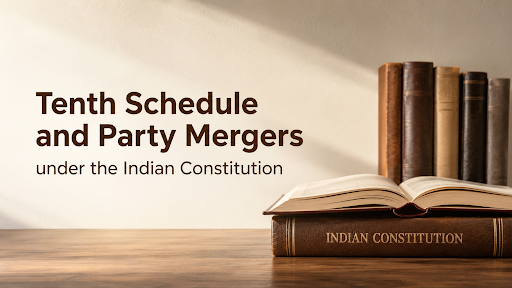
The Anti-Defection Law under the 10th Schedule faces intense scrutiny following the mass defection of 20 Trinamool Congress (TMC) MPs to the Nationalist Citizens Party of India (NCPI) and the merger of 7 AAP Rajya Sabha MPs with the BJP.
The Tenth Schedule serves as the primary legal framework for curbing political instability and opportunism in India.
Origin: The Rajiv Gandhi government introduced the schedule via the 52nd Constitutional Amendment Act, 1985.
Constitutional Basis: It functions alongside Articles 102(2) and 191(2), which formalize disqualification grounds for members of Parliament and State Legislatures.
Core Objective: The law targets "Aaya Ram Gaya Ram" politics, a term originating from the 1967 defection of Haryana MLA Gaya Lal, who switched parties three times in one day.
Government Stability: It mandates party discipline to prevent the collapse of governments and ensures that representatives honor the ideological mandate provided by the electorate.
Grounds for Disqualification
Voluntary Membership Resignation: Legislators face disqualification if they surrender their party membership. In Ravi S. Naik vs Union of India (1994), the Supreme Court ruled that conduct implying resignation, such as anti-party activities, triggers disqualification.
Voting Against the Whip: Members lose their seats if they vote or abstain contrary to the official party directive. Legislators avoid this only by obtaining prior permission or receiving party condonation within 15 days.
Independent Members: Independent legislators lose their seats immediately upon joining any political party.
Nominated Members: Nominated members face disqualification if they join a political party more than six months after taking their seat.
Paragraph 4 Merger Controversy
Paragraph 4 provides a "legal fiction" that exempts mass defections from the definition of defection, provided specific conditions are met.
The Two-Thirds Rule: A merger avoids penalties only if at least two-thirds of the members of the legislative party agree to the shift.
The "Twin Test" vs Disjunctive Reading: Constitutional experts advocate for a "twin test," requiring the original political party to merge first, followed by the legislative party.
Removal of the Split Provision: The 91st Constitutional Amendment Act, 2003 deleted Paragraph 3, which previously allowed a "split" if one-third of members defected. This amendment forces all mass defections to meet the stricter two-thirds threshold.
Role of the Presiding Officer
The Speaker of the Lok Sabha or Chairman of the Rajya Sabha holds the power to adjudicate disqualification petitions.
Quasi-Judicial Function: Presiding officers act as tribunals, yet their inherent political affiliations often lead to biased delays.
Judicial Intervention
In the Kihoto Hollohan vs Zachillhu (1992) case, the Supreme Court upheld the Tenth Schedule but struck down the clause granting absolute finality to the Speaker, subjecting their decisions to judicial review.
The Nabam Rebia (2016) case prohibits Speakers from adjudicating petitions while a removal motion against them is pending.
The Keisham Meghachandra Singh (2020) ruling mandates that Speakers resolve petitions within a three-month timeframe.
Restricted Legislative Freedom: The law forces legislators to vote along party lines, preventing them from exercising independent oversight or representing constituent interests that diverge from party mandates.
Strategic Delays: Speakers often stall decisions to favor the ruling regime, as seen in Andhra Pradesh, where an 18-month delay paralyzed the assembly.
Political Misuse: The Paragraph 4 exemption legalizes wholesale defection while punishing individual dissent. The 2022 Maharashtra crisis, where 40 out of 55 Shiv Sena MLAs walked out, demonstrates how the law fails to prevent the collapse of coalitions.
Independent Tribunal: As recommended by the Law Commission's 255th Report (2015), Parliament should transfer adjudicatory powers from the Speaker to an independent tribunal or the Election Commission of India (ECI).
Codification of Timeframes: The legislature must codify the Keisham Meghachandra ruling into statute, making the three-month deadline for disqualification decisions legally binding.
Strengthening Internal Democracy: Following the Dinesh Goswami Committee (1990) recommendations, parties should restrict the use of the whip to critical votes, such as No-Confidence Motions or Money Bills, allowing members greater freedom on routine legislative matters.
The Anti-Defection Law currently serves as a tool for political manipulation rather than a guardian of democratic stability. By eliminating the ambiguous loopholes in Paragraph 4 and removing the partisan influence of the Speaker, India can ensure that the legislative process remains accountable to the voters rather than the whims of party leadership.
Source: THEHINDU
|
PRACTICE QUESTION Q. Critically analyze the role of the Speaker as an adjudicating authority under the Tenth Schedule. 150 words |
The Tenth Schedule is a constitutional framework inserted via the 52nd Amendment Act in 1985 to penalize political defection by disqualifying legislators who change parties.
A merger avoids penalty by fulfilling the twin-test under Paragraph 4, requiring the original organizational party to merge with another party alongside the consent of at least two-thirds of its legislature party members.
The Speaker operates as the sole initial adjudicating tribunal vested with the absolute authority to investigate, validate mergers, and issue final rulings on disqualification petitions.
The Parliament's 91st Constitutional Amendment Act, 2003, completely deleted the one-third split exemption to check the massive systemic abuse of frequent, unprincipled group defections.




© 2026 iasgyan. All right reserved