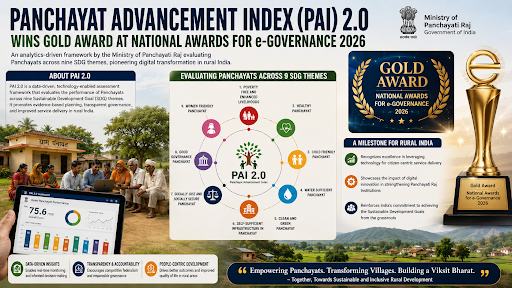
The Panchayat Advancement Index (PAI) 2.0, an analytics-driven framework by the Ministry of Panchayati Raj evaluating local bodies across nine SDG themes, won the Gold Award at the National Awards for e-Governance 2026 for digital transformation in rural India.
Why In News?
The Panchayat Advancement Index (PAI won the Gold Award at the National Awards for e-Governance (NAeG) 2026.
|
Read all about: Panchayat Advancement Index |
What is the Panchayat Advancement Index (PAI)?
The Ministry of Panchayati Raj (MoPR) develops the Panchayat Advancement Index (PAI) as India's first comprehensive, analytics-driven evaluation framework.
The framework assesses, scores, and ranks the real-time development performance of over 2.6 lakh Gram Panchayats across the country.
It evaluates rural local bodies against the nine core themes of the Localisation of Sustainable Development Goals (LSDGs), which include metrics like poverty-free, healthy, and water-sufficient villages.
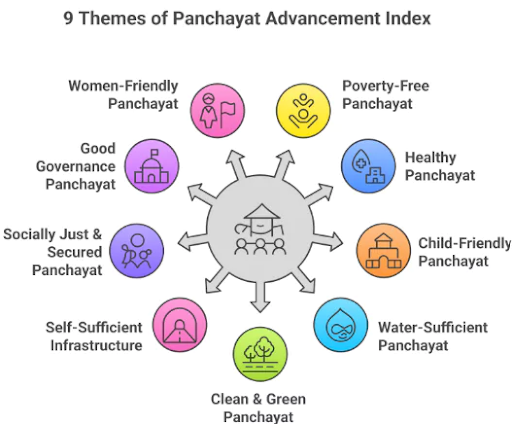
The upgraded PAI 2.0 processes 150 standardized indicators and 230 distinct data points to eliminate subjective administrative assessments.
The system classifies Gram Panchayats into five mathematically weighted performance tiers: Achiever (A+ score 90+), Front Runner (A score 75-89), Performer (B score 60-74), Aspirant (C score 40-59), and Beginner (D score <40).
The index links directly with the Gram Panchayat Development Plan (GPDP) to drive evidence-based planning, highlight critical gaps, and foster competitive federalism at the grassroots level.
About National Awards for e-Governance (NAeG) 2026
The Department of Administrative Reforms and Public Grievances (DARPG) and the Ministry of Electronics and Information Technology (MeitY) jointly organize the prestigious National Awards for e-Governance (NAeG).
The 2026 event heavily emphasizes the futuristic theme: “Viksit Bharat 2047: AI-Enabled, Data-Driven and Secure Digital Governance”.
The Ministry of Panchayati Raj secures the Gold Award in Category VII (Digital Transformation by use of Data Analytics in Digital Platforms) for successfully implementing the Panchayat Advancement Index.
The Gold Award grants the winning project an official trophy, a formal citation, and a ₹10 lakh cash incentive to fund further technological scaling and R&D.
Source: PIB
|
PRACTICE QUESTION Q. With reference to the National Awards for e-Governance (NAeG) 2026, consider the following statements:
Which of the statements given above is/are correct? A) 1 only B) 2 only C) Both 1 and 2 D) Neither 1 nor 2 Answer: B Explanation: Statement 1 is incorrect: The National Awards for e-Governance are presented by the Department of Administrative Reforms and Public Grievances (DARPG). While the awards ceremony is conducted during the National Conference on e-Governance, which is jointly organized by DARPG and the Ministry of Electronics and Information Technology (MeitY), NITI Aayog is not a joint organizer of these awards. Statement 2 is correct: The Panchayat Advancement Index (PAI), a platform by the Ministry of Panchayati Raj, won the Gold Award under Category VII: Digital Transformation by Use of Data Analytics in Digital Platforms. |
The Panchayat Advancement Index is India’s first comprehensive, analytics-driven evaluation framework that scores and ranks the performance of over 2.5 lakh rural local bodies on a unified digital dashboard.
The index acts as a standardized report card that triggers healthy competitive federalism at the absolute grassroots level while identifying critical developmental gaps in rural infrastructure.
The Union Ministry of Panchayati Raj developed and launched this data-driven monitoring platform. The index forces evidence-based policymaking and strict accountability by tying state resource allocations directly to real, objective data points validated by actual Gram Sabhas.
Digital governance eliminates bureaucratic corruption, secures real-time public service delivery to remote villages, and empowers ordinary rural citizens to track localized development funds transparently.






© 2026 iasgyan. All right reserved