The PAI 2.0 evaluates 2.5 lakh Panchayats on SDGs, promoting data-driven governance. Despite 97.3% participation, progress is hindered by the 3Fs deficit and Sarpanch Pati syndrome. Success requires aligning Finance Commission grants with performance to ensure a decentralized Viksit Bharat.
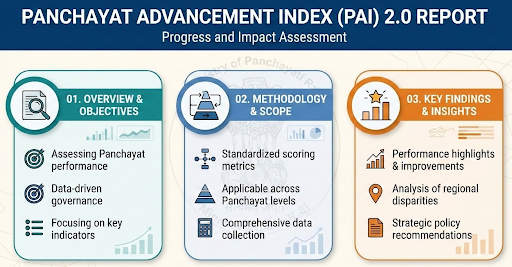
The Ministry of Panchayati Raj released the Panchayat Advancement Index (PAI) 2.0 Report for the FY Year 2023–24.
|
Read all about: National Panchayati Raj Day l Panchayati Raj Institutions |
It is an assessment framework established by the Ministry of Panchayati Raj (MoPR) to measure the holistic development and performance of Gram Panchayats across India.
It serves as a "report card" for rural local bodies, evaluating their progress in achieving the Localization of Sustainable Development Goals (LSDGs) to ensure global targets are met at the grassroots level.
Key Themes
Scale and Participation: PAI 2.0 saw a 97.30% participation rate, with data submitted by 2,59,867 Gram Panchayats across 33 States and UTs. This marks a 16.5% increase from the previous version.
Grading and Classification
Panchayats are scored on a scale of 0-100 and categorized into five performance grades. This system helps in identifying leaders and areas needing improvement.
|
Grade |
Category |
Score Range |
|
A+ |
Achiever |
90+ |
|
A |
Front Runner |
75 – 89 |
|
B |
Performer |
60 – 74 |
|
C |
Aspirant |
40 – 59 |
|
D |
Beginner |
Below 40 |
Poverty & Livelihoods: 3,313 GPs earned 'A+' grades, showcasing successful grassroots wealth creation.
Healthcare: 1,015 GPs reached 'A+' status through high community engagement in health and sanitation.
Governance: While 1,36,364 GPs are 'B' Grade performers, significant administrative improvements are still needed.
Data-Driven Planning: PAI replaces anecdotal evidence with tracking for 150 indicators and 230 data points, helping GPs create targeted Gram Panchayat Development Plans (GPDPs).
Transparency and Accountability: Mandatory Gram Sabha validation and public scorecards empower citizens to monitor representative performance.
Incentivizing Performance: It fulfills 15th Finance Commission goals by linking financial grants to verifiable local body metrics.
Administrative Efficiency: The portal auto-ports data from various Union Ministries, reducing administrative redundancy and GP workloads.
The 3Fs (Funds, Functions, Functionaries) Deficit: The Mani Shankar Aiyar Committee noted that poor devolution of funds, functions, and functionaries restricts PRI performance.
Capacity Gaps: According to the 2nd Administrative Reforms Commission (ARC), a lack of technical skills at the GP level causes data errors and indicator misinterpretation.
Proxy Governance: The "Sarpanch Pati" phenomenon, where male relatives exercise de-facto power, compromises the authenticity of gender-focused data.
Digital Divide: Poor connectivity in remote areas obstructs the real-time monitoring required by the PAI portal.
Link Finances to Performance: Government Funds should be directly tied to PAI scores, rewarding high performers and providing targeted capacity-building grants to low performers.
Strengthen Digital Infrastructure: Expand and strengthen digital connectivity through programs like BharatNet to ensure seamless data flow from all corners of the country.
Address Structural Deficits: Focus on genuine devolution of the 3Fs (Funds, Functions, Functionaries) and take strict measures to curb proxy governance.
Learn from Best grassroot Practices
International Case Studies
|
Model |
Key Feature |
Lesson for India & PAI |
|
Rwanda's 'Imihigo' System |
Performance contracts between local mayors and the President, with public ranking of districts. |
Enhance accountability by making District Magistrates directly responsible for improving the grades of the worst-performing panchayats. |
|
Indonesia's 'Dana Desa' (Village Fund) |
Direct fund transfers to villages based on a performance index, leading to faster poverty reduction. |
Transition PAI from a report card to a mandatory financial tool, linking funds from the 16th Finance Commission to score improvements. |
Domestic Success Stories
PAI 2.0 transforms rural governance by prioritizing outcome-based investment. Institutionalizing data-driven competition at the grassroots level will help achieve a decentralized Viksit Bharat by 2047.
Source: PIB
|
PRACTICE QUESTION Q. Consider the following statements regarding the Panchayat Advancement Index (PAI) 2.0: 1. It aggregates the 17 global Sustainable Development Goals (SDGs) into 9 locally relevant thematic areas. 2. It is an annual index released by NITI Aayog to measure the governance outcomes of rural bodies. 3. The framework mandates Gram Sabha validation for all data entered to eliminate bureaucratic opacity. Which of the statements given above is/are correct? a) 1 and 2 only b) 1 and 3 only c) 2 and 3 only d) 1, 2, and 3 Answer: b) Explanation: Statement 1 is correct: The PAI framework aggregates the 17 global SDGs into 9 locally relevant thematic areas to make them actionable at the village level. These themes include "Poverty-free and Enhanced Livelihoods," "Healthy Panchayat," and "Women-Friendly Panchayat." Statement 2 is incorrect: PAI 2.0 is developed and released by the Ministry of Panchayati Raj, not NITI Aayog. While NITI Aayog monitors SDGs at the national and state levels via the SDG India Index, the PAI is the specific tool for grassroots level evaluation. Statement 3 is correct: To ensure transparency and prevent bureaucratic opacity, the PAI 2.0 framework requires that all data entered by the Gram Panchayat must be validated and approved by the Gram Sabha before final submission. |
PAI 2.0 is a nationwide framework developed by the Ministry of Panchayati Raj to assess and grade the performance of Rural Local Government Institutions based on objective, verifiable indicators linked to localized Sustainable Development Goals (SDGs).
Panchayats are scored on a scale of 0–100 and classified into five grades: A+ (Achiever: 90+), A (Front Runner: 75–89), B (Performer: 60–74), C (Aspirant: 40–59), and D (Beginner: Below 40).
PAI 2.0 maps the 17 global SDGs into 9 locally relevant thematic areas, such as 'Poverty Free', 'Women Friendly', 'Clean and Green', and 'Self-Sufficient Infrastructure', making abstract global goals actionable at the grassroots level.






© 2026 iasgyan. All right reserved