The CCPA is strictly enforcing the Consumer Protection Act, 2019, to curb misleading advertisements by coaching institutes. The 2024 guidelines mandate transparency, prohibiting fake success claims and hidden course details to protect students against unfair trade practices.
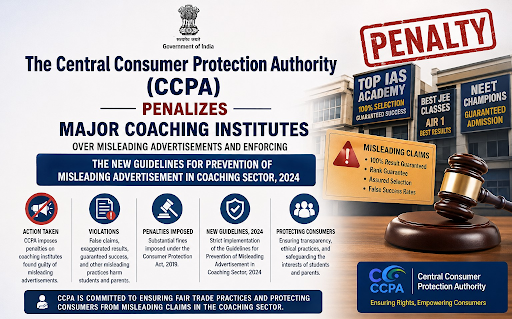
The Central Consumer Protection Authority (CCPA) penalizes major coaching institutes over misleading advertisements and enforcing the new Guidelines for Prevention of Misleading Advertisement in Coaching Sector, 2024.
|
Read all about: REGULATING COACHING INDUSTRY l EDUCATION MINISTRY ISSUES GUIDELINES FOR COACHING CENTRES |
The government establishes the CCPA as an independent statutory regulatory body under Section 10 of the Consumer Protection Act, 2019.
The authority protects, promotes, and enforces the rights of consumers as a class.
It operates to safeguard the public interest by eliminating unfair trade practices, deceptive promotional materials, and the marketing of hazardous goods.
Functions and Powers of CCPA
Regulates matters relating to consumer rights violations, misleading advertisements, and unfair trade practices across all sectors.
Initiates suo motu actions and launches comprehensive investigations through its Director General (Investigation) to uncover deep-rooted systemic deception.
Imposes strict monetary fines on violators to create deterrence.
Issues Mandatory Guidelines, such as the 2024 coaching sector guidelines, to establish clear legal standards for ethical advertising and transparency.
Directs offenders to discontinue deceptive advertisements, withdraw false claims, and mandates complete, factual disclosures to consumers.
Executes search and seizure operations, recalls hazardous goods, and refers complex cases to other regulatory bodies for multi-front investigations.
Holds public figures and endorsers accountable, possessing the power to impose fines of up to ₹10 lakh and imprisonment for up to two years for promoting false or misleading advertisements.
Coaching institutes project exaggerated success rates, inflate selection numbers, and falsely advertise guaranteed selections to lure students.
Institutes deliberately hide exact course details, falsely presenting candidates who only attend free mock interviews as full-time classroom students.
Centers commercialize education and manipulate vulnerable families by issuing false guarantees regarding job security, exam ranks, and assured admissions.
Institutes use names and photographs of successful toppers to boost their brand without obtaining the candidates' post-selection written consent.
Coaching centers employ unfair trade practices by manufacturing a false sense of urgency or seat scarcity to force immediate enrollment.
Toppers attending multiple free interview programs across different institutes makes it difficult to verify the true source of a student's success.
Coaching sector possesses immense financial power and relies on aggressive, FOMO-driven advertising (Fear Of Missing Out), making continuous nationwide monitoring highly complex.
Penalized coaching institutes challenge CCPA orders in appellate bodies like the National Consumer Disputes Redressal Commission (NCDRC), which slows down the enforcement of regulations.
Deceptive advertisements disproportionately impact underprivileged and rural families, who often take bank loans under the false impression of guaranteed returns.
Rapid expansion of hybrid learning models and growing market valued at $6.5 billion complicate uniform regulatory oversight.
Enforce the Guidelines for Prevention of Misleading Advertisement in Coaching Sector, 2024 to establish a clear roadmap for responsible communication and ethical conduct.
Institutes must obtain written, post-selection consent from successful candidates before utilizing their names, pictures, or testimonials in any promotional materials.
Central Consumer Protection Authority (CCPA) must ban the creation of false urgency (such as falsely implying limited seats) and prohibits guaranteed selection or assured admission claims.
CCPA should collaborate with the Advertising Standards Council of India (ASCI) to monitor digital and print media.
Create a standardized grading or rating system for coaching institutes based on authentic student feedback to expose misinformation and empower candidates to make informed choices.
Regulators must mandate fair, pro-rata fee refund policies for early course exits and eliminate coercive contracts that trap vulnerable students.
The CCPA enforces strict transparency and accountability measures to eliminate deceptive marketing, empowering aspirants to make informed choices in a fair and ethical educational ecosystem.
Source: INDIANEXPRESS
|
PRACTICE QUESTION Q. Consider the following statements about the Central Consumer Protection Authority (CCPA):
Which of the statements given above is/are correct? A) 1 and 2 only B) 2 and 3 only C) 1 and 3 only D) 1, 2, and 3 Answer: C Explanation: Statement 1 is correct: The CCPA is a statutory body established under Section 10 of the Consumer Protection Act, 2019. It officially came into force in July 2020 to replace the older framework under the 1986 Act. Statement 2 is correct: One of the most significant powers of the CCPA is its ability to take suo-motu cognizance of violations of consumer rights. This includes the power to investigate and take action against misleading advertisements and unfair trade practices that affect consumers as a group. |
The Consumer Protection Act, 2019 replaced the older 1986 law to strengthen consumer rights. It established the Central Consumer Protection Authority (CCPA) to regulate violations of consumer rights, unfair trade practices, and misleading advertisements.
The Central Consumer Protection Authority (CCPA) is a regulatory body established under India's Consumer Protection Act, 2019, to protect, promote, and enforce the rights of consumers.
The CCPA has the authority to conduct investigations, take suo-motu cognizance of issues, order the recall of goods, and impose hefty penalties on entities or endorsers for false or misleading advertisements.



© 2026 iasgyan. All right reserved