VINIMAY (LPMS) is India's unified digital platform for managing 15 land ports, launched by the Home Minister on 8 June 2026. It integrates customs, immigration, and logistics through single-window clearance, real-time tracking, and online payments, advancing trade facilitation and border security.
Why In News?
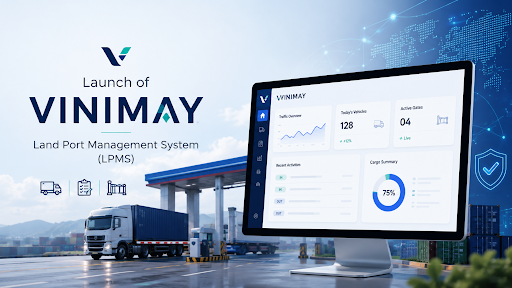
The Union Home Minister Amit Shah formally launches VINIMAY, the Land Port Management System (LPMS), to digitize and streamline operations across India's land ports.
What is the Land Port Management System (LPMS)?
Unified Digital Platform: LPMS operates under the brand name "VINIMAY" and modernizes, integrates, and unifies all operations at India's land ports.
Nodal Agency: The Land Ports Authority of India (LPAI), a statutory body under the Ministry of Home Affairs established under the Land Ports Authority of India Act, 2010, designs and develops the platform.
Operational Footprint: LPAI currently manages 15 land ports across India's international borders with Bangladesh, Nepal, Bhutan, Pakistan, and Myanmar.
End-to-End Digitization: The system digitizes the entire port workflow—from slot booking to customs clearance—to eliminate unpredictable transit times and manual delays.
Objectives of LPMS
Technology-Driven Border Management: Replaces manual, paper-based processes with automated, digital workflows powered by data analytics and AI-driven forecasting.
Trade Facilitation: Accelerates EXIM (Export Import) trade by removing procedural bottlenecks and enabling seamless cross-border movement of goods.
Logistics Cost Reduction: Cuts transaction times, manual documentation, and vehicle turnaround times to directly lower logistics expenses for traders.
Enhanced Border Security: Deploys traceable digital procedures, Radiation Detection Equipment (RDE), and Full Body Truck Scanners to strengthen security without compromising transit speed.
Key Features of VINIMAY
Single-Window Digital Clearance: Integrates multiple government agencies—including Customs (CBIC), Immigration (BOI), Border Guarding Forces, Plant Quarantine, Animal Quarantine, Health Services, and FSSAI—onto a single unified digital platform to eliminate duplicate paperwork.
Cargo and Passenger Processing: Delivers end-to-end digital workflows where traders and passengers book slots, submit documents, make payments, and track status entirely online.
Slot Booking and Online Payments: Enables pre-booking of slots for trucks, cargo, and passengers while supporting online payments for weighment, parking, warehousing, and tariff fees to replace cash-based transactions.
Real-Time Tracking System: Provides live cargo tracking from entry to exit using Automatic Number Plate Recognition (ANPR) and automated boom barriers.
Integrated Regulatory Platform: Interfaces with ICEGATE (Indian Customs Electronic Gateway), ULIP (Unified Logistics Interface Platform), and the national Motor Vehicle Ecosystem to ensure secure, real-time data exchange.
Benefits of VINIMAY
Sustained Trade Growth: Supports the massive surge in EXIM trade through land ports, which grew from ₹5,000 crore (2014-15) to ₹82,800 crore (2024-25), by accelerating cargo movement.
Minimized Waiting Times: Eliminates border queues and unpredictable delays through automated clearances and digital pre-booking.
Improved Ease of Doing Business: Aligns with India's global Ease of Doing Business push by enabling seamless coordination between government agencies and private operators.
Enhanced Transparency: Records every transaction digitally to ensure all fees and clearances remain traceable, auditable, and free from corruption risks.
Source: newsonair
|
PRACTICE QUESTION Q. Consider the following statements about the Land Port Management System (LPMS):
Which of the above statements is/are correct? (a) 1 and 2 only (b) 2 and 3 only (c) 1 and 3 only (d) 1, 2, and 3 Answer: A Explanation: Statement 1 is correct: The Land Port Management System (LPMS) was developed by the Land Ports Authority of India (LPAI), which is a statutory body functioning under the Department of Border Management. Statement 2 is correct: The platform is fully designed to integrate with key national logistics ecosystems, including ICEGATE, the Unified Logistics Interface Platform (ULIP), and the Motor Vehicle Ecosystem. Statement 3 is incorrect: LPMS is not restricted only to cargo. It provides end-to-end digital workflows that cover both cargo and passenger movement, handling tracking, slots, payments, and clearances for both groups. |
Launched by Home Minister Amit Shah on June 9, 2026, LPMS VINIMAY is a certified digital platform that integrates all Indian land port operations into a single, paperless ecosystem.
The Land Ports Authority of India (LPAI) acts as the statutory body responsible for developing and managing the physical and digital infrastructure at India's cross-border checkposts to ensure efficiency.
The platform strengthens security by unifying data across customs, immigration, and border forces, creating a "smart border" surveillance grid that instantly detects illegal movements and regulatory violations.
Attari, Dera Baba Nanak (Punjab); Rupaidiha, Raxaul (UP/Bihar); Jogbani, Darranga (Assam); Petrapole, Dawki, Sutarkandi, Golakganj, Mankachar (WB/Assam); Agartala, Srimantapur, Sabroom, Moreh (NE).






© 2026 iasgyan. All right reserved