The PCPNDT Act 1994 prohibits sex selection to combat female foeticide and declining child sex ratios in India. Despite census improvements, the Supreme Court demands strict enforcement and meticulous record-keeping to eradicate deep-seated patriarchal biases and protect the girl child.

Why In News?
The Supreme Court observed that patriarchal preference for male children continues in society and stressed strict enforcement of the PCPNDT Act to curb sex-selective practices.
What is the PCPNDT Act?
The Pre-Conception and Pre-Natal Diagnostic Techniques (Prohibition of Sex Selection) Act, 1994 (commonly known as the PCPNDT Act) prohibit prenatal sex determination and prevent the misuse of diagnostic techniques for female foeticide
Objectives: Eradicate gender-discriminatory practices that threaten the dignity and protect the girl child's right to life under Article 21,.
Key Provisions of the Act
Sex Selection Ban
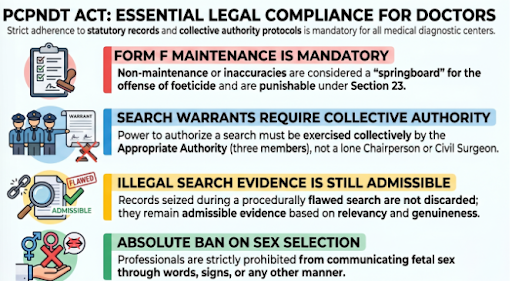
The Act prohibits sex selection before or after conception. Professionals are strictly forbidden from revealing fetal sex through any communication method.
Diagnostic Regulation
Prenatal techniques are restricted to detecting specific medical conditions (e.g., genetic or metabolic disorders). Practitioners must complete Form F for every ultrasound.
Clinic Registration
The Act requires mandatory registration for all genetic and ultrasound facilities. Unregistered centers face the immediate seizure of equipment.
Penalties
First-time offenders face three years in prison and a ₹10,000 fine, increasing to five years and ₹50,000 for repeats. The State Medical Council suspends or permanently cancels the licenses of involved doctors.
Supreme Court's Key Observations
Persistence of Patriarchal Mindsets
The Supreme Court observed that deep-seated patriarchal preferences and covert sex selection remain prevalent across India.
Child Sex Ratio Concerns
The Court noted a severe decline in the national child sex ratio from 945 in 1991 to 919 in 2011. It emphasized that a slight recovery to 929 does not signal true equality.
Mandatory Enforcement
The bench maintained that strict enforcement of the PCPNDT Act is vital. Meticulous record-keeping is a necessity to prevent foeticide, not just a formality.
Challenges in Implementation
Illegal Sex Determination Networks
Unregulated diagnostic services and clandestine networks continue to facilitate sex-selective abortions in both rural and urban areas.
Weak Monitoring Mechanisms
Clerical errors, incomplete paperwork, and the failure to maintain Form F shield illegal sex determination practices.
Social Acceptance of Son Preference
Families often continue producing children until a male heir is born, reflecting a deep-rooted systemic bias. Intersectional factors such as caste, tribal identity, and migration complicate the reach of awareness programs.
Government Initiatives
Beti Bachao Beti Padhao (BBBP)
Launched in 2015 in Panipat, Haryana, this scheme targets the declining Child Sex Ratio and promotes the survival, protection, and education of the girl child. The program drives awareness campaigns like "Selfie with Daughter" to challenge normative gender biases.
It is an umbrella scheme designed to safeguard women through emergency rescue services and rehabilitate them via financial assistance, skill development, and safe housing options.
Gender Budgeting
Schemes like the Sukanya Samriddhi Yojana provide high-interest savings accounts to secure a girl's financial future. State-level financial initiatives, including the Ladli Lakshmi Yojana and Aapki Beti Hamari Beti, offer monetary grants to empower girls.
Way Forward
Behavioural Change
Society must replace the perceived "inherent weakness" of women with true equality so a girl child's right to be born is never questioned.
Stronger Monitoring
Authorities must ensure the strict enforcement of the PCPNDT Act, penalize record-keeping violations, and dismantle illegal ultrasound networks,,.
Women's Empowerment
Policymakers must focus on structural transformations, economic empowerment, and mobilizing Self-Help Groups (SHGs) for community-level intervention.
Conclusion
To protect the girl child's right to life and equality in India, patriarchal biases must be dismantled through the rigorous enforcement of the PCPNDT Act and impactful behavioral change campaigns.
Source: INDIANEXPRESS
|
PRACTICE QUESTION Q. "The declining child sex ratio in India is a complex interplay of patriarchal norms, economic considerations, and technological advancements." Elaborate. 150 words |
The Pre-Conception and Pre-Natal Diagnostic Techniques Act, 1994 is a federal law that strictly bans the use of medical diagnostic technologies for determining the sex of a fetus to prevent female foeticide.
India prohibits sex selection to eradicate the deep-seated patriarchal preference for sons that drives sex-selective abortions and dangerously skews the national demographic sex ratio.
In June 2026 judgment, the Supreme Court dismissed a doctor's appeal in Dr. Ramesh v. State of Maharashtra, ruling that non-maintenance of medical records is a substantive offence rather than a clerical error because it acts as a "springboard" for illegal sex determination.
India can correct the imbalance by strictly enforcing the PCPNDT Act alongside social welfare schemes like Beti Bachao Beti Padhao and Ladli Lakshmi Yojana to fundamentally shift the societal mindset that devalues the girl child.






© 2026 iasgyan. All right reserved