Indian judiciary pioneers a 'Swadeshi Jurisprudence', developing an indigenous AI ecosystem to tackle massive case backlogs and improve linguistic access. The Draft AI Regulations 2026 mandate human oversight, strictly prohibiting automated adjudication to safeguard constitutional integrity.
Why In News?
Chief Justice of India Surya Kant emphasized the need to develop an indigenous AI ecosystem that supports Indian jurisprudence, legal traditions, and judicial requirements.
|
Read all about: ROLE OF AI IN JUDICIARY l AI INTEGRATION IN JUDICIARY l SUPREME COURT DRAFT AI RULES 2026 EXPLAINED |
What is an AI Ecosystem for the Judiciary?
Meaning and Components
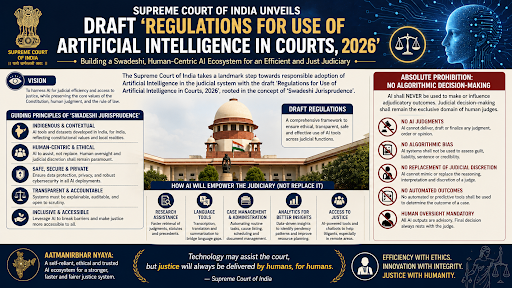
An AI judicial ecosystem establishes a network where advanced technology complements judicial work rather than substituting human judgment.
The ecosystem integrates Machine Learning (ML), Natural Language Processing (NLP), and Optical Character Recognition (OCR) directly into court software applications.
Integration of AI into Justice Delivery
Courts embed AI algorithms directly into platforms like the Integrated Case Management & Information System (ICMIS) and e-filing modules.
The Supreme Court’s AI Committee oversees AI deployments, coordinating with National Informatics Centre (NIC) and IIT Madras to modernize workflows.
Human-Centric Technology Framework
The framework strictly mandates Human-in-the-Loop (HITL) oversight, ensuring humans retain ultimate decision-making authority and accountability.
The judiciary treats technology strictly as an aid to human reasoning, prohibiting AI from rendering independent adjudicatory decisions.
|
What is Swadeshi Jurisprudence? Indigenous Legal Thinking The Chief Justice of India defines Swadeshi Jurisprudence as an Indian legal philosophy that avoids sole reliance on imported technological models. Context-Specific Interpretation of Law Developers build Indian Large Language Models (LLMs) specifically tailored to domestic institutional requirements, procedural nuances, and statutory guidelines. Reflecting Indian Constitutional Values The approach rigorously anchors legal technology in India's linguistic diversity, social conditions, and foundational constitutional promise. |
Key Features of an AI-Enabled Judicial Ecosystem
AI-Assisted Legal Research: The judiciary utilizes tools like the Legal Research Analysis Assistant (LegRAA) and SUPACE to analyze case facts and extract relevant legal references.
Automated Case Classification: The Supreme Court Registry deploys ML and OCR tools to automatically flag defects in e-filings, enabling faster procedural scrutiny.
Smart Cause Lists and Scheduling: The system executes automated case listing and intelligent scheduling to manage daily court dockets in real-time.
Real-Time Court Transcription: The Supreme Court utilizes Automatic Speech Recognition (ASR) to publish near real-time transcripts of Constitution Bench oral arguments.
Multilingual Translation of Judgments: The judiciary deploys SUVAS (Supreme Court Vidhik Anuvaad Software) to translate complex English judgments into 18 Indian languages.
Predictive Case Management: Administrators leverage analytical tools for backlog monitoring and court performance assessment.
Digital Record Management: Courts transition to Case Information System (CIS 4.0) dashboards to track case progress, digitize records, and manage electronic summons.
Benefits of AI in Judiciary
Faster Disposal of Cases: Judges expedite case resolutions by utilizing SUPACE to instantly identify precedents and understand complex factual matrices.
Increased Transparency: Courts maximize public transparency by releasing live oral transcripts on official digital platforms.
Improved Efficiency: AI streamlines administrative efficiency, liberating judicial officers to focus purely on substantive legal analysis.
Better Access for Rural Litigants: Technology democratizes justice by translating judgments into vernacular languages and facilitating remote virtual hearings.
Reduced Administrative Burden: Systems automate manual operations like formatting compliance, defect scrutiny, and metadata extraction.
Data-Driven Judicial Management: The Inter-operable Criminal Justice System (ICJS) uses AI to link police, forensics, and courts securely based on the "one data, one entry" principle.
Challenges of AI in Judiciary
Algorithmic Bias
Machine learning models risk perpetuating historical inequalities, as evidenced globally by tools profiling individuals based on race or demographics.
Data Privacy Concerns
Feeding confidential client data or sensitive judicial data into unverified public AI models creates severe data breach liabilities.
Lack of Transparency in AI Models
Proprietary algorithms create a "black box" problem, hiding the logic used to generate outputs from judges and litigants.
Accountability Issues
The system faces liability disputes when AI creates hallucinations—fabricating non-existent case laws or misstating legal principles.
Ethical and Constitutional Risks
Over-reliance on AI risks causing "value lock-in," which stagnates jurisprudential evolution by rigidly enforcing past status quo.
Digital Divide
AI deployment threatens to widen the gap for marginalized citizens who lack basic digital literacy or reliable internet connectivity.
|
Why AI Cannot Replace Judges
|
Way Forward
Develop Indian Legal AI Models
The government and judiciary should collaborate with IITs to build and verify domain-trained LLMs suited to Indian jurisprudence.
Establish AI Ethics Framework for Courts
The Supreme Court executes the draft Regulations for Use of Artificial Intelligence in Courts, 2026 to establish a robust governance architecture.
Ensure Human Oversight
The regulations must mandate strict Human-in-the-Loop verification, keeping the judge responsible for every legal outcome.
Strengthen Data Protection Measures
Courts should enforce the Digital Personal Data Protection Act, 2023 to secure sensitive judicial data and enforce data anonymization.
Promote Explainable AI
The AI framework must compel AI systems to pass rigorous Technical and Ethical Impact Assessments before deployment.
Build Capacity Among Judges and Lawyers
Implement comprehensive training programs, educating judicial officers on mitigating AI biases, hallucinations, and technical errors.
Conclusion
The strategic implementation of an indigenous AI ecosystem revolutionizes judiciary by reducing backlogs and democratizing access to justice, provided it strictly remains an explainable, human-centric aid that protects constitutional values.
Source: THEHINDU
|
PRACTICE QUESTION Q. Consider the following statements regarding the integration of Artificial Intelligence (AI) in the Indian Judiciary:
Which of the statements given above is/are correct? (a) 1 and 2 only (b) 1 and 3 only (c) 2 and 3 only (d) 1, 2, and 3 Answer: (b) Explanation: Statement 1 is correct. SUVAS (Supreme Court Vidhik Anuvaad Software) is an AI-driven neural translation tool deployed by the Supreme Court. As of 2026, it supports bi-directional translation between English and 19 regional languages (including Hindi, Kannada, Tamil, etc.) to make judgments accessible to litigants. Statement 2 is incorrect. SUPACE (Supreme Court Portal for Assistance in Court’s Efficiency) is designed strictly as a research and assistive tool to help judges process facts, manage files, and identify precedents. It is explicitly not used to predict case outcomes or issue automated sentences; judicial decision-making remains the exclusive domain of human judges. Statement 3 is correct. The draft 'Regulations for Use of Artificial Intelligence (AI) in Courts, 2026', released on June 3, 2026, mandates a "Human-in-the-Loop" (HITL) architecture. It expressly prohibits the use of AI for core judicial functions such as adjudication, sentencing, determining bail eligibility, and risk-scoring (e.g., recidivism prediction). |
The judicial AI ecosystem is a secure, integrated digital framework comprising machine learning models, legal databases, and automated tools designed to streamline case workflows and augment decision-making.
Artificial intelligence assists Indian courts by automating administrative tasks, predicting case lifespans, translating complex legal documents into regional languages, and categorizing massive volumes of pending litigations.
The primary ethical dangers include entrenching historic data biases, the lack of algorithmic transparency behind proprietary code, and potential violations of citizen data privacy.
AI expands accessibility by powering regional language translation bots, simplifying complex legal jargon for ordinary citizens, and reducing the financial burden of prolonged litigation.





© 2026 iasgyan. All right reserved