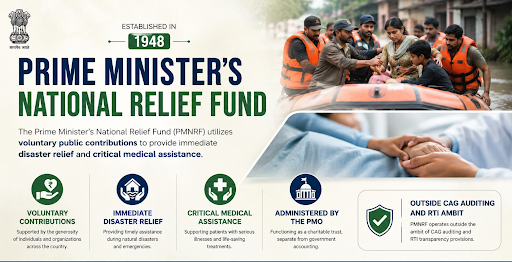
Established in 1948, the Prime Minister’s National Relief Fund (PMNRF) utilizes voluntary public contributions to provide immediate disaster relief and critical medical assistance. Administered by the PMO, it functions as a charitable trust outside CAG auditing and RTI ambit.
Why In News?
The Prime Minister announced ₹2 lakh from the PMNRF for the kin of the deceased and ₹50,000 for the injured following the Visakhapatnam Steel Plant mishap.
What is Prime Minister's National Relief Fund (PMNRF)?
Pt. Jawaharlal Nehru established the PMNRF in January 1948 to assist displaced persons from Pakistan.
The government now utilises the fund to provide immediate relief to families of victims of natural calamities (floods, cyclones, earthquakes), major accidents, and riots.
The fund covers expenses for high-cost medical treatments like heart surgeries, kidney transplants, cancer, and acid attacks.
Nature of the Fund
The government recognizes the fund as a public charitable trust under the Income Tax Act.
The fund survives entirely on voluntary public contributions from individuals and institutions and receives absolutely no budgetary support.
The law exempts contributions from the Foreign Contribution Regulation Act (FCRA).
Donors receive a 100% tax deduction under Section 80(G) of the Income Tax Act.
The fund operates independently and does not draw from the Consolidated Fund of India.
Administration and Management
The Prime Minister's Office (PMO) operates and manages the fund.
The Prime Minister acts as the ex-officio Chairperson.
The Prime Minister holds the sole discretion to approve disbursements and select beneficiaries.
An independent non-government auditor (Chartered Accountants) audits the fund annually; the Comptroller and Auditor General of India (CAG) does not audit it.
The PMO officially states that PMNRF is not a "public authority" under Section 2(h) of the RTI Act, 2005.
PMNRF vs PM CARES Fund
|
Feature |
PMNRF |
PM CARES Fund |
|
Establishment |
January 1948 by Pt. Jawaharlal Nehru. |
March 2020. |
|
Primary Objective |
Originally for Pakistan displaced persons; currently for natural calamities, accidents, and medical treatments. |
To deal with emergency/distress situations like the COVID-19 pandemic. |
|
Administration/Trustees |
Prime Minister (ex-officio Chairperson), assisted by PMO. |
Prime Minister (Chair) plus ex-officio trustees: Ministers of Defence, Home Affairs, and Finance. |
|
Funding Source |
100% voluntary public contributions; no budgetary support. |
100% voluntary public contributions; no Consolidated Fund money. |
|
Auditing |
Independent Chartered Accountants (Not CAG). |
Independent auditor (Not CAG). |
|
RTI Act Status |
PMO claims it is not a "public authority" (larger bench decision pending). |
PMO claims it is not a "public authority". |
|
Tax Benefits |
100% deduction under Section 80G. |
100% deduction under Section 80G. |
Significance of PMNRF
Ensures swift, non-political disbursement of funds during national emergencies.
Facilitates life-saving medical assistance for economically weaker citizens via authorized hospitals.
Maintains public confidence through independent audits and incentivizes donations via structured charitable trust laws and tax benefits.
Source: PIB
|
PRACTICE QUESTION Q. With reference to the Prime Minister's National Relief Fund (PMNRF), consider the following statements:
Which of the statements given above is/are correct? (A) 1 only (B) 2 only (C) Both 1 and 2 (D) Neither 1 nor 2 Answer: D Explanation: Statement 1 is incorrect: The Comptroller and Auditor General of India (CAG) does not audit the Prime Minister's National Relief Fund (PMNRF). Instead, the fund is audited annually by an independent firm of Chartered Accountants appointed by the trustees. Statement 2 is incorrect: PMNRF consists entirely of public contributions and does not receive any routine budgetary support from the Consolidated Fund of India. It is maintained entirely as a public trust. |
The Prime Minister’s National Relief Fund is a sovereign trust funded entirely by voluntary public donations to provide immediate financial assistance to citizens affected by natural and man-made disasters.
The Prime Minister of India administers the fund on behalf of the trust, with assistance from a dedicated joint secretary-level officer serving as the secretary to the fund.
While PMNRF was established in 1948 specifically to aid refugees and manage general disasters, PM CARES was created in 2020 as a dedicated trust to handle public health emergencies and expand long-term healthcare infrastructure.
The fund distributes financial ex-gratia relief for flood, cyclone, earthquake, and major accident victims, while also covering medical costs for expensive treatments like cancer, kidney transplants, and heart surgeries.






© 2026 iasgyan. All right reserved