The Supreme Court of India ruled that High Courts cannot dismiss writ petitions under Article 226(1) using the forum non conveniens doctrine. This judgment protects litigants' access to justice by affirming jurisdiction based on the respondent's location.
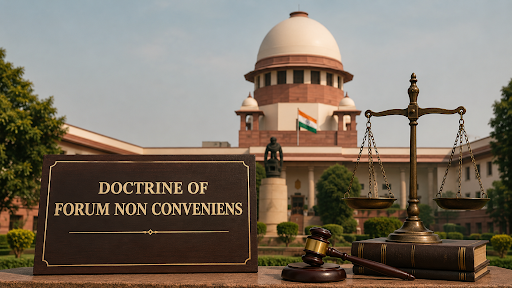
Why In News?
The Supreme Court rules that High Courts cannot routinely deny writ jurisdiction under Article 226(1) by mechanically invoking the doctrine of forum non conveniens.
What is the Doctrine of Forum Non Conveniens?
Forum non conveniens translates to "inconvenient forum" in Latin. The doctrine allows a court that legally possesses jurisdiction to dismiss or stay a case if it determines that another forum is more appropriate or convenient for adjudication.
Purpose of the Doctrine
Prevents wasted resources: It avoids wasting the Judicial System's resources and time.
Ensures convenience: It considers the location of witnesses and evidence, and the financial cost of litigation for the parties involved.
Manages administrative load: It prevents overburdening court dockets with cases that lack a significant connection to the jurisdiction.
Constitutional Basis
Article 226(1) empowers every High Court to issue writs (habeas corpus, mandamus, prohibition, quo warranto, and certiorari) to any person or authority located within its territorial limits.
Article 226(2) confers jurisdiction to High Courts to issue writs even if the authority is outside its local jurisdiction, provided the cause of action arises wholly or partly within its territorial limits.
High Courts exercise concurrent jurisdiction when multiple forums exist; however, the Supreme Court notes that the existence of alternative forums does not automatically displace a High Court's jurisdiction under Article 226(1).
Key Observations of the Supreme Court
Constitutional Remedies Cannot Be Easily Denied
The Supreme Court declares that directing a litigant away from a chosen forum impedes access to justice.
The Court warns that applying the doctrine in constitutional writ proceedings is self-defeating and denies justice rather than advancing it.
Limited Application in Writ Proceedings
The doctrine has limited application in Article 226 proceedings and requires courts to exercise considerable caution before refusing to hear a case.
In certiorari proceedings, courts can readily call for records from the respondents' offices; therefore, logistical considerations cannot override the petitioner's choice of forum.
Difference Between Jurisdiction and Convenience
Jurisdiction is the constitutional power to hear a case (derived from the respondent's location or the cause of action).
Convenience is a discretionary doctrine; the Court rules that mere administrative convenience does not justify a refusal to exercise validly invoked constitutional jurisdiction.
|
Forum Non Conveniens vs Forum Shopping Forum Shopping: A disreputable practice where litigants deliberately choose a specific Court or Judge ('bench hunting') to secure a favorable outcome, often creating an imbalance in court workloads. Forum Non Conveniens: A judicial discretionary power used by courts to prevent forum shopping by transferring or dismissing a case so a more convenient or appropriate forum hears it. |
Significance of the Judgment
Strengthening Access to Justice
The verdict safeguards access to justice for thousands of Central Armed Police Forces (CAPFs) personnel across India.
It ensures that employees facing harsh administrative actions can seek redressal efficiently without being forced to travel to distant jurisdictions.
Protection of Constitutional Remedies
The judgment protects the fundamental right to seek judicial review against arbitrary administrative actions, ensuring the state remains accountable.
Conclusion
The Supreme Court ensures that High Courts cannot use the discretionary doctrine of forum non conveniens to deny citizens their fundamental right to seek constitutional remedies against state authorities located within their territorial jurisdiction.
Source: LIVELAW
|
PRACTICE QUESTION Q. With reference to the practice of "Forum Shopping" in the Indian legal system, which of the following statements is most accurate? A) It is a legitimate constitutional right allowing petitioners to try their luck in multiple High Courts simultaneously. B) It refers to the deliberate selection of a specific court or judge by a litigant to secure a favorable outcome. C) It is synonymous with the Doctrine of Forum Non Conveniens. D) It allows the Supreme Court to transfer cases to the National Green Tribunal. Answer: B Explanation: In the Indian legal system, "forum shopping" (sometimes called "bench hunting") is the unethical practice where lawyers or litigants intentionally file their cases in a jurisdiction or before a specific judge they perceive to be more sympathetic to their cause. The Supreme Court strongly condemns this practice, declaring it an abuse of legal process that undermines judicial integrity and causes unfairness to the opposing party. |
The doctrine of forum non conveniens is a common law principle that allows a competent court to discretionarily decline or stay a case if another alternative court is clearly a more appropriate and convenient forum to serve the interests of justice.
The Supreme Court limited its application in Baksish Ahmad vs Union of India (June 2026) because invoking this doctrine to dismiss writ petitions unjustly denies access to justice, especially since relevant official records are already conveniently located at the respondent's home office.
While forum non conveniens is a court's defensive discretion to refuse a case for logistical fairness, forum shopping is an unethical, manipulative practice by a litigant who strategically hops between multiple courts to find a judge likely to issue a favorable ruling.
Article 226(1) is a vital constitutional provision that empowers a High Court to issue writs to any person or authority based entirely on the physical location (situs) of the respondent's office within its territorial boundaries




© 2026 iasgyan. All right reserved