The Union Ministry of Education's 'Guidelines for Regulation of Coaching Center 2024' aims to regulate India's 'shadow education' system by mandating registration, setting age limits for enrolment, ensuring tutor qualifications, and enforcing fair fee policies. These regulations are a response to rising student suicides, financial exploitation, and the undermining of formal education.

Copyright infringement not intended
Picture Courtesy: HINDUSTANTIMES
A Centre-appointed panel is considering holding entrance exams in class 11 or aligning their difficulty with the grade's curriculum to reform exams and lessen reliance on coaching.
|
Read all about: EDUCATION MINISTRY ISSUES GUIDELINES FOR COACHING CENTRES l RAJASTHAN TO REGULATE COACHING CENTRES l VINEET JOSHI PANEL ON COACHING |
The Ministry of Education established a high-level committee in June 2025 to propose entrance exam reforms and reduce the dependency on coaching, citing student suicides, unregulated coaching, and academic pressure.
Key Proposals and Areas of Exploration
Entrance Exam Timing
Exploring the possibility of conducting some entrance exams at the Class 11 level to provide early exposure and reduce the high-stakes pressure of Class 12.
Curriculum & Syllabus Alignment
Redesigning school curricula to mirror the format (e.g., more MCQs) and difficulty of entrance exams. The NCERT is proposed as the nodal agency to ensure syllabus alignment between school boards and competitive tests.
Board Exam Weightage
Suggesting an increase in the weightage of Class 12 board examination results in college admissions to reduce the sole reliance on single entrance test scores.
Regulating Coaching Hours
A proposal to cap coaching classes at a maximum of 2-3 hours per day to prevent student burnout and promote self-study and well-being.
Addressing 'Dummy Schools'
The committee is tasked with examining the phenomenon of 'dummy schools', where students enroll only for registration while attending full-time coaching, thereby bypassing formal education.
Career Guidance
Strengthening career counselling services in schools to make students and parents aware of diverse career pathways beyond a few elite institutions.
In 2024, the Ministry of Education, introduced the "Guidelines for Regulation of Coaching Centers 2024" to establish a legal framework to regulate the private coaching industry.
Why Was Regulation Necessary?
Unregulated Growth
Private coaching sector, valued at $6.50 Billion in 2024 and projected to grow to $17.40 Billion by 2033, expanded into a massive industry without a robust regulatory framework. (Source: IMARC Group)
Student Well-being
Intense academic pressure, especially in coaching hubs like Kota, has been linked to a rising number of student suicides. In 2023, Kota reported 26 student suicides, prompting urgent calls for reform (Source: PTI).
Commercial Malpractices
Many centers charged excessive fees, promised guaranteed ranks, and had unclear refund policies, financially and psychologically burdening students and parents.
Lack of Safety & Standards
Frequent reports of fires, insufficient infrastructure, and poor safety highlighted the necessity for mandatory standards.
Key Provisions of the 2024 Guidelines
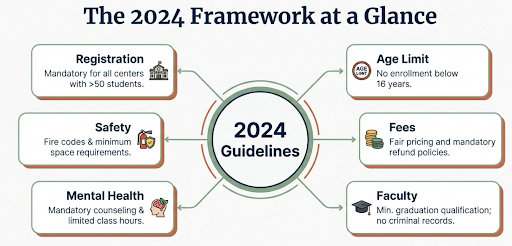
Mandatory Registration: All centers (defined as those teaching more than 50 students) must register with local competent authorities.
Age Restriction: Coaching centers are prohibited from enrolling students below 16 years of age or before they have passed their secondary school (Class 10) examination.
Tutor Qualification: Tutors must have a minimum qualification of graduation. Centers cannot hire individuals convicted of any offense involving moral turpitude.
Misleading Promises: The guidelines ban coaching institutes from making misleading promises or guaranteeing ranks and marks to attract students.
Mental Well-being: It is mandatory for centers to have a counselling system and take steps for the mental well-being of students, ensuring classes are conducted without undue pressure.
Fee Regulation: Fees charged must be reasonable. If a student leaves a course mid-way, a pro-rata refund must be provided within 10 days.
Infrastructure & Safety: Centers must allocate a minimum of one square meter per student and comply with all fire and building safety codes.
Penalties for Violation: Guidelines propose penalties for non-compliance, starting from ₹25,000 for a first offense, ₹1 lakh for a second, and subsequent revocation of registration for repeated breaches.
Regulation of coaching centres is a necessary short-term measure for student welfare, but the long-term goal must be to strengthen the formal education system to reduce dependence on private coaching by improving teaching, modernising curricula, and evolving assessments.
Source: HINDUSTANTIMES
|
PRACTICE QUESTION Q. "The mushrooming of coaching centers in India is a symptom of the structural gaps in the formal schooling system." Discuss. 250 words |
These are a set of directives issued by the Union Ministry of Education to establish a legal framework for the private coaching industry in India. They aim to address issues like high fees, student stress, and misleading ads.
Tuition fees must be "fair and reasonable." A clear fee structure and refund policy must be provided in the prospectus. If a student leaves a course midway, the centre must provide a pro-rata refund within 10 days.
Since 'Education' is on the Concurrent List of the Constitution, the state governments are responsible for implementing these guidelines. They are expected to enact their own laws or frame rules based on this central model framework.



© 2026 iasgyan. All right reserved