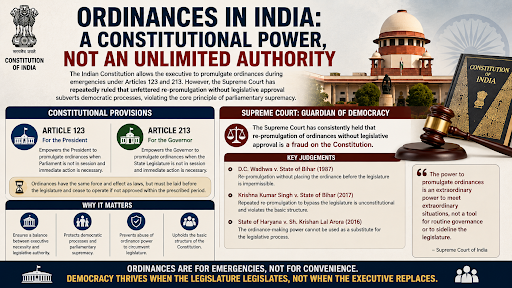
The Indian Constitution allows the executive to promulgate ordinances during emergencies under Articles 123 and 213. However, the Supreme Court has repeatedly ruled that unfettered re-promulgation without legislative approval subverts democratic processes, violating the core principle of parliamentary supremacy.
Why In News?
The Supreme Court is examining the President's and Governors' ordinance-making powers, specifically whether frequent re-promulgation compromises democratic governance and legislative supremacy.
|
Read all about: Ordinance Making Power Of President |
What is an Ordinance?
Ordinances are authoritative legal orders for immediate legislative action when the legislature is in recess. They hold the same force and effect as regular laws.
The Constitution provides conditional legislative power to the executive as a temporary measure. This ensures the legislature remains the primary law-making authority rather than establishing a parallel system.
Emergency Legislative Mechanism reserved for urgent situations, triggers only when the executive is satisfied that circumstances require immediate intervention.
Constitutional Provisions Related to Ordinances
Article 123 – President's Ordinance-Making Power
Article 123 empowers the President of India to promulgate Ordinances during the recess of Parliament.
The President exercises this power on subjects where Parliament possesses legislative competence.
Article 213 – Governor's Ordinance-Making Power
Article 213 authorizes the State Governor to issue Ordinances when the State Legislative Assembly (or both Houses in a bicameral legislature) is not in session.
The Governor explicitly requires prior instructions from the President if the equivalent Bill mandates the President's previous sanction or assent.
Conditions for Promulgation
Legislative Recess: The executive can only enact an Ordinance when the respective legislature is actively out of session.
Immediate Necessity: The President or Governor must objectively confirm the existence of an emergent situation necessitating rapid action.
Duration and Parliamentary Approval Requirements
The government faces a mandatory constitutional obligation to lay every Ordinance before the legislature.
An Ordinance automatically ceases to operate six weeks after the legislature reassembles.
The legislature holds the power to prematurely terminate the Ordinance by passing a resolution disapproving it.
An Ordinance generally holds a maximum possible lifespan of 7.5 months (six months maximum between sessions plus six weeks).
What Questions Are Before the Supreme Court?
Can Ordinances Be Re-Promulgated Repeatedly?
The Supreme Court evaluates whether the executive's unfettered re-promulgation of Ordinances violates constitutional limits.
Is Immediate Necessity Subject to Judicial Review?
The Court examines whether the subjective satisfaction of the President or Governor regarding "immediate necessity" escapes or falls under judicial review.
Can the Executive Bypass the Legislature Through Ordinances?
The Court addresses whether Article 213 imposes a mandatory obligation on the executive to physically table the Ordinance before the legislature.
What are the Limits of Executive Discretion?
The judiciary decides whether actions taken under an Ordinance remain valid (enduring rights) after the Ordinance ceases to operate.
|
Important Supreme Court Judgments on Ordinances D.C. Wadhwa vs State of Bihar
Krishna Kumar Singh vs State of Bihar
|
Key Constitutional Issues Involved
Separation of Powers
Ordinance re-promulgation disrupts the Separation of Powers doctrine by allowing the executive branch to usurp exclusive law-making functions.
Legislative Supremacy
The Constitution places the legislature as the supreme law-making authority; re-promulgation directly attacks and undermines parliamentary supremacy.
Judicial Review
The 44th Constitutional Amendment deleted clauses that made executive satisfaction "final and conclusive". Courts now actively apply judicial review to check if the executive acted with oblique motives or committed a fraud on power.
Constitutional Morality
Failing to place an Ordinance before the legislature acts as an abuse of the constitutional process and breaches constitutional morality.
Democratic Accountability
The executive remains collectively accountable to the elected legislature; circumventing legislative debate destroys this accountability.
Arguments Supporting Ordinance Powers
Need for Quick Executive Action
The government uses this power to enforce rapid, necessary actions in response to unpredictable national situations.
Administrative Efficiency
The executive leverages Ordinances to rapidly correct legislative loopholes, ensuring administrative efficiency (e.g., the Enemy Property Ordinance).
Addressing Unforeseen Situations
Dr. B.R. Ambedkar argued that existing codes often fall short, requiring sudden legislative intervention without awaiting parliamentary sessions.
Maintaining Continuity of Government
Ordinances ensure seamless governance and prevent public interest from suffering due to the physical inability of the legislature to meet instantly.
Criticisms of Excessive Ordinance Use
Weakening Parliamentary Democracy
The routine re-promulgation of Ordinances establishes an undemocratic "Ordinance Raj," fatally weakening parliamentary democracy.
Circumventing Legislative Debate
The executive deliberately denies the legislature the opportunity to scrutinize, debate, approve, or disapprove the enacted provisions.
Concentration of Power in the Executive
The government converts a strictly emergency provision into a persistent, parallel law-making tool, consolidating immense power within the executive.
Reduced Public Accountability
By sidestepping open legislative debates, the executive effectively pushes through laws secretly, destroying public accountability.
Way Forward
Stricter Standards for "Immediate Necessity"
The executive must justify the promulgation of an Ordinance by demonstrating undeniable, objective emergency circumstances to the judiciary.
Enhanced Legislative Oversight
Legislators must exercise their constitutional right to move resolutions of disapproval to combat executive overreach immediately.
Time-Bound Judicial Review
Constitutional Courts must strike down any colorable exercise of power and close the loopholes left by the D.C. Wadhwa exception.
Greater Transparency in Ordinance Promulgation
The government must halt the practice of re-promulgation, guaranteeing that temporary executive decrees never morph into permanent laws without voting.
Conclusion
The Supreme Court decisively reinforces parliamentary supremacy by declaring the unfettered re-promulgation of ordinances a fraud on the Constitution.
Source: THEHINDU
|
PRACTICE QUESTION Q. Consider the following statements regarding the Ordinance-making power of the Executive under the Indian Constitution:
Which of the statements given above is/are correct? A) 1 only B) 2 only C) Both 1 and 2 D) Neither 1 nor 2 Answer: D. Explanation: Statement 1 is Incorrect: The President's ordinance-making power under Article 123 is not a parallel power of legislation. It can only be exercised when at least one House of Parliament is not in session. An ordinance promulgated when both Houses are in session is considered void. Statement 2 is Incorrect: The "subjective satisfaction" of the President is not absolutely immune from judicial review. While the 38th Amendment Act (1975) made the President’s satisfaction final and conclusive, the 44th Constitutional Amendment Act (1978) deleted that provision, making the President's satisfaction justiciable on the grounds of malafide (bad faith). This was further affirmed by the Supreme Court in cases like Cooper vs Union of India and D.C. Wadhwa v. State of Bihar. |
An ordinance is a temporary law promulgated by the Executive head (the President or a Governor) to take immediate legislative action when the legislature is not in session.
The Constitution explicitly vests this power in the President under Article 123 for central laws and in the State Governors under Article 213 for state-level legislation.
An ordinance cannot be routinely re-promulgated because repeatedly extending temporary executive laws without parliamentary voting constitutes a clear subversion of democratic legislative processes.
Yes, the judiciary maintains full authority to strike down an ordinance if it violates fundamental rights, lacks genuine urgency, or is passed with malafide intent to bypass parliament.




© 2026 iasgyan. All right reserved