The Indian Constitution empowers the President and Governors to promulgate ordinances during legislative recess for emergent situations. However, frequent re-promulgation and recent uses, like increasing Supreme Court judges to 38, raise concerns regarding parliamentary supremacy and separation of powers.
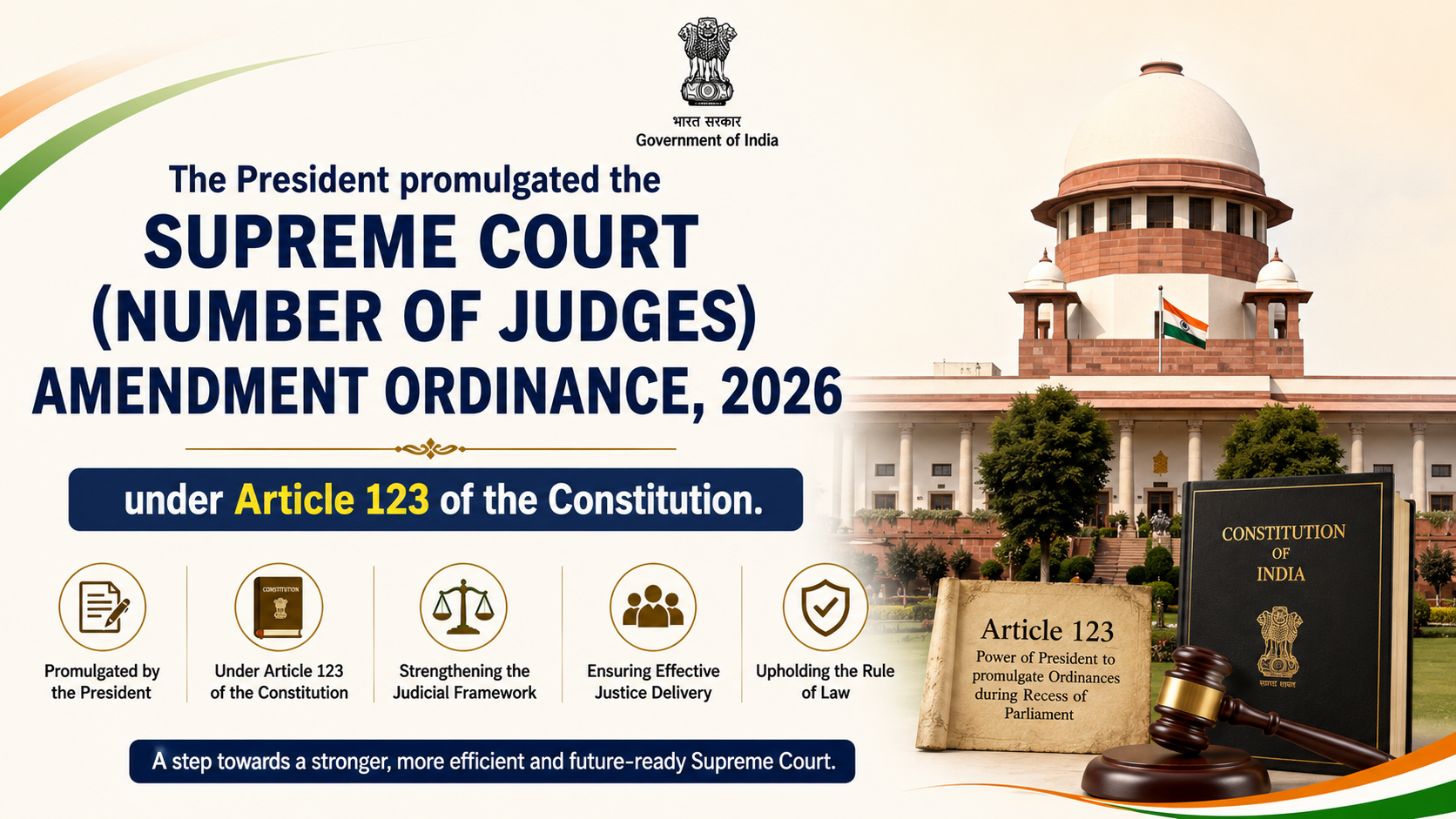
The President promulgated the Supreme Court (Number of Judges) Amendment Ordinance 2026, to Increase the sanctioned strength of Supreme Court judges from 33 to 37, excluding the Chief Justice of India.
Constitutional Basis
Article 123 of the Constitution empowers the President of India to promulgate ordinances.
The President exercises this legislative power solely on the advice of the Council of Ministers, headed by the Prime Minister, rather than through personal discretion.
Essential Conditions
The President of India can issue an ordinance when either one or both Houses of Parliament are not in session, as a law cannot be passed by a single House alone.
The President must feel completely satisfied that current circumstances demand immediate, urgent action.
Scope & Limitations
The ordinance carries the exact same force and legal effect as an Act passed by Parliament.
The President maintains coextensive jurisdiction, meaning they only legislate on subjects where Parliament holds the authority to make laws.
The President can apply an ordinance retrospectively; ordinance comes into effect from a past date, even before the day it was signed and published.
The President strictly cannot amend the Constitution through the ordinance route.
Duration & Expiry
The executive must lay the ordinance before both Houses of Parliament immediately upon their reassembly for mandatory scrutiny.
The ordinance ceases to operate automatically six weeks after Parliament reassembles.
Parliament can terminate the ordinance earlier if both Houses pass a resolution disapproving it.
The President retains the right to withdraw the ordinance at any time.
An ordinance survives for a maximum absolute duration of six months and six weeks (approximately 7.5 months) because no more than six months can intervene between two parliamentary sessions.
Judicial Review
The Supreme Court subjects the President's satisfaction to judicial review to check for malafide intent or oblique motives, as established in the RC Cooper vs Union of India case.
The Court in the AK Roy vs Union of India evaluates ordinances against the tests of vagueness, arbitrariness, reasonableness, and public interest.
The Court in DC Wadhwa vs State of Bihar case, strikes down successive re-promulgation of an ordinance without legislative approval as a "fraud on the constitution" and a "colourable exercise of power".
The Court in the Krishna Kumar Singh vs State of Bihar case,rules mandatory parliamentary scrutiny and declares re-promulgation a direct violation of constitutional supremacy.
 Advantages of Ordinance Power
Provides immediate legislative machinery during the recess of Parliament, guaranteeing that governance does not halt.
Empowers the executive to manage unforeseen, exigent circumstances.
Equips the government to tackle emergencies, such as a sudden pandemic, that demand immediate legislative backing without waiting for standard, time-consuming parliamentary procedures.
Bypasses the Legislature: Executive uses ordinances to circumvent normal legislative debate and scrutiny, functioning as a parallel law-making track rather than a temporary expedient.
Usurps Legislative Power: Regular and continued use of ordinances leads to an "Ordinance Raj", where the executive usurps the primary law-making role meant exclusively for Parliament or State Legislatures.
Undermines Separation of Powers: Passing legislation via ordinances without parliamentary votes challenges the core doctrine of separation of powers, disrupting the system of checks and balances.
Lacks Genuine Emergency: Executive often promulgates ordinances without citing unforeseen, exigent circumstances, using the route for routine policy changes, political ends, or when it lacks a majority in the upper house.
Exploits Constitutional Silence: Executive relies on the re-promulgation of ordinances (e.g., the LARR Ordinance 2014, Enemy Property Ordinance) to keep laws alive indefinitely without facing a legislative vote, taking advantage of the fact that Article 123 does not bar re-promulgation.
Mandate Strict Time Limits: Parliament needs to enact a constitutional amendment that prescribes a strict, short maximum period to compel the executive to place the ordinance before the legislature for scrutiny.
Remove Legal Loopholes: Judiciary must strike down the Wadhwa exceptions to prevent the executive from justifying re-promulgation under the pretext of heavy legislative workload.
Require Ample Justification: Executive must provide ample reason and concrete material within the text of the ordinance itself to prove that an immediate, genuine emergency requires bypassing standard procedures.
The ordinance-making power requires strict judicial and legislative boundaries to prevent executive overreach and guarantee it remains a restricted tool for genuine emergencies, rather than a convenient surrogate legislative track.
Source: ECONOMICTIMES
|
PRACTICE QUESTION Q. Consider the following statements about the Ordinance-making power of the Executive: I. Article 123 empowers the President to promulgate ordinances only when both Houses of Parliament are not in session. II. An ordinance mechanically expires at the end of six months from the date of the reassembly of the Parliament. III. The Supreme Court in the D.C. Wadhwa case held that the successive re-promulgation of ordinances without attempting to pass a Bill is a "fraud on the Constitution". Which of the statements given above is/are incorrect? A) I and II only B) I and III only C) II and III only D) I, II, and III Answer: A Explanation: Statement I is incorrect: While Article 123 empowers the President to promulgate ordinances when Parliament is not in session, this power is triggered when either of the two Houses is not in session, not only when both are absent. Because a law cannot be passed by only one House, the recess of even one House is sufficient for the President to act. Statement II is incorrect: An ordinance does not expire six months after reassembly; it expires exactly six weeks from the date of the reassembly of Parliament, unless it is approved or a resolution disapproving it is passed earlier. The "six months" figure often cited refers to the maximum gap allowed between two sessions of Parliament, leading to a theoretical maximum life of an ordinance of six months and six weeks. Statement III is correct: In the D.C. Wadhwa v. State of Bihar (1987) case, the Supreme Court held that the mechanical and successive re-promulgation of ordinances without attempting to get them passed as Bills by the legislature is a "fraud on the Constitution" and a subversion of the democratic legislative process. |
The maximum duration an ordinance can last is six months and six weeks, as Article 85(1) dictates that no more than six months can intervene between two parliamentary sessions, and an ordinance mechanically expires six weeks after the Parliament reassembles.
The Supreme Court ruled in the Krishna Kumar Singh case that the satisfaction of the President or Governor to promulgate an ordinance is subject to judicial review to check for oblique motives or a lack of relevant material justifying immediate action.
Re-promulgation refers to the practice of repeatedly re-issuing an ordinance after it lapses to extend its life, without getting it passed by the legislature. The Supreme Court has criticized this as a subversion of the democratic process and a "fraud on the Constitution".




© 2026 iasgyan. All right reserved