National Panchayati Raj is India’s three-tier system of local self-government, formalized by the 73rd Constitutional Amendment Act (1993). It empowers rural communities through Gram Panchayats, ensuring grassroots democracy, social justice, and local economic development via elected representatives and decentralized administration.
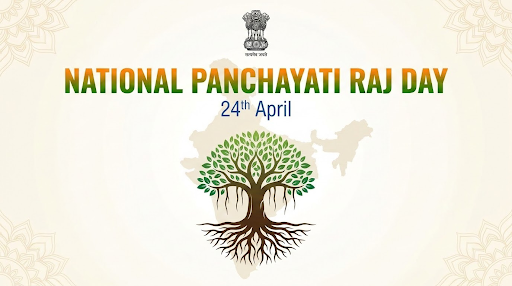
The National Panchayati Raj Day is celebrated on April 24 to mark the enactment of the 73rd Constitutional Amendment Act 1992.
It is India's rural local self-government system. Functioning as the "third tier" of governance alongside the Union and States, it enables local management through elected representatives.
The system was formally institutionalized through the 73rd Constitutional Amendment Act, 1992, which came into force on April 24, 1993.
The Three-Tier Structure
Key Features
The Panchayati Raj has transformed India from a "Representative Democracy" to a "Participatory Democracy".
Democratic Decentralization
Before 1992, power was centralized. PRIs shifted decision-making to the village level, enabling residents to manage local needs like infrastructure and education.
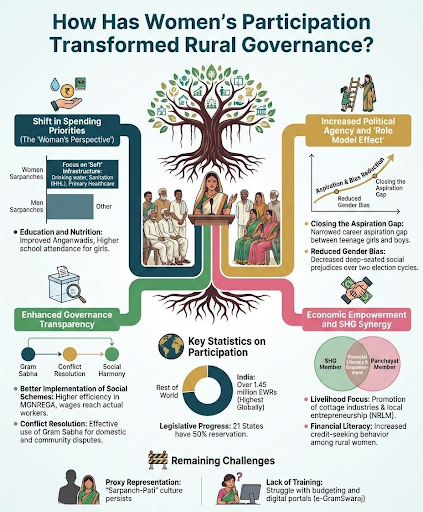
Political Empowerment of Women
The Constitution mandates that not less than one-third (33%) of seats and chairperson posts be reserved for women.
Social Inclusion of Marginalized Groups
Proportional seat reservation for Scheduled Castes (SC) and Scheduled Tribes (ST) has eroded traditional feudal structures, empowering marginalized communities to govern local resources.
Accountability and Transparency
The system introduced mechanisms that make leaders directly answerable to the people:
Efficient Service Delivery
By being physically closer to the citizens, PRIs have improved the "last-mile delivery" of essential services.
Fiscal Dependency
Vertical Imbalance: Most Panchayats generate less than 5% of their total revenue locally. They rely heavily on "tied" grants from Central and State Finance Commissions, which restricts their ability to spend on local-specific needs. (Source: RBI)
Inability to Tax: Although empowered to levy property and professional taxes, many Panchayats avoid doing so to stay popular with voters.
Partial Devolution
Discretionary Transfer: Under Article 243G, the transfer of the 29 subjects in the 11th Schedule is left to the discretion of State Legislatures.
Parallel Bodies: State governments create "Special Purpose Vehicles" or parallel agencies for schemes like the Jal Jeevan Mission, which bypasses the Panchayat's authority.
Administrative Weakness
Staff Shortage: A single Panchayat Secretary manages 3 to 4 villages. Without dedicated technical staff (engineers, doctors, accountants), Panchayats cannot execute complex projects.
Dual Control: Local staff report to their state departments (e.g., Block Development Officer) rather than the elected Sarpanch, creating a breakdown in accountability.
Socio-Political Hurdles
Sarpanch-Pati Culture: In some regions, elected women are sidelined by male relatives, who manage official business.
Elite Capture: In several villages, dominant castes or wealthy families continue to control the Gram Sabha, silencing the voices of the marginalized.
Clear Delineation of Functions
Currently, there is ambiguity between the functions of the State and the Panchayat.
Financial Autonomy
Panchayats suffer from a "dependency syndrome," relying on grants for 95% of their funds.
Creation of a Local Cadre
Elected representatives often lack the technical support to execute complex projects.
Accountability Mechanisms
Social Audit: Following the Meghalaya model, Social Audits should be made mandatory for all schemes, not just MGNREGA, backed by a customized state law.
Ombudsman: The 2nd ARC recommended setting up a local body Ombudsman to investigate cases of corruption and maladministration by elected representatives.
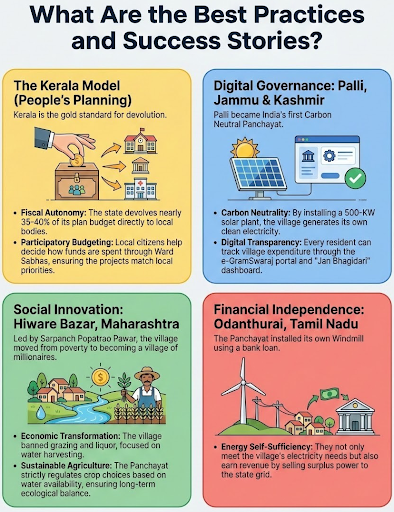
National Panchayati Raj Day is not just a celebration of decentralization, but a reminder that true democracy begins at the grassroots—where participation, empowerment, and accountability must go hand in hand.
Source: PIB
|
PRACTICE QUESTION Q. Despite the constitutional mandate of the 73rd Amendment, Panchayati Raj Institutions (PRIs) function more as implementing agencies than as truly autonomous local self-governments. Critically analyze. 250 words |
The 73rd Constitutional Amendment Act of 1992 granted mandatory legal status to Panchayati Raj Institutions (PRIs). It added Part IX to the Constitution, establishing a uniform three-tier system of local self-government across rural India to ensure democratic decentralization.
The 3Fs refer to Funds, Functions, and Functionaries. For Panchayats to be genuinely autonomous, state governments must devolve adequate financial resources (Funds), delegate subjects to legislate upon (Functions), and provide the necessary administrative staff (Functionaries).
It is a patriarchal challenge in rural governance where Elected Women Representatives (EWRs) are reduced to rubber stamps. The actual administrative, political, and financial power is wielded by their male relatives, usually their husbands ("Pati").






© 2026 iasgyan. All right reserved