The Indo-Pacific is a vital geopolitical construct linking the Indian and Pacific Oceans. Driven by economic growth and great power rivalry, India navigates this region through frameworks like SAGAR, IPOI, and the QUAD to ensure maritime security and strategic autonomy.
Why In News?
Japanese Prime Minister Sanae Takaichi arrives in India for the 16th India-Japan Annual Summit, reaffirming a bilateral commitment to a Free and Open Indo-Pacific.
What is the Indo-Pacific?
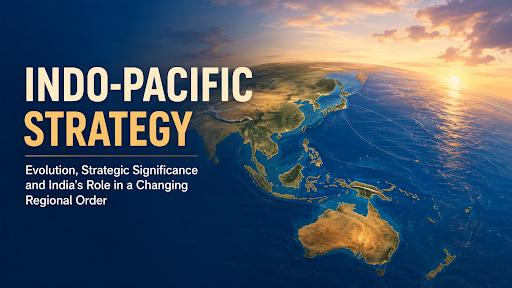
The Indo-Pacific serves as a geopolitical and strategic construct linking the Indian Ocean and Pacific Ocean into a single, interconnected maritime region.
The concept gained prominence due to the rising economic importance of maritime trade routes. Former Japanese Prime Minister Shinzo Abe provided the modern political articulation in his 2007 address to the Indian Parliament, describing it as the "Confluence of the Two Seas."
Nations aim to promote a free, open, and inclusive region, ensure maritime security, strengthen economic connectivity, and maintain a rules-based international order.
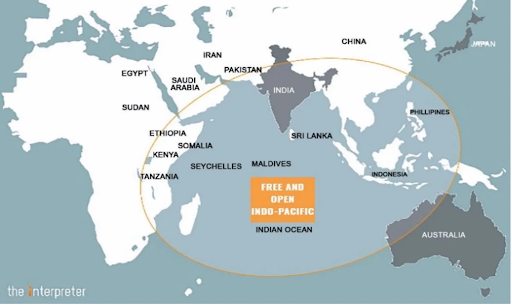
Key Features of the Region
Maritime-Centric Geopolitics: Nations shift from a traditional continental focus toward a balanced land-sea strategic outlook.
Strategic Sea Lanes of Communication (SLOCs): The region hosts critical energy corridors and major chokepoints that underpin global trade.
Multi-Polar Regional Architecture: The framework moves away from Cold War-era alliance systems toward diverse partnerships between India, Australia, Japan, and Southeast Asia.
Economic and Security Cooperation: Intense minilateral cooperation, such as the India-France-Australia trilateral dialogue and AUKUS, manages shared security goals.
ASEAN Centrality: The Association of Southeast Asian Nations (ASEAN) remains the core of the regional architecture, driving norms of inclusivity, non-interference, and connectivity.
Functional Minilateralism: Strategic dialogues bypass cumbersome multilateral platforms to focus on specific objectives like maritime domain awareness and disaster relief.
Integrated Strategic Theatre: Major powers treat the Indian and Pacific Oceans as one connected space, evidenced by China’s expanding commercial and military footprint from the South China Sea to the east coast of Africa.
Significance of the Indo-Pacific
Global Trade and Energy Security: The region accounts for over 60% of global GDP and houses more than half the world’s population.
Maritime Connectivity: Approximately 95% of India’s trade by volume and 70% by value transits through maritime routes, making secure Sea Lines of Communication (SLOCs) vital for national survival.
Strategic Stability: The region fosters a balance of power, deterring unilateral aggression and preventing any single nation from establishing hegemony.
Countering Non-Traditional Threats: Regional partnerships actively address piracy in the Gulf of Aden, illegal fishing, maritime terrorism, and climate change.
Blue Economy Development: The region holds massive potential for the sustainable development of marine resources and disaster risk reduction.
Supply Chain Resilience: Nations restructure global value chains to reduce dependencies on single-source manufacturing hubs like China.
India’s Role in the Indo-Pacific
SAGAR Vision: Introduced in 2015, Security and Growth for All in the Region (SAGAR) prioritizes collective security, regional prosperity, and capacity-building for smaller island nations.
Vision MAHASAGAR: India projects Soft-Power diplomacy through historical maritime linkages and developmental assistance to integrate the Global South.
Indo-Pacific Oceans Initiative (IPOI): Launched in 2019, this normative framework focuses on maritime ecology, marine resource development, and adherence to international law.
QUAD Participation: India leverages the Quad (India-US-Japan-Australia) for soft balancing, coordinating on defense exercises, critical technologies, and vaccine distribution.
Act East Policy: India prioritizes connectivity projects, such as the India-Myanmar-Thailand Trilateral Highway, to link its economy with Southeast Asia.
Net Security Provider: The Indian Navy conducts sustained Humanitarian Assistance and Disaster Relief (HADR) missions and anti-piracy patrols.
Maritime Domain Awareness: India hosts the Information Fusion Centre–Indian Ocean Region (IFC-IOR) in Gurgaon to share critical maritime data with partner states.
Challenges to Regional Stability
Great Power Competition: The intensifying rivalry between the United States and China creates a volatile environment, forcing nations to navigate complex strategic alignments.
Maritime Disputes: China’s aggressive island construction and assertions of sovereignty in the South China Sea threaten freedom of navigation.
Geopolitical Fragmentation: The proliferation of overlapping minilateral formats causes "forum shopping," which saturates diplomatic agendas and dilutes operational resources.
Supply Chain Vulnerabilities: India and partner states remain deeply dependent on Chinese manufacturing, exposing them to economic coercion.
Regional Security Concerns: Initiatives like AUKUS raise concern regarding an accelerated regional arms race and potential violations of nuclear non-proliferation agreements.
Resource and Capability Limitations: India’s defense budget and naval modernization pace currently lag behind China’s massive military expansion (Carnegie Endowment for International Peace, 2021).
Continental Pressures: India must manage two-front security concerns along its land borders with China and Pakistan, diverting resources from maritime priorities.
Way Forward For India
Strengthening Maritime Partnerships: India accelerates joint naval exercises—like Malabar and Milan—and deepens Mutual Logistics Support Arrangements (MLSA) with allies like Australia and France.
Enhancing Regional Connectivity: India expedites projects like the Kaladan Multimodal Transit Transport Project to provide an alternative to China’s Belt and Road Initiative (BRI).
Promoting Rules-Based Order: Nations uphold the United Nations Convention on the Law of the Sea (UNCLOS) to deter coercive maritime behavior.
Deepening Cooperation with ASEAN: India reinforces ASEAN Centrality by engaging deeply with forums like the East Asia Summit (EAS) and ASEAN Defence Ministers' Meeting Plus (ADMM-Plus).
Defense Modernization: India upgrades its blue-water naval capabilities, integrating more aircraft carriers like INS Vikrant and nuclear submarines.
Leveraging Soft Power: India projects cultural diplomacy through shared Buddhist heritage, diaspora networks, and digital capacity building across the Global South.
Conclusion
To expand Indo-Pacific influence, India must balance strategic autonomy with strong multilateral and minilateral partnerships. Securing long-term interests and regional stability requires deterring hegemonic threats while fostering an open, prosperous maritime domain.
Source: INDIANEXPRESS
|
PRACTICE QUESTION Q. Evaluate the strategic significance of the Indo-Pacific region for India's economic and security interests.. (150 Words, 10 Marks) |
The Indo-Pacific is a geopolitical and strategic construct that views the Indian Ocean and the Pacific Ocean as a single, interconnected strategic theatre, vital for global trade and security.
It is critical for India because 95% of its trade by volume transits through sea routes. It is essential for securing energy lifelines, countering adversarial expansion, and expanding economic integration with Southeast Asia.
Launched in 2019, IPOI is an open, non-treaty-based initiative consisting of seven pillars, including maritime ecology, marine resources, capacity building, and disaster risk reduction, to collaboratively manage the maritime domain.
The Quad (India, US, Japan, Australia) serves as a soft-balancing minilateral grouping that advances a "Free and Open Indo-Pacific" through collaboration on maritime security, critical technologies, and supply chain resilience.


© 2026 iasgyan. All right reserved