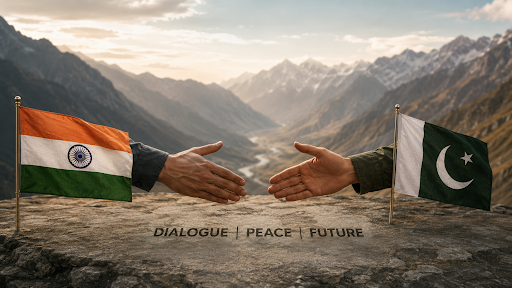
India and Pakistan are exploring Track-II dialogues, spurred by a joint peace appeal from eminent citizens. However, official bilateral talks remain suspended since 2016, with India maintaining that terror and dialogue cannot proceed together.
Why In News?
The recent advocacy by RSS leadership for resuming diplomatic engagement with Pakistan triggers a strategic debate following the suspension of dialogue after the April 2025 Pahalgam terror attack and India’s subsequent military response, Operation Sindoor.
|
Read all about: INDIA-PAKISTAN RELATIONS |
Major Dialogue Frameworks
Shimla Agreement (1972): This pact legally binds India and Pakistan to resolve differences strictly through bilateral negotiations, formally closing the door on UN and third-party mediation.
Lahore Declaration (1999): Both nations explicitly recommit to implementing the Shimla framework in letter and spirit to ensure peaceful coexistence.
Backchannel Diplomacy: National Security Advisers engage in secret talks; for instance, the February 2021 ceasefire agreement emerges directly from backchannel negotiations between India and Pakistan's military leadership.
Shanghai Cooperation Organization (SCO): The SCO provides multilateral platforms, specifically the Regional Anti-Terrorist Structure (RATS), which facilitates indirect security dialogues and counter-terrorism cooperation.
Key Issues in Bilateral Relations
Cross-Border Terrorism: Pakistan utilizes asymmetrical warfare and proxy terror groups as explicit instruments of state policy against India.
Indus Waters Treaty (IWT): India suspends the 1960 treaty in April 2025 following the Pahalgam attack, placing the water-sharing agreement in permanent abeyance to signal strategic displeasure.
Kashmir Dispute: Pakistan persistently seeks to internationalize the issue, demanding UN mediation, which directly violates its bilateral commitments.
Trade Barriers: Bilateral trade collapses after 2019, as India revokes Pakistan's Most Favoured Nation (MFN) status and drastically increases tariffs, decimating economic linkages.
Reducing Strategic Miscalculations: Dialogue offers insights into Pakistan’s military intent, helping India prevent nuclear brinkmanship or uncontrolled escalation.
Managing Provocations: Active communication lines allow India to de-escalate threats against critical assets like the Jamnagar economic hub.
Enhancing Regional Stability: Engaging Pakistan secures India’s continental borders, allowing New Delhi to focus its resources on the Indo-Pacific.
Checking Adversarial Influence: Diplomatic engagement prevents adversaries from exploiting the India-Pakistan rift to expand the Belt and Road Initiative (BRI) in South Asia.
Promoting Economic Opportunities: Resuming agricultural trade could unlock an estimated US$37 billion in potential economic benefits.
Strengthening Confidence Building Measures: Track-II diplomacy allows interlocutors to test peace propositions away from public scrutiny.
Continued Terrorism: The April 2025 Pahalgam attack, which killed 26 civilians, represents a foundational breach of peace conditions.
Trust Deficit: Pakistan habitually uses terrorism as a diplomatic tool, undermining the credibility of past peace initiatives.
Domestic Political Sensitivities: The Indian government maintains a "terror and talks cannot go together" doctrine, making formal dialogue politically costly.
China-Pakistan Nexus: Pakistan relies on China for US$29 billion in loans and 80% of its arms imports, creating a strategic alliance that encircles India.
Enforcing Redlines: India maintains its condition that Pakistan must verifiably dismantle state-sponsored terrorism before initiating formal talks.
Sustaining "New Normal": India continues the aggressive deterrence established post-Operation Sindoor, asserting its right to precise military retaliation.
Covert Dialogues: India sustains backchannel communication with the Pakistan Army leadership in Rawalpindi, as they remain the ultimate decision-makers.
Functional Engagement: India leverages multilateral forums like the SCO for indirect engagement on regional security frameworks.
Incremental Confidence-Building: Both nations must strictly adhere to the 2021 Line of Control (LoC) ceasefire as the absolute baseline for stability.
Terror and Talks: India firmly establishes that meaningful dialogue occurs only in an environment free from violence.
Bilateral Framework: India strictly adheres to the 1972 Shimla Agreement, rejecting all third-party mediation.
National Security: India applies the Yoga Kshema framework to balance national economic prosperity with rigorous border protection.
India maintains a firm deterrence posture against Pakistan's cross-border terrorism while quietly leveraging backchannel diplomacy to prevent miscalculations and secure long-term regional stability.
Source: THEHINDU
|
PRACTICE QUESTION "Engagement without compromising national security remains the central challenge in India–Pakistan relations." Critically analyze. (250 Words, 15 Marks) |
The "New Normal" refers to India's aggressive deterrence posture established after terror attacks, characterized by swift and precise military retaliation (like Operation Sindoor) against cross-border terror infrastructure, ending the era of passive tolerance.
India placed the 1960 Indus Waters Treaty in "abeyance" or suspension in April 2025 as a direct strategic response to the deadly Pahalgam terrorist attack, citing Pakistan's continuous use of cross-border terrorism.
Track-II diplomacy involves unofficial, backchannel talks between retired officials, civil society members, and intelligence figures. It allows both nations to test peace propositions, gauge military intent, and de-escalate tensions without the political risks associated with formal, public dialogues.

© 2026 iasgyan. All right reserved