The India-Australia Comprehensive Strategic Partnership actively shapes Indo-Pacific stability. Driven by shared concerns over regional security, both democracies collaborate on critical minerals, defence technology, maritime awareness, and clean energy. Upgrading ECTA to CECA remains vital for deep economic alignment.
Why In News?
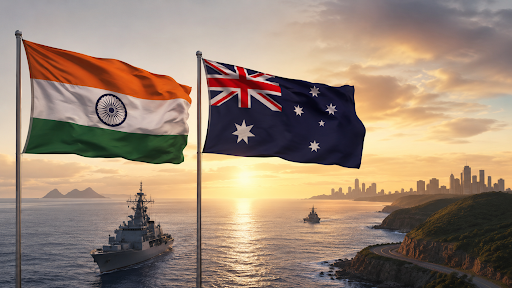
Prime Minister Narendra Modi concluded the Third Australia-India Annual Summit in Melbourne.
|
Read all about: Australia-India Partnership Explained |
What is the India–Australia Strategic Partnership?
Comprehensive Strategic Partnership (CSP): Both nations officially elevated their relationship in 2020, institutionalizing annual leaders' summits and 2+2 ministerial dialogues.
Strategic Evolution: The partnership moves beyond the traditional 3Cs (Cricket, Curry, Commonwealth) toward critical technologies, uranium exports, and maritime security.
Key Pillars of the Partnership
Security and Defence: Joint military exercises including AUSINDEX, Pitch Black, and Malabar enhance operational synergy, supported by the Mutual Logistics Support Arrangement (MLSA).
Economic Integration: The Economic Cooperation and Trade Agreement (ECTA) eliminates tariffs on 100% of Indian exports, creating a foundation for the Comprehensive Economic Cooperation Agreement (CECA).
Technology & Education: The Migration and Mobility Partnership Arrangement (MMPA) and the MATES scheme facilitate professional mobility, while institutions like Flinders University establish campuses in India.
Why is Australia Important for India's Strategic Interests?
Indo-Pacific Vision: Both nations promote a free, open, and rules-based Indo-Pacific, utilizing the Quad framework to resist unilateral changes to the maritime status quo.
Maritime Security: Australia secures its 50% of seaborne exports through the Indian Ocean, collaborating via the India-Australia Maritime Security Collaboration Roadmap and an MoU between the Indian Coast Guard and Australia’s Maritime Border Command.
Critical Minerals: The India-Australia Critical Minerals Investment Partnership targets five lithium and cobalt projects to reduce reliance on global monopolies and support India’s EV and green energy targets.
Supply Chain Resilience: Leaders launch the Australia-India Partnership on Cyber, Critical Technologies and Supply Chains to hedge against single-point supply chain dependencies.
Counter-Terrorism: The 15th India-Australia Joint Working Group combats the misuse of cryptocurrencies and encrypted communications by terror networks.
What are the Major Areas of India–Australia Cooperation?
Defence: Forces utilize the Information Fusion Centre – Indian Ocean Region (IFC-IOR) for a Common Operational Picture and conduct exercises like Talisman Sabre 2027, Kakadu 2026, and Austrahind.
Economic Growth: Bilateral trade exceeds AUD 50 billion under ECTA, driving employment in textiles and services.
Clean Energy: Australia leverages its 28% global uranium reserve to initiate exports to India following SHANTI Act reforms, while the Rooftop Solar Academy advances renewable energy goals.
Education: India maintains its status as Australia’s second-largest source of international students with 140,000+ enrollments, while the Mobility Arrangement for Talented Early-professionals Scheme (MATES) allows STEM graduates to work without employer sponsorship.
India–Australia PM Visit (July 2026): Key Outcomes
|
Initiative/Agreement |
Key Objective / Outcome |
|
Joint Declaration on Defense and Security Cooperation (JDDSC) |
Renews the 2009 security declaration; focuses on military interoperability, capacity building, maritime cooperation, defence industry collaboration, cyber security, counter-terrorism, HADR, and cooperation in UNCLOS, ASEAN, and IORA. |
|
Maritime Security Collaboration Roadmap (MSCR) |
Enhances maritime security through information sharing, capability development, and operational coordination. |
|
India–Australia Joint Statement on Energy Security |
Reaffirms commitment to ensuring energy security amid global geopolitical uncertainties. |
|
Administrative Arrangement of India–Australia Civil Nuclear Agreement |
Operationalizes the 2014 Civil Nuclear Agreement and enables Australian uranium exports to India. |
|
Australia–India Partnership for Cyber, Critical Technologies and Supply Chains (PACTS) |
Strengthens cooperation in cyber security, critical technologies, digital resilience, and secure supply chains. |
|
MoU between Indian Coast Guard (ICG) and Maritime Border Command (MBC), Australia |
Cooperation in maritime law enforcement, maritime domain awareness, and border protection. |
|
Indian Military Instructor at Australian Defence College (2028–29) |
Facilitates deployment of an Indian military instructor to enhance defence education cooperation. |
|
MSDE–TAFE Western Australia MoU (Mining CoE) |
Establishes a Centre of Excellence in Mining & METS at NSTI Bhubaneswar for training, research, and student exchanges. |
|
Repatriation of Indian Antiquities |
Return of three antiquities: Nandi (granite), Bhadrakali Trident (bronze), and Skanda/Karttikeya (basalt). |
|
Rooftop Solar Training Academy |
Operationalized at Pandit Deendayal Energy University, Gandhinagar; aims to train 2,000 women and youth as solar technicians under PM Surya Ghar Yojana. |
|
Australia–Canada–India Technology and Innovation (ACITI) Partnership MoU |
Promotes trilateral cooperation in emerging technologies and innovation. |
|
GeoScience Australia–Geological Survey of India (GSI) MoU |
Cooperation in advanced exploration methods, capacity building, skill development, and modernization of GSI. |
|
TKDL Access Agreement (CSIR–IP Australia) |
Grants IP Australia access to the Traditional Knowledge Digital Library (TKDL) database. |
|
CSIR–University of Melbourne MoU |
Collaboration in drug discovery research, trainee programmes, and faculty exchanges. |
|
Letter of Approval to Victoria University |
Permits Victoria University to establish and operate its campus in Gurugram. |
What Challenges Need to Be Addressed?
Trade Realization: Trade growth remains concentrated among large firms, leaving SMEs unaware of ECTA benefits.
Regulatory Barriers: Divergent industrial standards and complex visa/migration politics hinder the seamless movement of professionals.
Geopolitical Divergence: Australia’s AUKUS focus remains on the Western Pacific, while India balances continental threats and maritime challenges.
Supply Chain Vulnerabilities: Both nations face high dependency on external powers for critical manufacturing inputs.
Private Sector Gap: Public awareness lags, with only 5% of Australians identifying India as a primary global power in the next decade, according to the Lowy Institute.
Way Forward
Fast-Track CECA: Accelerate negotiations to expand market access in digital trade, professional services, and government procurement.
Deepen Mineral Partnerships: Institutionalize joint ventures in lithium, cobalt, and rare earths to move from extraction to midstream processing.Maritime Awareness: Scale intelligence sharing via the IORA Working Group on Maritime Safety.
Defence Industrialization: Operationalize the MoU for the Provision of Defence Articles to shift from exercises to joint defence manufacturing.
Research Collaboration: Leverage the Australia-Canada-India Technology and Innovation (ACITI) Partnership to co-develop AI and cyber security solutions.
Resilient Supply Chains: Integrate Indian SMEs into the Australian ecosystem using the Indian diaspora as a strategic bridge.
The India-Australia partnership must evolve from political convergence to durable institutional alignment. By securing the Indo-Pacific through resilient supply chains, maritime security, and deep economic integration, both nations solidify their roles as key regional anchors.
Source: THEHINDU
|
PRACTICE QUESTION Q. Examine the significance of the India–Australia Comprehensive Strategic Partnership and discuss the challenges and opportunities in bilateral relations. (250 Words, 15 Marks) |

© 2026 iasgyan. All right reserved