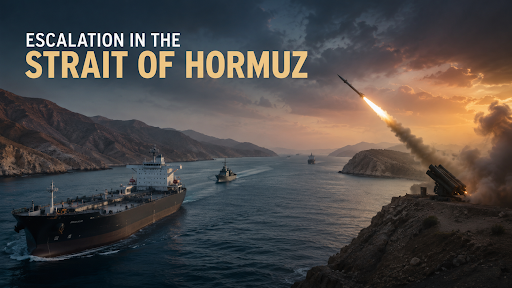
The protection of neutral shipping during maritime conflicts relies on UNCLOS and the San Remo Manual. Recent attacks in critical chokepoints like the Strait of Hormuz highlight gaps in global governance, threatening India’s energy security, seafarers, and international trade routes.
U.S. Navy missile strikes on neutral tankers, including the Settebello, have killed three Indian seafarers.
Non-Belligerent Flags: Neutral ships are vessels flying the flag of a state that strictly abstains from participating in an ongoing international armed conflict.
Transit Passage: Neutral states enjoy the unhindered right of "transit passage" through international straits, as codified in Part III, Section 2 (Articles 37–44) of the United Nations Convention on the Law of the Sea (UNCLOS).
Immunity of Commerce: Maritime neutrality law protects neutral territory, shipping, and commerce from interference, provided the neutral state refrains from delivering direct military assistance to any belligerent.
Exclusive Flag State Jurisdiction: Under UNCLOS Articles 92 and 58, neutral ships remain subject to the exclusive jurisdiction of their flag state on the high seas, shielding them from arbitrary foreign military interference.
Hague Conventions: Article 6 of the Hague Convention XIII of 1907 forbids neutral powers from directly or indirectly supplying warships, ammunition, or war materials to a belligerent power.
UNCLOS: This "Constitution of the Oceans" defines maritime zones and guarantees freedom of navigation, applying universally as customary international law even to non-signatory states like the U.S. and Iran.
San Remo Manual (1994): This manual outlines strict rules for naval warfare, target discrimination, and the precise conditions under which neutral merchant vessels lose protection.
UN Charter: Article 2(4) prohibits the use of force against territorial integrity, while Article 51 limits the lawful use of force strictly to self-defence against an imminent armed attack.
General Principle: Under International Humanitarian Law (IHL), belligerents must direct attacks solely against 'military objectives'. Container ships, oil tankers, and submarine cables classify as protected civilian objects.
Lawful Attack Circumstances: Belligerents may attack neutral vessels if they:
Visit and Search: Belligerent warships possess the right to stop and search neutral merchant ships outside neutral waters if they suspect the presence of contraband.
Blockade Enforcement: A naval blockade must remain effective, publicly declared, and impartially applied to avoid classification as an illegal "paper blockade."
Prize Law: Belligerents exercise the right of capture by taking a vessel as a prize for adjudication in a domestic prize court to determine the legality of the seizure.
Maritime Exclusion Zones (MEZ): Belligerents establish MEZs to warn vessels away from conflict areas, though entering an MEZ does not automatically transform a neutral ship into a lawful target.
Global Trade Security: Disruptions in the Red Sea and Suez Canal inflate freight costs and precipitate supply chain breakdowns.
Maritime Commerce: Open sea lanes shield Small Island Developing States (SIDS) and Least Developed Countries (LDCs) from consumer price inflation.
Energy Supply Chains: The Strait of Hormuz carries approximately one-fifth of global oil supplies; closure threatens to trigger oil price spikes of $10–15 per barrel and global recession.
Submarine Infrastructure: Freedom of navigation protects crucial underwater assets like internet cables and oil pipelines from arbitrary military destruction.
Hybrid Warfare: Non-state actors, such as the Houthi movement, exploit institutional gaps in UNCLOS to attack commercial shipping via proxy conflicts.
Maritime Drones: The proliferation of UAVs and maritime drones allows combatants to launch cheap, deniable, and destructive strikes.
Flags of Convenience: The use of "flags of convenience" obscures vessel ownership, complicating the distinction between neutral commerce and contraband smuggling.
Geopolitical Weaponization: States bypass traditional prize courts by using domestic civil forfeiture laws and unilateral sanctions, creating legal gray zones.
Way Forward
UNCLOS Modernization: The international community must establish binding provisions to address non-state actor interference and cyber threats.
International Cooperation: Nations must utilize the UNSC to authorize and regulate the use of force at sea.
Protecting SLOCs: Regional powers must build joint maritime security architectures and coordinated escort mechanisms for critical chokepoints.
Standardizing Rules of Engagement: Global navies must adopt strict, transparent rules based on the San Remo Manual, emphasizing proportionality and distinction.
Upholding the immunity of neutral shipping requires bridging the gap between traditional naval warfare doctrines and modern UN Charter principles to protect global trade and seafarer lives from unilateral geopolitical escalations.
Source: thehindu
|
PRACTICE QUESTION Q. With reference to the United Nations Convention on the Law of the Sea (UNCLOS) and maritime conflict, which of the following statements is/are correct? 1. UNCLOS guarantees the right of "transit passage" through international straits, a right that continues even during an armed conflict for neutral shipping. 2. UNCLOS provides a comprehensive and binding dispute resolution mechanism to specifically prosecute non-state actors for disrupting maritime commerce. Select the correct answer using the code given below: A) 1 only B) 2 only C) Both 1 and 2 D) Neither 1 nor 2 Answer: A Explanation: Statement 1 is correct: Under Article 38 of UNCLOS, all ships and aircraft enjoy the right of transit passage through straits used for international navigation. According to international maritime law and the law of naval warfare, this right cannot be suspended by coastal states, and it specifically continues to protect neutral shipping during an armed conflict to preserve international trade. Statement 2 is incorrect: UNCLOS features a robust dispute resolution mechanism (such as the International Tribunal for the Law of the Sea, or ITLOS), but it is structured to handle disputes between sovereign States parties, not individuals. It does not provide a comprehensive mechanism to directly prosecute non-state actors (such as pirates, terrorists, or militant groups) for disrupting commerce. |
A neutral ship is a commercial or military vessel flying the flag of a sovereign state that is not a party to an ongoing armed conflict, legally granting it freedom of navigation and immunity from capture or attack under international maritime law.
A neutral merchant ship loses its immune status and can be lawfully attacked only if it actively engages in hostile acts on behalf of the enemy, serves as an auxiliary auxiliary vessel for the enemy's military forces, directly resists interception and search, or deliberately breaches an officially declared blockading zone.
The San Remo Manual on International Law Applicable to Armed Conflicts at Sea is a comprehensive, internationally recognized legal document compiled in 1994 by legal and naval experts that codifies the customary laws of naval warfare, specifically regulating the rights, duties, and targeting parameters of combatant and neutral ships.
Maritime security is absolutely critical for India because the nation depends on safe sea lanes for over 90% of its commercial trade volume, relies on unhindered ocean transits to secure its vital crude oil imports, and must continuously protect its vast 7,516 km coastline from cross-border terror threats and external military expansion.

© 2026 iasgyan. All right reserved