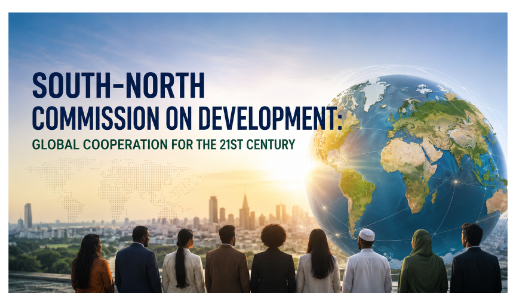
The newly launched South-North Commission on Development aims to reform global governance, addressing inequalities in climate finance, trade, and debt. Co-chaired by Olaf Scholz and Laura Chinchilla, the 20-member body emphasizes equal Global South representation to redefine international cooperation.
Why In News?
The German government launched the independent South-North Commission on Development on June 30, 2026, at the Hamburg Sustainability Conference (HSC).
What is the South-North Commission on Development?
It functions as an independent, global network and international platform designed to dismantle deep-seated inequalities in global governance and move beyond outdated donor-recipient frameworks.
The Commission builds upon the historic legacy of the 1980 Brandt Commission to correct historical imbalances.
Objectives:
Why is the South-North Commission Important?
Development Inequalities: It dismantles archaic rules established before many Global South nations gained independence.
Global Governance Reform: It challenges the outdated design of international organizations to restore trust and accountability.
South-North Cooperation: It shifts engagement from a zero-sum contest into a system of shared risk and mutual interest.
Sustainable Development Goals: It acts as a counterweight to multilateral fatigue by actively rescuing unraveling SDGs.
Global South Voice: It leverages momentum from recent G20 presidencies held by Indonesia, India, Brazil, and South Africa.
Security Integration: It recognizes inclusive development as "hard power" to prevent civil wars and geopolitical instability, as noted by the United Nations Development Programme (UNDP).
What are the Key Features of the South-North Commission?
Multi-Stakeholder Participation: It brings up to 20 influential commissioners from politics, the private sector, academia, and civil society.
Global South Majority: It operates on a foundational principle of strict equality, ensuring a majority of members hail from the Global South.
Development Financing: It targets failures in mechanisms like the G20 Common Framework for Debt to provide real fiscal relief.
Climate Justice: It treats the transition to clean energy as a pillar for national security and economic stability.
Reform-Oriented Agenda: It mandates an interim report for 2027 and a comprehensive final report by the end of 2028.
Inclusive Framework: It hosts parallel regional consultations across Africa, Europe, Latin America, and Asia.
What Benefits Can the Commission Offer?
Greater Equity: It transitions international relations into a cooperative, rules-based multilateral order.
Improved Financing: It mobilizes domestic resources by curbing illicit financial flows, particularly in Africa.
Climate Action: It fosters joint initiatives and standards for nature-aligned investments and industrial decarbonization.
Better Representation: It promotes local value-addition of critical minerals and rare earths within resource-rich nations.
Fair Trade: It challenges escalatory tariffs that punish developing nations, unlocking manufacturing capacity and job creation.
What are the Major Challenges Facing Global Development Cooperation?
Geopolitical Rivalries: Conflicts in West Asia disrupt maritime trade and energy supplies.
Financing Constraints: Global fossil fuel subsidies reach a projected US$1.1 trillion in 2026, hindering the clean energy transition.
Institutional Representation: Powerful nations frequently violate the rules-based order, causing the multilateral system to unravel.
Climate and Development Gaps: Simultaneous crises of inflation, conflict, and climate change threaten decades of development gains
Divergent Priorities: The Global South is not a monolith; emerging powers and the poorest nations often hold conflicting interests.
Militarization: Global military expenditures exceed $800 billion annually, dwarfing the $80 billion needed annually to eradicate poverty.
What Institutional, Legal and Policy Frameworks Support Global Development Cooperation?
United Nations System: Agencies like UNDP, UNICEF, and WFP lead on-the-ground interventions, including the initiative to end child malnutrition by 2030.
Sustainable Development Goals: The UN 2030 Agenda provides the 17-goal architecture for global policy.
Climate Finance: International funds incentivize reforestation and emissions reductions.
Cooperation Platforms: Forums like the G20, BRICS, and the African Union provide staging grounds for Southern perspectives.
Trade and Finance Bodies: The WTO, World Bank, and IMF govern international commerce and structural adjustment, requiring urgent democratic restructuring.
What Measures Can Strengthen South-North Development Cooperation?
Institutional Reform: Overhaul the UN Security Council, World Bank, and IMF to grant developing nations proportional voting power.
Finance Expansion: Require developed nations to honor the official development assistance standard of 0.7% of their Gross National Product (GNP).
Technology Transfer: Implement the Hamburg Declaration on Responsible AI for the SDGs to leverage digital innovation.
Climate Justice: Establish international regimes to protect the global commons and transition to solar, wind, and geothermal energy.
Inclusive Decision-Making: Create a sovereign debt restructuring framework that offers legal protection without punitive austerity.
Fair Trade: Eliminate protectionist restrictions, such as agricultural subsidies and textile tariffs, in the Global North.
Conclusion
The South-North Commission on Development provides a critical, reform-oriented roadmap to replace outdated donor-recipient models with equitable, multilateral partnerships capable of securing sustainable growth in a fractured 21st-century world.
Source: DOWNTOEARTH
|
PRACTICE QUESTION Q. "Emerging development platforms reflect growing demands for reform in global governance and international cooperation." Discuss (150 Words, 10 Marks) |
The South-North Commission is an independent, 20-member international panel composed of political, civil, and business leaders, with a majority from the Global South. It aims to develop solutions for global challenges, redefine multilateral cooperation, and inform the post-2030 development agenda.
It was launched at the Hamburg Sustainability Conference 2026 to address severe strains on the multilateral system, mounting geopolitical conflicts, and the stark reality that current global financial rules no longer reflect a multipolar world where the Global South drives most economic growth.
It shifts the relationship away from a donor-recipient charity model to one of equal partnership. It advocates for the Global South's right to locally refine raw materials, escape escalatory trade tariffs, and restructure sovereign debt.
The Commission seeks to reform the UN and multilateral development banks, create new cooperation models for development finance, ensure equitable trade practices (like dismantling value-added tariffs), and build inclusive frameworks for climate justice and artificial intelligence.

© 2026 iasgyan. All right reserved