The 2026 UN SDG Index, released at the Hamburg Sustainability Conference, ranked India at a historic 94th. However, despite massive gains in infrastructure and energy, India struggles heavily with SDG 2 (Zero Hunger), requiring an urgent shift toward dietary diversity and localized governance.
Why In News?
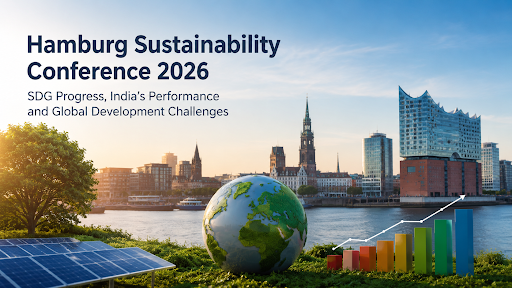
The third Hamburg Sustainability Conference (HSC) convened global leaders on June 29, 2026, coinciding with the release of the 2026 UN Sustainable Development Goals (SDGs) Index.
What is the Hamburg Sustainability Conference (HSC)?
The HSC serves as a hybrid, multi-stakeholder platform designed to rescue the UN SDGs by forging economic, digital, and environmental alliances between the Global North and Global South.
Organizers—including the UN Development Programme (UNDP), Germany’s Federal Ministry for Economic Cooperation and Development (BMZ), the Michael Otto Foundation, and the City of Hamburg—established the conference to counter rising global military expenditures and multilateral fatigue.
Objectives: The platform aims to accelerate SDG implementation, promote sustainable development partnerships among 1,600 participants, strengthen climate cooperation, and protect supply chains from geopolitical fallout in the Middle East and Eastern Europe.
Key Features and Pillars
Resilient Economies: The conference promotes industrial decarbonization and adopts the Hamburg Declaration on Responsible AI to ensure digital innovation remains inclusive.
Human Collaboration: It challenges the design of Bretton Woods institutions to restore trust and bridge the divide between the Global North and South.
Climate Finance: Officials highlight the dangerous trajectory of fossil fuel subsidies, which are projected to reach $1.1 trillion in 2026, thereby shrinking available development finance.
Risk & Uncertainty: The platform addresses how geopolitical conflicts and ecological risks choke vital supply chains for fertilizers and critical minerals.
International Partnerships: The HSC launches over 15 new alliances covering clean energy, responsible AI, and a BMZ-UNICEF joint call to end child malnutrition by 2030.
India’s Performance and Global SDG Progress
Historic Leap: India climbs to the 94th position out of 167 countries, achieving a composite SDG score of 68.3 out of 100.
Top Improver: India registers the largest improvement among major global economies, jumping 18 places since the goals were adopted in 2015.
Infrastructure Triumphs: The ranking validates India’s rapid expansion in rural electrification (SDG 7) and digital broadband connectivity (SDG 9), proving the efficacy of Digital Public Infrastructure (DPI).
Global Reality Check: The 2026 UN SDG Index reveals that only 16.5% of targets are progressing adequately, with SDG 11 (Sustainable Cities), SDG 14 (Life Below Water), and SDG 16 (Peace and Justice) remaining fundamentally stagnant.
Persistent Challenges
Hunger and Nutrition: Despite aggregate gains, India remains off-track on SDG 2 (Zero Hunger). 29.3% of children under five remain stunted (National Family Health Survey-6), while adult obesity has increased from 4.91% in 2015 to 7.27%.
Global Food Crisis: Over 266 million people face acute food insecurity across 47 countries, with active famines in Gaza and Sudan.
Financing Gaps: Humanitarian agencies like the World Food Programme (WFP) face crippling budget cuts that limit their ability to combat malnutrition.
Climate Impacts: India’s per capita CO2 emissions surged from 1.69 tonnes in 2015 to 2.21 tonnes in 2023, threatening SDG 13.
Geopolitical Fragmentation: Global military spending reached $2.7 trillion in 2024 and is projected to hit $6.6 trillion by 2035, absorbing capital meant for development.
Governance Disparities: India’s Press Freedom Index score dropped from 59.51 in 2015 to 31.96 in 2026.
Government Initiatives and Frameworks
Voluntary National Review (VNR) 2025: NITI Aayog reports that over 248 million Indians exited multidimensional poverty between 2013-14 and 2022-23.
Global Alliance Against Hunger and Poverty: India joined the National and Knowledge Pillars of this G20 Alliance in late 2024.
Sub-National Localization: NITI Aayog utilizes the SDG India Index, the National Multidimensional Poverty Index (MPI), and the North Eastern Region (NER) District SDG Index to map localized data.
Lifecycle Nutrition: The government implements POSHAN Abhiyaan, PM-POSHAN, and the Let’s Fix Our Food (LFOF) initiative to address hidden hunger.
Climate Action: India promotes Mission LiFE (Lifestyle for Environment) and leads the International Solar Alliance (ISA) to scale green transitions.
Way Forward
Nutrition-Centric Policy: Policymakers must shift the Public Distribution System (PDS) toward dietary diversity, micronutrient fortification, and biofortification to cure hidden hunger.
Financial Reform: The international community must restructure development banking to inject risk-tolerant capital into the Global South.
South-South Collaboration: India must leverage Digital Public Infrastructure (DPI) leadership to empower developing nations and strengthen supply chain resilience.
Data-Driven Monitoring: Governments must disaggregate localized dashboards to identify and surgically fix failing sub-components rather than relying on aggregate index ranks.
Conclusion
While India’s historic leap to the 94th rank in the 2026 UN SDG Index highlights digital and infrastructure triumphs, achieving the 2030 Agenda requires an urgent, nutrition-centric policy overhaul to completely eradicate the persistent specter of hidden hunger.
Source: DOWNTOEARTH
|
PRACTICE QUESTION Q. The 'Global Alliance Against Hunger and Poverty', which recently saw India joining its National and Knowledge Pillars, was originally launched under the G20 Presidency of which country? A) India B) Indonesia C) Brazil D) South Africa Answer: C Explanation The Global Alliance Against Hunger and Poverty was originally launched during the G20 Leaders' Summit held in Rio de Janeiro, Brazil. The alliance operates through three main pillars: National, Financial, and Knowledge. |
The Hamburg Sustainability Conference (HSC) is an international, multi-stakeholder annual platform jointly organized by the UNDP, Germany's BMZ, the Michael Otto Foundation, and the City of Hamburg to forge private-public alliances and co-create practical strategies to rescue the unravelling UN Sustainable Development Goals (SDGs).
The UN SDG Index is an annual, data-driven global assessment published by the UN Sustainable Development Solutions Network (SDSN) that tracks, scores, and ranks 167 nations based on their structural alignment and statistical progress toward achieving the 17 global goals.
India has climbed to its highest-ever position of 94th out of 167 nations with a record-high index baseline score of 68.3 out of 100, making it one of the world's fastest-improving economies since 2015; however, it mathematically remains off track to fulfill the comprehensive 2030 targets.
Hunger persists as a massive structural failure (SDG 2: Zero Hunger) because rising macroeconomic wealth has not translated into balanced nutritional distribution, resulting in stagnating undernourishment levels (12%), high adult obesity rates, and a worrying rise in child wasting to 19% (NFHS-6) due to poor dietary diversity and localized food insecurity.

© 2026 iasgyan. All right reserved