UNCLOS, SOLAS, and MARPOL Explained: Global Maritime Laws

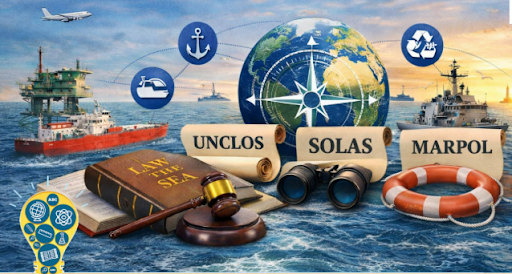
UNCLOS establishes "laws of the sea," defining territorial boundaries and resource rights. SOLAS sets essential safety standards for ship construction, equipment, and operation. MARPOL focuses on environmental protection, strictly regulating pollution from oil, chemicals, and sewage. 
Description

Copyright infringement not intended

Picture Courtesy:  INDIANEXPRESS

Context

International maritime laws such as UNCLOS, SOLAS and MARPOL are in focus due to rising global maritime disputes and shipping safety concerns.

What is UNCLOS?

UNCLOS (United Nations Convention on the Law of the Sea) established the legal framework for all ocean activities, including maritime boundaries, navigation rights, and resource management.  

Origin: Adopted in 1982 and entering into force in 1994, UNCLOS replaced four earlier 1958 conventions to create a "constitution for the oceans," providing a uniform legal regime. 

Maritime Zones Defined by UNCLOS
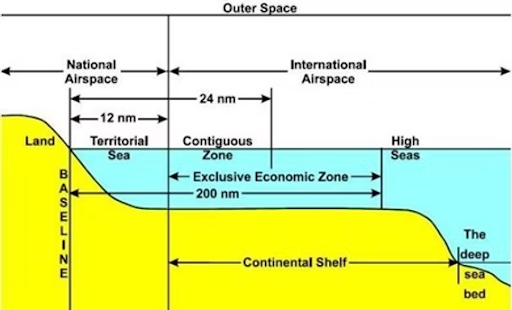
  • Internal Waters: Waters on the landward side of the baseline, where the state has total sovereignty.
  • Territorial Sea (up to 12 nautical miles): The coastal state has sovereign rights over the water, seabed, and airspace, though it must allow "innocent passage" of foreign vessels.
  • Contiguous Zone (up to 24 nautical miles): Allows the state to enforce customs, immigration, and sanitary laws.
  • Exclusive Economic Zone - EEZ (up to 200 nautical miles): The coastal state has exclusive rights to explore and exploit natural resources (like fishing and oil) in both the water column and the seabed.
  • Continental Shelf: Covers the seabed beyond the territorial sea where the state has rights to non-living resources (minerals, oil).
  • High Seas: Waters beyond any national jurisdiction, regarded as the "common heritage of mankind" for international use, research, and navigation.

Key Principles and Functions

  • Environmental Protection: Mandates states to protect the marine environment from pollution.
  • Scientific Research: Defines rules for conducting marine scientific research.
  • Resource Management: Governs the exploration and exploitation of marine resources, including deep-sea mining regulated by the International Seabed Authority.

Dispute Settlement: Part XV of UNCLOS establishes binding procedures for settling disputes, including the International Tribunal for the Law of the Sea (ITLOS) in Hamburg, Germany, and the International Court of Justice

Signatories: The treaty has 171 State parties (including 168 UN member states, the UN Observer State Palestine, the Cook Islands, Niue, and the European Union).

  • India signed the Convention in 1982, and formally ratified it in 1995. 

What is SOLAS? 

SOLAS (Safety of Life at Sea) is an international treaty adopted by the International Maritime Organization (IMO) in 1974.

It sets minimum standards for construction, equipment, and operation, focusing on fire protection, lifesaving appliances, and navigation safety.  

Origin: The first version was adopted in 1914 following the Titanic sinking.

Structure: Comprises 14 chapters covering various safety aspects.

  • Chapter II-1 & II-2: Construction (structure, stability, machinery) and Fire Protection (detection and extinction).
  • Chapter III: Life-saving appliances (lifeboats, life jackets).
  • Chapter V: Safety of Navigation (navigational equipment, search and rescue).
  • Chapter VI & VII: Carriage of Cargoes (safe stowage) and Dangerous Goods.
  • Chapter XI-2: Security, mandated after 9/11.

Enforcement: Flag states are responsible for ensuring their ships comply, with Port State Control verifying compliance.

Key Requirements

  • VGM (Verified Gross Mass): SOLAS requires a packed container's weight to be verified before loading to prevent instability.
  • Maintenance & Drills: Regular maintenance of equipment and crew drills (fire, abandon ship) are mandatory. 

Common Codes and Regulations

  • FSS Code: Fire Safety Systems.
  • LSA Code: Life-Saving Appliances.
  • IMSBC Code: International Maritime Solid Bulk Cargoes. 

Membership: The Convention has 167 contracting states, representing approximately 99% of the gross tonnage of the world's merchant shipping. 

  • India has ratified the SOLAS Convention 1974 and its subsequent protocols.

What is MARPOL?

MARPOL (Marine Pollution) is an international convention adopted by the International Maritime Organization (IMO) in 1973/1978 to prevent ships from polluting the marine environment, covering both operational and accidental pollution.

It regulates oil, chemicals, sewage, garbage, and air emissions from ships through six technical annexes. 

  1. Annex I (Oil - 1983): Regulates the prevention of pollution by oil. It includes strict rules on discharging oily water (maximum 15 parts per million), oily mixtures, and sludge. It also mandates double hulls for oil tankers.
  2. Annex II (Noxious Liquid Substances in Bulk - 1987): Controls pollution by harmful chemical substances transported in large quantities. It classifies substances and restricts their discharge.
  3. Annex III (Harmful Substances in Packaged Form - 1992): Covers prevention of pollution by dangerous goods packed in containers or tanks, regulating packing, labeling, and documentation.
  4. Annex IV (Sewage - 2003): Sets rules regarding the discharge of sewage from ships, including requirements for treatment plants or disinfection.
  5. Annex V (Garbage - 1988): Restricts the disposal of garbage, such as plastics, food waste, and cargo residues. It completely bans the disposal of all plastics.
  6. Annex VI (Air Pollution - 2005): Sets limits on Sulfur Oxides and Nitrogen Oxides emissions from ship exhausts, prohibits intentional emissions of ozone-depleting substances, and restricts incineration on ships. 

Membership: 156 states are parties to the MARPOL Convention. India ratified the convention and its six annexes.

  • India has implemented MARPOL regulations within its domestic law, through the Merchant Shipping Act, 1958.

Source: INDIANEXPRESS

PRACTICE QUESTION

Q. The MARPOL Convention covers pollution from ships. Which of the following are included in its annexes? 

  1. Prevention of pollution by oil.
  2. Prevention of pollution by noxious liquid substances.
  3. Prevention of pollution by garbage and air pollution. 

Select the correct answer using the code given below:

A) 1 and 2 only

B) 2 and 3 only

C) 1 and 3 only

D) 1, 2 and 3

Answer: D

Explanation:

The MARPOL Convention (International Convention for the Prevention of Pollution from Ships) consists of six technical annexes, all of which are designed to address different forms of ship-generated pollution: 

  1. Prevention of pollution by oil is covered under Annex I, which regulates the discharge of oil and oily mixtures from both operational measures and accidental spills.
  2. Prevention of pollution by noxious liquid substances in bulk is covered under Annex II, which details discharge criteria and measures for controlling approximately 250 evaluated substances.
  3. Prevention of pollution by garbage and air pollution are covered under Annex V and Annex VI, respectively. Annex V imposes a complete ban on the disposal of plastics into the sea, while Annex VI sets limits on sulfur oxide and nitrogen oxide emissions from ship exhausts

Frequently Asked Questions (FAQs)

The three pillars are UNCLOS (establishes sovereign limits and guarantees freedom of navigation), SOLAS (sets mandatory safety standards for ships and crews), and MARPOL (regulates and prevents marine pollution from ships).

A shadow fleet refers to older, often uninsured tankers that operate with disabled Automatic Identification Systems (AIS) tracking to evade Western sanctions, particularly those trading Russian oil. These vessels lack proper regulatory oversight, posing severe maritime safety risks and increasing the threat of uncompensated oil spills.

This principle applies to the deep seabed and ocean floor beyond national jurisdiction (known as "the Area"). UNCLOS declares that this area and its resources cannot be claimed by any nation, and its exploration/mining must be managed for the benefit of all humanity by the International Seabed Authority (ISA). 
Free access to e-paper and WhatsApp updates

Let's Get In Touch!