

Operation Sindoor (May 2025) marked a strategic shift in India’s doctrine toward active, high-precision deterrence following a terrorist attack in Pahalgam.
Operation Sindoor was a military campaign launched on May 7, 2025, involving precision air and missile strikes against terrorist camps in Pakistan and Pakistan-administered Kashmir.
It was launched in retaliation to the April 22, 2025, Pahalgam terrorist attack, where 26 civilians were executed by The Resistance Front (TRF), a proxy of Lashkar-e-Taiba.
The four-day conflict triggered retaliatory strikes by Pakistan (Operation Bunyan-un-Marsoos) and culminated in a ceasefire on May 10, 2025.
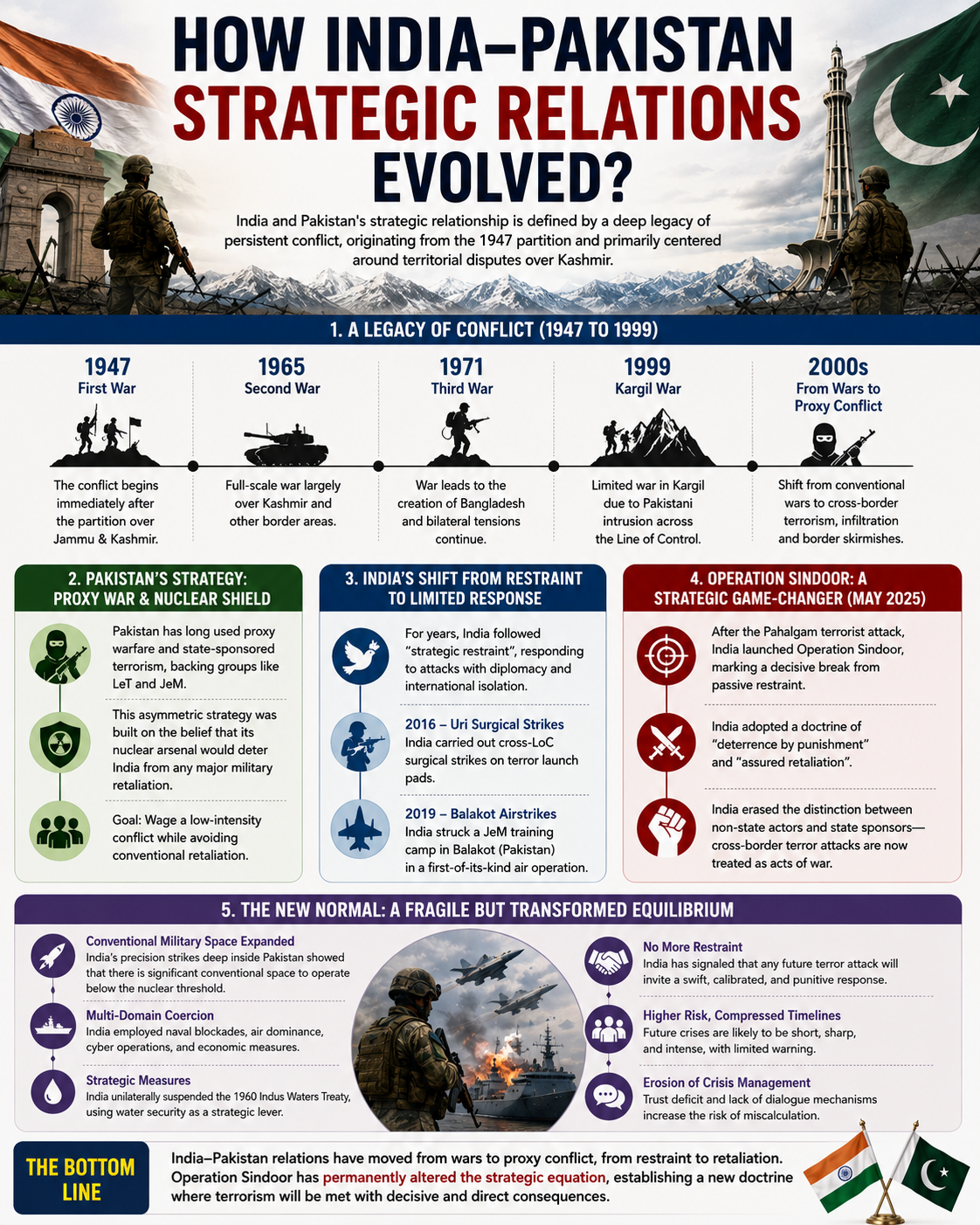 What are the Strategic Implications of Operation Sindoor?
Broken Nuclear Shield: India shattered Pakistan's nuclear bluff by conducting deep conventional strikes without breaching the nuclear threshold.
State Accountability: A new normal was set by holding the Pakistani state and military directly responsible for terrorist proxy actions.
Military Dominance: India established conventional superiority by destroying 11 airfields and 13 aircraft through high-precision targeting.
Non-Contact Warfare: The operation proved the power of multi-domain, non-contact strikes using drones, cruise missiles, and electronic warfare without crossing borders.
Hardware Superiority: Pakistan’s Chinese-supplied HQ-9 and JF-17 systems failed to defend critical military sites.
Strategic Deterrence: Regional deterrence evolved from nuclear threats to rapid, high-tech, and proportionate conventional military actions.
Indus Waters Treaty Suspension: India suspended the 1960 treaty to exert agricultural and economic pressure on Pakistan, declaring "blood and water cannot flow together."
Maritime and Trade Blockade: Deploying a Carrier Battle Group to the northern Arabian Sea paralyzed Pakistan's trade by confining its navy and causing a sharp rise in insurance premiums.
Expanded Conventional Deterrence: Successful strikes demonstrated India's ability to conduct deep offensive operations within Pakistan without inciting a nuclear response.
Diplomatic and Cultural Sanctions: India intensified pressure by revoking visas, halting trade, enforcing cultural boycotts, and reducing diplomatic ties.
Intelligence-Driven Synergy: The PRAHAAR strategy overhauled India's intelligence by integrating human, technical, and cyber capabilities via the Multi Agency Centre (MAC).
Global Narrative Decoupling: Indian communications successfully reframed the conflict as a counter-terrorism effort, isolating it from the broader Kashmir territorial dispute.
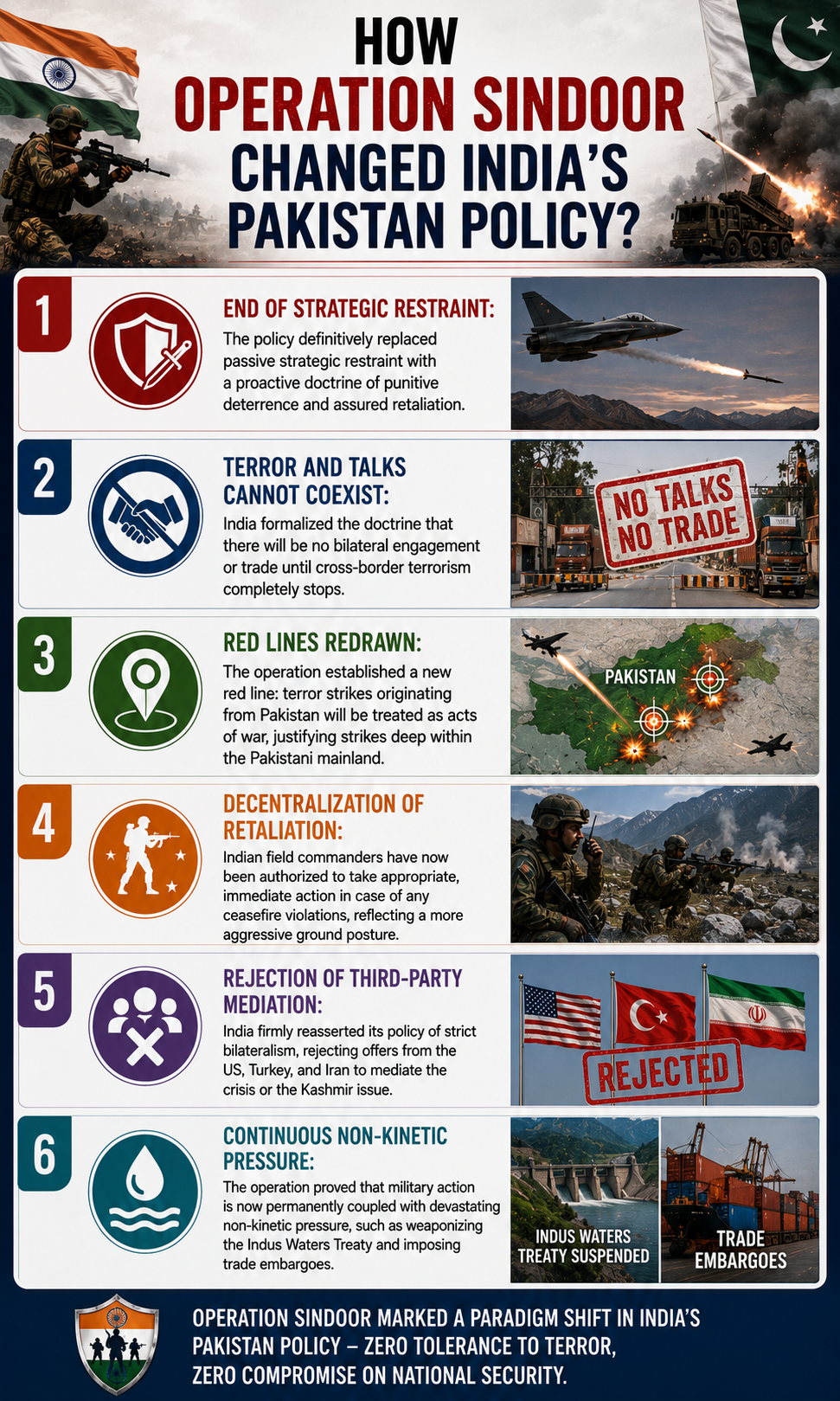
How did major powers reacted?
United States: Brokered a ceasefire to prevent nuclear escalation. President Trump claimed credit, but India called it a bilateral decision.
China: Urged restraint publicly while aiding Pakistan with satellite intel and technical support for J-10CE fighters.
Russia: Supported India’s right to self-defense; the success of Russian S-400 systems strengthened strategic partnership.
European Union: All 27 members backed India's right to defend against terrorism following the Pahalgam attack.
Middle East: Israel supported India, and the Gulf Cooperation Council (GCC) worked to de-escalate, whereas Turkey backed Pakistan.
Escalation Risks: Rapid drone and missile exchanges showed how punitive strikes can spiral, increasing the threat of nuclear war through miscalculation.
Two-Front Threat: The conflict solidified the China-Pakistan axis, indicating future wars may require India to simultaneously manage a coordinated bilateral military threat.
Cyber and Hybrid Escalation: Unpredictable retaliatory cyber strikes can bypass defenses, causing infrastructure failure and civilian chaos.
Economic and Domestic Disruptions: The conflict stressed India's economy, closing 25 airports and causing mass flight cancellations and border panic.
Vulnerability to Disinformation: Communication gaps allowed deepfakes and propaganda to dominate narratives, fueling public anxiety.
Accelerate Technological Modernization: Speed up the integration of AI, drone swarms, and directed energy weapons to maintain its military-technological edge.
Enhance Cyber and Space Defenses: Protect critical infrastructure (like nuclear command systems) against hybrid cyber-attacks and expand space-based intelligence, surveillance, and reconnaissance (ISR).
Refine Strategic Communications (NSCT): Establish a National Strategic Communication Taskforce to unify narrative efforts, counter disinformation in real-time, and prevent adversary propaganda from causing civilian panic.
Establish Water Security CBMs: Form a Bilateral Climate and Disaster Risk Working Group or a Water Crisis Communication Protocol to prevent natural hydrological volatility from sparking military escalation.
Deepen Jointness in Armed Forces: Strengthening integration of the Army, Navy, and Air Force under Integrated Theatre Commands to separate operational roles from administrative functions for seamless multi-domain combat.
Counter the Sino-Pakistani Axis: Expand defense diplomacy and strategic alliances with Western nations, Russia, and Middle Eastern powers to balance China's growing military footprint in Pakistan.
Streamline Defense Procurement: Use Emergency Procurement (EP) provisions to address capability voids, especially in long-range precision munitions and integrated air defense networks.
Operation Sindoor successfully dismantled the nuclear shield for cross-border terrorism, establishing a new paradigm of punitive deterrence that requires India to continuously balance technological military dominance with proactive diplomatic and crisis-management resilience.
Source: INDIAN EXPRESS
|
PRACTICE QUESTION Q. Analyse the geopolitical and economic implications of India's decision to suspend the Indus Waters Treaty during the 2025 India-Pakistan crisis. 250 words |
Operation Sindoor was an Indian military campaign launched on May 7, 2025, involving precision air and missile strikes on terrorist infrastructure in Pakistan and Pakistan-administered Kashmir.
The conflict was triggered by a terrorist attack on April 22, 2025, in Pahalgam, Kashmir, where 26 civilians were killed by The Resistance Front (TRF).
India's suspension of the treaty threatened Pakistan's agriculture and energy security, asserting the doctrine that "blood and water cannot flow together".
© 2026 iasgyan. All right reserved