

Copyright infringement not intended
Picture Courtesy: INDIAN EXPRESS
The question of India-Pakistan diplomatic engagement revolves around the fundamental dilemma of whether dialogue is possible while maintaining an uncompromising position against terrorism.
|
Read all about: Stable Pakistan Threat to India l Hazards Of Going Global On India-Pakistan Issues India's Terror Policy Shift l India Suspends Indus Water Treaty l INDIA-PAKISTAN RELATIONS |
For over two decades, India-Pakistan relations have been stuck in a predictable and damaging cycle: Hope → Engagement → Betrayal → Deadlock.
Diplomatic breakthroughs have been consistently sabotaged by terror attacks, often linked to the Pakistani "deep state," to derail the peace process.
The "Doctrine of Disengagement" led India to condition dialogue with Pakistan on credible action against terrorism, resulting in the suspension of the SAARC summit process since 2016 and the downgrading of diplomatic ties after 2019.
While isolating Pakistan has yielded some diplomatic gains, a permanent "no-contact" policy carries long-term risks.
Risk of Unmanaged Escalation
Absence of communication channels means a minor provocation or a rogue terror attack could spiral into a full-scale conflict due to misinterpretation. 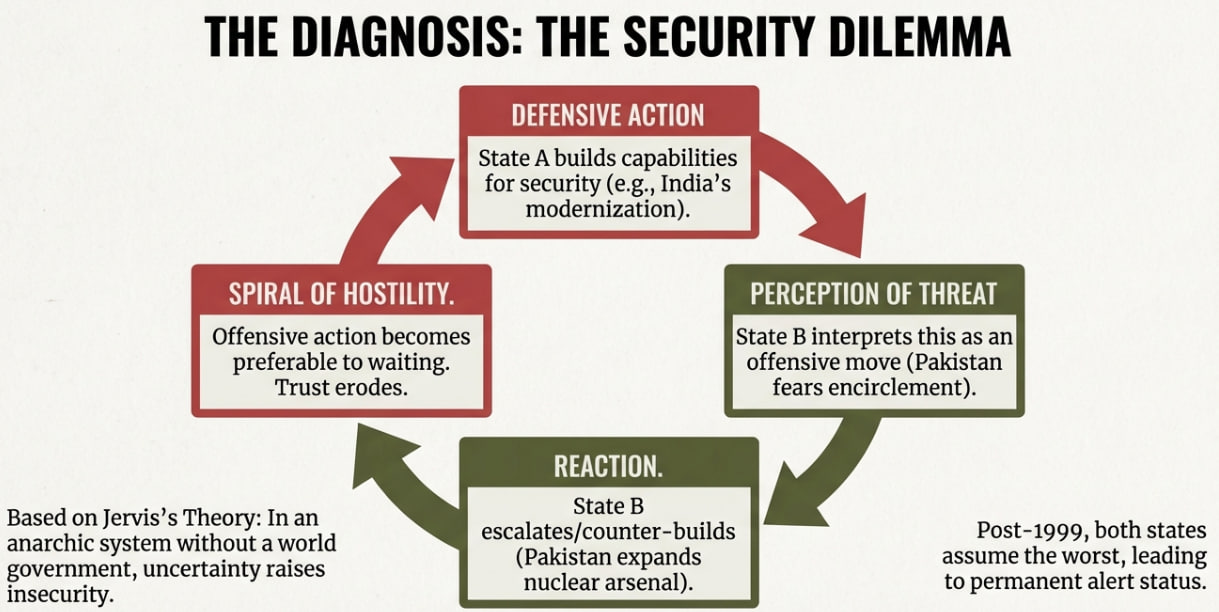
The "Echo Chamber" Effect
Without official dialogue, hyper-nationalist rhetoric dominates public discourse, shrinking the political space for future leaders to pursue peaceful negotiations.
Economic Opportunity Cost
The lack of regional connectivity hurts economic growth for both nations. Trade potential is immense but remains untapped due to political hostility.
|
Metric |
Figure |
Source |
|
Potential India-Pakistan Trade |
$37 billion |
World Bank Report, 2018 |
|
Actual Trade (2023-24) |
$1.35 billion |
Ministry of Commerce & Industry |
Instead of starting with immediate, high-stakes comprehensive dialogues, a more effective strategy is a "layered engagement" that begins with lower-risk sectors to build trust and create peace-advocating groups.
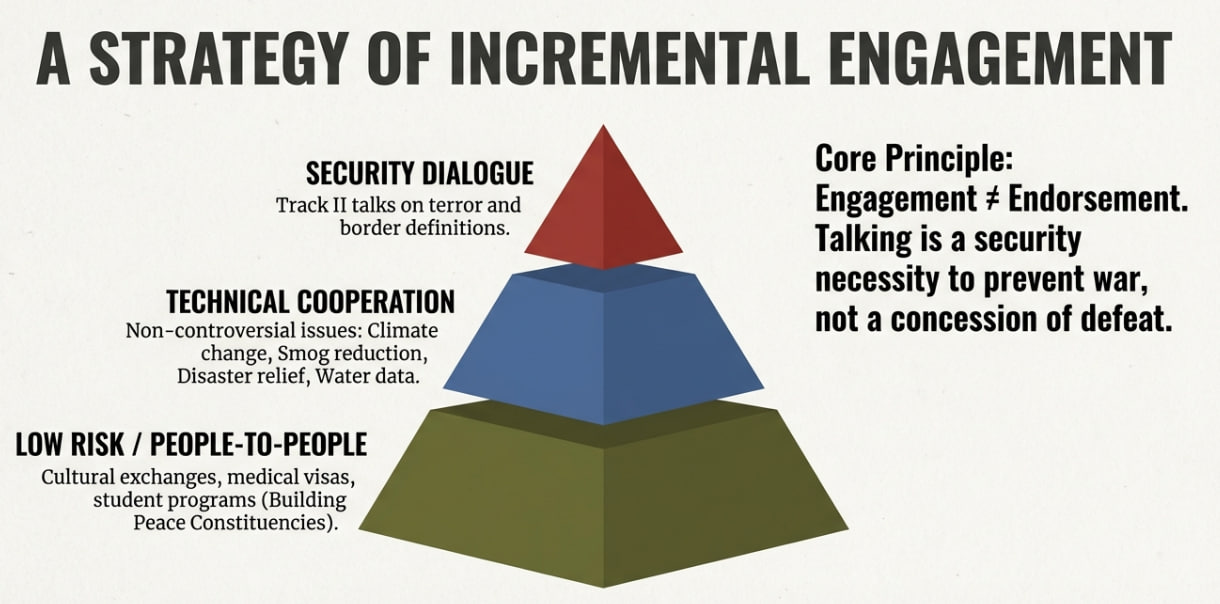 People-to-People and Cultural Engagement
Soft power initiatives, such as the successful "insulated cooperation" of the Kartarpur Sahib Corridor, help reduce state hostility even during diplomatic freezes.
Expanding soft power efforts through actions like re-establishing medical visas and academic exchanges could further strengthen relationships.
Humanitarian and Ecological Cooperation
Both nations face shared threats that transcend political boundaries, providing a neutral ground for cooperation. Key areas include:
Maintaining Technical Treaties
The Indus Waters Treaty (IWT) of 1960 has survived three wars, proving that technical cooperation can endure political friction, though India suspended it in 2025 after Pahalgam attack and is currently demanding modifications to reflect modern environmental and demographic realities.
Essential Security Safeguards for Engagement
Any form of engagement must be conditional and performance-based, not an endorsement of Pakistan's policies. India must maintain a position of strength with clear red lines.
The FATF Benchmark: India should continue using platforms like the Financial Action Task Force (FATF) to ensure Pakistan takes irreversible action against terror financing and UN-designated terrorists.
Calibrated "Action-for-Action": India can set clear, achievable benchmarks for Pakistan (e.g., prosecuting 26/11 handlers) and respond with calibrated, reciprocal gestures (e.g., restoring sporting ties) only when they are met.
Managed Competition
The strategy advocates for a firm counter-terrorism policy while also pursuing practical, low-risk areas of cooperation. Implementation should be "bottom-up," prioritizing concrete, local achievements over major political events.
Learn from Global Best Practice (The China-Taiwan Model)
Despite deep political hostility, China and Taiwan maintain robust economic ties. This model shows it is possible to separate hard security issues (borders, terrorism) from functional cooperation (trade, climate).
As former PM Atal Bihari Vajpayee stated, "Friends can be changed, but not neighbors." India's strategy must be pragmatic, combining a strong security posture with intelligent, people-centric diplomacy to manage a complex and unavoidable relationship.
Source: INDIAN EXPRESS
|
PRACTICE QUESTION Q. How has the possession of nuclear weapons by both nations since 1998 changed the nature of their conventional military conflicts? 150 words |
The core of the dispute remains the territory of Jammu and Kashmir. Since the Partition of 1947, both nations have claimed the region in its entirety but control only parts of it, separated by the Line of Control (LoC). India maintains that the entire state is its sovereign territory following legal accession, while Pakistan calls for a UN-mandated plebiscite.
Relations are currently strained and at a low point. Formal diplomatic dialogue has been largely suspended since 2019, following India's revocation of the special status of Jammu & Kashmir (Article 370). While a ceasefire agreement along the Line of Control (LoC) was reaffirmed in 2021, regular diplomatic engagement is minimal.
It is the region of Jammu and Kashmir under Pakistani control, which India considers illegally occupied territory since the 1947-48 war.
© 2026 iasgyan. All right reserved