France hosts the 52nd G7 Summit in Évian, where leaders address economic security, Chinese overcapacity, and AI governance. India participates as an outreach partner for the 13th time.
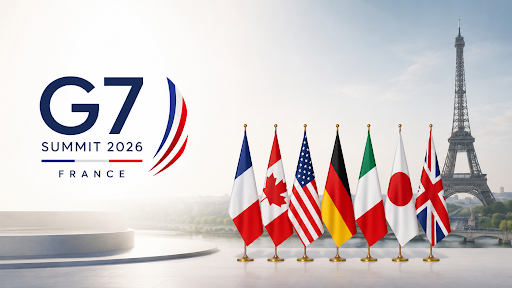
France hosts the 52nd G7 Summit in Évian from June 15-17, 2026, where leaders convene to address global economic security, AI governance, and supply chain resilience.
Informal Forum: The Group of Seven (G7) functions as an intergovernmental platform established in 1975 to coordinate global economic and political policy without a formal constitution or fixed headquarters.
Membership: The bloc includes Canada, France, Germany, Italy, Japan, the United Kingdom, and the United States, with the European Union (EU) participating as a non-enumerated member.
Evolution: The group transitioned from the G8 back to the G7 in 2014 following the suspension of Russia after the annexation of Crimea.
|
G7 vs G20 Representation: The G7 represents approximately 29% of global GDP, whereas the G20 accounts for over 80% of global economic output. Operational Focus: The G7 acts as an agile "operating system" for like-minded partners to align supply chains, while the G20 serves as a broader, albeit often paralyzed, forum for multilateralism. |
Economic Growth Gap: G7 economies project a sluggish 1.2% average GDP growth for 2026, trailing the 3.7% average of the BRICS coalition.
Energy Security: The summit prioritizes the Clean Energy Economy Action Plan, which mobilizes joint investments into battery clusters and critical mineral extraction.
AI and Tech Governance: Members advance frameworks like Pax Silica to regulate quantum innovation and secure technological stacks against strategic adversaries.
Supply Chain Resilience: France promotes the use of "non-price criteria"—focusing on trustworthiness and sustainability—in public procurement to mitigate reliance on Chinese industrial monopolies.
Prime Minister Narendra Modi attends as a strategic "outreach partner" for his 13th overall G7 participation to strengthen ties between the bloc and the Global South.
Diplomatic Bridge: The G7 recognizes India as an indispensable partner and a vital link to the Global South.
Technological Integration: India leverages the Bharat Innovates 2026 summit in Nice to integrate domestic startups into global semiconductor and AI value chains.
Strategic Anchor: India’s participation empowers it to secure access to advanced technologies while functioning as a key stabilizer in the Indo-Pacific region.
Source: REUTERS
|
PRACTICE QUESTION Q. In the context of global supply chain resilience discussed at recent G7 summits, the term "Pax Silica" refers to: A) A multilateral treaty aimed at banning the mining of silica sand in protected oceans. B) A geoeconomic coalition led by the US to secure the semiconductor value chain among trusted partners. C) A joint G7 and BRICS task force dedicated to the equitable distribution of solar panels. D) A Chinese state-sponsored initiative to dominate global artificial intelligence algorithms. Answer: B Explanation: The US State Department launched the Pax Silica Initiative in December 2025 to create resilient supply chains for semiconductors, silicon, and AI. By collaborating with trusted democratic partners, the coalition aims to minimize dependencies on dominant critical mineral processors. India joined the Pax Silica Declaration at the 2026 AI Impact Summit to enhance strategic technology cooperation. |
The Group of Seven (G7) is an intergovernmental political forum of the world’s leading industrialized democracies that coordinates policy on global economic governance, security, and energy.
The member nations are Canada, France, Germany, Italy, Japan, the United Kingdom, and the United States, with the European Union participating as a non-enumerated member.
Host nations invite India as a high-priority guest partner to represent the voice of the Global South and collaborate on critical issues like climate change, digital transformation, and economic resilience.
Leaders focused on de-escalating the West Asia conflict, securing the Strait of Hormuz, governing Artificial Intelligence, and diversifying critical mineral supply chains.

© 2026 iasgyan. All right reserved