India's fisheries sector drives economic growth, employment, and food security, producing 197.75 lakh tonnes annually. However, it faces severe ecological threats like marine heatwaves, overfishing, and IUU fishing, demanding robust governance, modern infrastructure, and sustainable management to ensure long-term resilience.
Why In News?
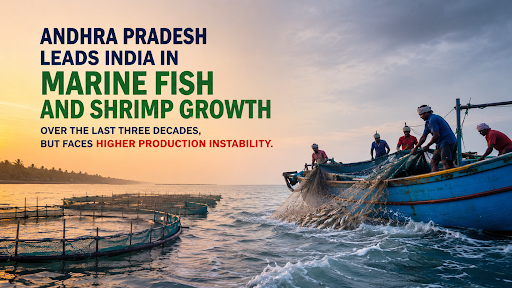
Andhra Pradesh leads in marine fish and shrimp growth over the last three decades, but faces higher production instability.
About Fisheries Sector in India
The fisheries sector encompasses the capture, cultivation, processing and marketing of fish and other aquatic resources from marine, inland and aquaculture sources.
India is the world's 2nd-largest fish-producing nation (contributing nearly 8% of global output). It ranks 1st globally in inland fish production as per the FAO.
Why is the Fisheries Sector Important for India?
Supports Livelihoods of Millions
The sector provides direct and indirect livelihoods to approximately 30 million people, primarily empowering marginalized coastal and inland communities. (Source: NITI Aayog)
Contributes to Food Security
Fisheries act as an essential source of micronutrients, combating hidden hunger and reducing nutritional deficiencies across rural demographics.
Generates Export Earnings
Seafood exports reached an all-time high of ₹73,890 crore in FY 2025-26, driven largely by frozen shrimp exports to the USA and China. (Source: PIB)
Promotes Coastal Economic Development
The sector contributes 1.09% to the National Gross Value Added (GVA) and 7.43% to the Agriculture GVA, anchoring coastal state economies. (Source: PIB)
Strengthens the Blue Economy
Harnessing India's 2.02 million sq. km EEZ presents vast opportunities for deep-sea tuna fishing, seaweed cultivation, and mariculture, positioning India as a global maritime leader. (Source: NITI Aayog)
What are the Key Features of Indian Fisheries Sector?
Marine Fisheries
Marine fisheries produce 46.15 lakh tonnes (23% of total output), from the west coast (Gujarat, Kerala) and east coast (Tamil Nadu), though largely constrained to shallow continental shelves.
Inland Fisheries
Inland fisheries dominate the sector, driving the "Blue Revolution" by producing 151.60 lakh tonnes (77%) of output, led by states like Andhra Pradesh and West Bengal.
Aquaculture and Mariculture
Farmers adopt modern, technology-driven practices like Recirculatory Aquaculture Systems (RAS), Bio-floc technology, and Seaweed farming (funded under PMMSY). (Source: PIB)
Fish Processing Industry
India operates around 646 registered seafood processing units, transforming raw catches into value-added products, though primarily focused on freezing shrimp.
Export-Oriented Production
The production chain prioritizes export markets, necessitating strict compliance with sanitary and phytosanitary (SPS) measures and digital traceability.
What are the Major Concerns Associated with Indian Fisheries Sector?
Overfishing and Resource Depletion
Unregulated access degrades inshore benthic environments, pushing traditional fishers outward; the FAO notes that India's marine production has plateaued as most major stocks are fully exploited.
Climate Change Impacts
Marine heatwaves in the Indian Ocean disrupt plankton dynamics and shift migration routes for high-value species like Tuna, severely threatening coastal livelihoods.
Marine Pollution
Widespread microplastic pollution and Ghost Fishing (lost/abandoned nets and longlines indiscriminately killing marine life) devastate marine biodiversity.
Illegal, Unreported and Unregulated (IUU) Fishing
IUU fishing constitutes a severe transnational security and economic threat. Chinese Distant Water Fishing (DWF) fleets exploit Regional Fisheries Management Organizations (RFMO) jurisdictional gaps, undermining Indian Ocean stability.
Declining Fish Stocks
Populations of commercially vital species, such as Yellowfin Tuna, face global overfishing pressures, prompting bodies like the Indian Ocean Tuna Commission (IOTC) to recommend urgent rebuilding measures.
Weak Post-Harvest Infrastructure
India faces a 20% post-harvest wastage due to deficits in cold chain logistics, automated processing, and deep-sea vessel berthing capacities.
Frameworks to Support the Fisheries Sector In India
Pradhan Mantri Matsya Sampada Yojana (PMMSY)
This umbrella scheme drives infrastructure development, technology infusion (RAS, Biofloc), and fisher welfare.
Fisheries and Aquaculture Infrastructure Development Fund (FIDF)
Offering up to 3% interest subvention to state entities and private entrepreneurs for building fishing harbours and ice plants.
Through the Deep Ocean Mission and specialized surveys by the Fishery Survey of India (FSI), the government maps Deep-Sea resources and designates potential fishing zones.
Marine Fisheries Regulation Acts
States enforce the Marine Fisheries Regulation Acts (MFRAs) within territorial waters (12 nmi), while the Central government governs the EEZ via the enacted EEZ Rules 2025.
Department of Fisheries
Operating under the Ministry of Fisheries, Animal Husbandry and Dairying, this nodal agency coordinates nationwide policies, administers subsidies, and drives digital governance through the National Fisheries Digital Platform (NFDP).
What Measures Can Strengthen Sustainable Fisheries in India?
Scientific Fish Stock Management
Enhance the National Marine Fisheries Data Centre (NMFDC) to consolidate logbooks, satellite data, and acoustic surveys, transitioning management to a rigid, quota-based ecosystem approach.
Sustainable Fishing Practices
Strictly enforce the uniform monsoon fishing ban and completely eradicate destructive gears like bull trawling and LED light fishing, as mandated by the EEZ Rules 2025.
Expansion of Mariculture and Aquaculture
Unlock the continental shelf by scaling up open-sea cage farming, seaweed cultivation, and high-value marine ornamental breeding to reduce nearshore capture pressure.
Strengthening Cold Chain Infrastructure
Construct integrated Smart and Modern Fishing Harbours (like the Mayabunder project) equipped with reefer container stations, automated sorting, and irradiation facilities to meet stringent export protocols.
Promoting Community-Based Resource Management
Empower traditional fishers by integrating them into FFPOs, granting exclusive deep-sea access rights, and diversifying livelihoods through eco-tourism and value-added processing.
Improving Marine Conservation Efforts
Establish strategically located Marine Protected Areas (MPAs) and implement rigorous Monitoring, Control, and Surveillance (MCS) using Vessel Monitoring Systems (VMS) to thwart IUU syndicates.
Conclusion
To secure the future of its Blue Economy, India must shift from purely production-centric policies to technology-driven, ecologically sustainable governance that modernizes infrastructure while protecting marine biodiversity and traditional livelihoods
Source: newindianexpress
|
PRACTICE QUESTION Q. "The long-term sustainability of India's fisheries sector depends on balancing economic growth with ecological conservation." Examine. (250 Words, 15 Marks) |



© 2026 iasgyan. All right reserved