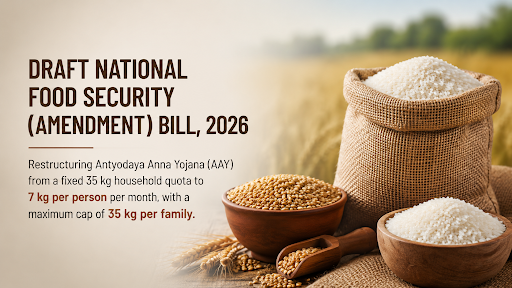
The Draft NFSA (Amendment) Bill 2026 proposes allocating 7 kg of foodgrains per person for AAY households, capped at 35 kg. This rationalizes food subsidies and addresses disparities, though large families may face nutritional gaps due to the rigid cap.
Why In News?
The Union Government introduces the Draft National Food Security (Amendment) Bill, 2026 to overhaul the Public Distribution System (PDS) entitlement framework for the poorest households.
About National Food Security Act (NFSA) 2013
Rights-Based Approach: The legislation shifts welfare from a discretionary model to a legal entitlement, guaranteeing access to quality food at affordable prices.
Beneficiary Categories: Households are broadly divided into two main categories: Antyodaya Anna Yojana (AAY) households (the poorest of the poor) and Priority Households (PHH).
Monthly Entitlements: AAY families receive 35 kg of foodgrains per family per month. Priority households are entitled to 5 kg per person per month.
Population Coverage: The act covers up to 75% of the rural population and 50% of the urban population, totaling approximately 81.35 crore beneficiaries based on the 2011 Population Census.
Subsidized Pricing: While the government distributes NFSA grains free of charge under the Pradhan Mantri Garib Kalyan Anna Yojana (PMGKAY), the legal baseline prices set by the Act are highly subsidized: Rice at ₹3/kg, Wheat at ₹2/kg, and Coarse Grains at ₹1/kg.
Women Empowerment: The act designates the eldest woman (aged 18 years or above) as the head of the household for ration card issuance.
Life Cycle Approach: Beyond basic grain distribution, the Act mandates nutritional support for vulnerable groups.
|
Government Initiatives Supporting Food Security ONORC: The One Nation One Ration Card initiative enables nationwide portability of entitlements. PMGKAY: This scheme serves as the primary execution engine, supporting 80.6 crore beneficiaries. Digital Reforms: SMART-PDS automates supply-chain management and e-PoS operations. SARTHAK-PDS: Approved for 2026-31 with a ₹25,530 crore outlay, this scheme utilizes AI, Blockchain, and Machine Learning for predictive governance. |
Key Features of the Draft Amendment Bill, 2026
Per-Capita Allocation: The draft mandates 7 kg of foodgrains per person monthly, replacing the flat 35 kg household model.
Household Ceiling: Ensures that no family receives more than the maximum limit of 35 kg of foodgrains per month, regardless of household size.
Digital Verification: The government integrates Aadhaar-seeded e-KYC to authenticate family sizes and remove bogus ration cards from the National Informatics Centre repository.
Subsidy Targeting: Per-person allocation optimizes subsidy distribution, preventing hoarding by small households and ensuring proportionate shares for larger ones.
Nutritional Alignment: The revision reflects Indian Council of Medical Research (ICMR) recommendations regarding stable carbohydrate intake per individual.
Equitable Distribution: Intended to resolve inequities in the previous system, where smaller families enjoyed a higher per-capita ration, while larger families received significantly less.
Free Allocation: Foodgrains under the revised AAY provisions remain free of any charges for beneficiaries.
Why are the Amendments Proposed?
Rationalisation: The government seeks to correct the mathematical imbalance where smaller households received higher per-capita entitlements than larger ones.
Demographic Adaptation: The amendment addresses the reality that large AAY families currently receive less per-capita food than PHH beneficiaries.
Efficiency: Linking quotas to actual family size curbs surplus distribution and reduces localized foodgrain diversion.
Equity: The Department of Food and Public Distribution aims to eliminate intra-category disparities to ensure statistical fairness.
Concerns and Challenges
Exclusion Errors: Reliance on the outdated 2011 Census potentially excludes over 100 million newly vulnerable people.
Impact on Large Families: The 35 kg cap penalizes families of six or more, who receive less than 6 kg per person.
Technological Barriers: Biometric failures and incomplete e-KYC verifications threaten to deny rations to the elderly and manual laborers.
Federal Coordination: Effective implementation requires extensive data harmonization between the Union and State governments.
Dietary Diversity: The amendment ignores the ICMR push for protein-rich diets, focusing exclusively on cereals.
Way Forward
Dynamic Identification: Governments must conduct new socio-economic surveys to replace the 2011 Census data.
Database Syncing: State Command and Control Centres must update birth, death, and migration records in real-time.
Ceiling Review: Policymakers should consider removing the 35 kg cap for families exceeding five members to prevent nutritional deprivation.
Nutritional Diversity: The government must integrate millets (Shree Anna), pulses, and bio-fortified foods into the PDS basket.
Conclusion
The Draft NFSA Amendment 2026 is a step toward intelligent, targeted welfare governance. However, its ultimate success depends on the government's ability to remove the arbitrary household cap and resolve systemic technological exclusions that currently threaten the most vulnerable populations.
Source: DOWNTOEARTH
|
PRACTICE QUESTION Q. With reference to the National Food Security Act (NFSA), 2013, which of the following statements is/are correct? 1. It covers 75% of the urban population and 50% of the rural population. 2. The eldest woman in the household, aged 18 years or above, is mandated to be the head of the household for issuing ration cards. Select the correct answer using the code given below: (a) 1 only (b) 2 only (c) Both 1 and 2 (d) Neither 1 nor 2 Answer: (b) Explanation: Statement 1 is incorrect: The National Food Security Act (NFSA), 2013, actually covers up to 75% of the rural population and up to 50% of the urban population. The question intentionally swaps these percentages. Under this coverage, nearly two-thirds (around 67%) of India's total population receives subsidized foodgrains. Statement 2 is correct: Section 13 of the Act explicitly mandates that the eldest woman of the household, aged 18 years or above, shall be designated as the head of the household for the sole purpose of issuing ration cards. This specific provision was included as a legal measure to promote women's empowerment. |





© 2026 iasgyan. All right reserved