DIKSHA is India's 'One Nation, One Digital Platform' for school education. Launched by the Ministry of Education, it offers multilingual e-content, QR-coded textbooks, and teacher training. It drives NEP 2020's vision by democratizing learning despite persistent digital divide challenges.
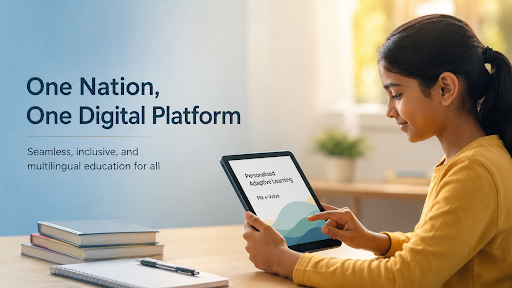
The Union Government positions DIKSHA as India's definitive "One Nation, One Digital Platform" to ensure seamless, inclusive, and multilingual education nationwide.
Digital Infrastructure for Knowledge Sharing: The government launched the platform on September 5, 2017, to serve as a National Teacher Platform.
Open Architecture: Developers built the system on open standards, open architecture, and open licensing to host Open Educational Resources (OER) for maximum accessibility.
Nodal Governance: The Ministry of Education spearheads the initiative through the National Council of Educational Research and Training (NCERT) in collaboration with the Central Institute of Educational Technology (CIET).
Federated Design: The system allows participating states and institutions to independently upload, manage, and customize content based on regional requirements.
Sunbird Integration: The platform utilizes the Sunbird registry and credential system to maintain verifiable user profiles and issue digital certificates.
Massive User Adoption: The platform records over 2.25 crore registered users, 3 lakh daily active users, and facilitates over 575 crore learning sessions.
E-Content Repository: The portal hosts over 3.67 lakh electronic contents, including 2D/3D animations, simulations, and over 450 Virtual Labs.
Energised Textbooks (ETBs): The platform features over 7,687 ETBs that use embedded QR codes to link physical NCERT books to digital videos and teacher guides.
Teacher Training: It powers capacity building via NISHTHA and state-specific modules, delivering certified, self-paced training through an integrated Learning Management System (LMS).
Linguistic Inclusivity: Users access content in 135 languages, while NCERT translates core textbooks into 22 scheduled languages.
Accessibility: The platform supports visually and hearing-impaired students through DAISY format, text-to-speech, and Indian Sign Language (ISL) videos.
Offline Functionality: DIKSHA Offline allows users to download content in advance or preload materials onto smart boards to combat network unreliability.
Digital Public Infrastructure (DPI): The platform serves 248 million children and 9.4 million teachers across more than 60 education boards.
Career Lifecycle Support: It supports educators from enrollment in Teacher Education Institutes (TEIs) until retirement, assisting with resource creation and assessment.
Adaptive Assessments: By integrating Personalised Adaptive Learning (PAL), the system automatically loops students back to basic concepts when they make mistakes, ensuring conceptual clarity.
Public-Private Partnership (PPP): The ecosystem leverages expertise from the EkStep Foundation and the Central Square Foundation.
|
DIKSHA and National Education Policy (NEP) 2020 Tech-Integration: It replaces rote learning with immersive, competency-based question banks and AI-driven chatbots. Foundational Literacy and Numeracy (FLN): The content focuses on cementing FLN while providing advanced modules for senior secondary education. PM eVidya Convergence: DIKSHA acts as the digital anchor for PM eVidya, which includes 200 DTH TV channels (Swayam Prabha) and 400 Radio channels. |
Digital Divide: A significant number of rural and economically disadvantaged students lack access to smartphones, tablets, or computers.
Connectivity Constraints: Intermittent internet in tribal and hilly regions hinders the streaming of media-rich content.
Infrastructure Gaps: Many government schools lack the smart boards and ICT labs required for daily classroom integration.Implementation Costs: Integrating AI-based PAL requires intensive content tagging, which currently faces budget constraints in states like Andhra Pradesh, Assam, and Haryana.
Digital Literacy: Teachers in remote areas often struggle to navigate the platform or author content effectively.
BharatNet Execution: The government must expedite BharatNet to ensure high-speed broadband reaches all rural Government Secondary Schools.
Scaling PAL: The Ministry must secure dedicated funding to scale PAL, prioritizing Chemistry, Mathematics, and Physics for Classes 9 to 12.
Localized Content: States must incentivize the development of regional language content to move beyond a Hindi/English-only approach.
Hardware Subsidies: The Centre should collaborate with corporate Corporate Social Responsibility (CSR) funds to provide subsidized devices to Below Poverty Line (BPL) families.
Teacher Upskilling: Institutions must conduct mandatory, hands-on digital literacy workshops to transition teachers into modern digital facilitators.
DIKSHA revolutionizes India's educational landscape as a robust Digital Public Infrastructure, democratizing access to quality learning and empowering educators to achieve the inclusive, technology-driven vision of NEP 2020.
Source: pib
|
PRACTICE QUESTION Q. Regarding the Digital Infrastructure for Knowledge Sharing (DIKSHA), consider the following statements: 1. It is a closed-source platform developed exclusively for use by the Central Board of Secondary Education (CBSE). 2. It operates on a federated architecture allowing individual states to upload and manage localized educational content. 3. The platform incorporates the DAISY (Digital Accessible Information System) format to support differently-abled learners. Which of the statements given above is/are correct? A) 1 and 2 only B) 2 and 3 only C) 1 and 3 only D) 1, 2, and 3 Answer: B Explanation: Statement 1 is incorrect: DIKSHA (Digital Infrastructure for Knowledge Sharing) is not closed-source nor exclusive to the Central Board of Secondary Education (CBSE). It is an open-source platform (built on Sunbird technology) initiated by the National Council of Educational Research and Training (NCERT) under the Ministry of Education. It serves as the "One Nation, One Digital Platform" for school education and is used by almost all states, union territories, and various educational boards across India. Statement 2 is correct: The platform operates on a decentralized, federated architecture. This allows individual states and union territories to independently upload, manage, and localize educational content and courses in their respective regional languages and curricula. Statement 3 is correct: To support differently-abled learners, the platform incorporates accessibility features, including the DAISY (Digital Accessible Information System) format, text-to-speech functionality, and Indian Sign Language (ISL) videos. |
Digital Infrastructure for Knowledge Sharing (DIKSHA) is India’s national, open-source digital public infrastructure for school education that serves as a comprehensive repository of high-quality, multi-lingual, and interactive e-learning resources.
The portal operationalises the National Education Policy (NEP) 2020 by driving the National Digital Education Architecture (NDEAR), facilitating localized, competency-based learning modules, and hosting foundational literacy and numeracy materials for the NIPUN Bharat Mission.
Energized Textbooks are physical school books embedded with scannable Quick Response (QR) codes that instantly connect students and teachers to chapter-specific, curated digital content like explanatory videos, interactive quizzes, and animation files on the DIKSHA platform.
DIKSHA empowers teachers by providing access to standard, peer-reviewed lesson planning templates, hosting advanced professional development courses via the NISHTHA training programme, and equipping them with robust digital tools to conduct continuous student assessments.


© 2026 iasgyan. All right reserved