The Tenth Schedule's Paragraph 4 exempts two-thirds of legislators merging from disqualification. Recent wholesale defections expose this loophole, transforming splits into legal mergers. Reforming the Speaker's adjudication power and defining mergers strictly prevents the anti-defection law's complete redundancy.
A recent surge in political defections across India, utilizes the Tenth Schedule’s merger exception to bypass disqualification, reignites debates regarding the efficacy of the Anti-Defection Law in preserving democratic mandates.
52nd Constitutional Amendment Act, 1985: Parliament enacts this legislation to curb the "evil of political defections" that destabilizes governments and erodes public trust.
Tenth Schedule: This amendment introduces the Tenth Schedule to the Constitution, formally incorporating the term "Political Party" into constitutional text.
Objectives: The law deters political corruption and horse-trading while binding elected representatives to the ideological platform and mandate of their sponsoring party.
Voluntarily Giving Up Membership: Under Paragraph 2(1)(a), members face disqualification if they voluntarily abandon their party.
Status of Expelled Members: In G. Viswanathan vs Speaker Tamil Nadu Assembly (1996), the Court clarifies that an expelled member remains tied to their original party; joining another party post-expulsion triggers disqualification.
Voting Against Party Whip: Paragraph 2(1)(b) penalizes members who vote or abstain contrary to the party whip without prior authorization, unless the party condones the action within 15 days.
Independent Members: These members face disqualification if they join any political party after their election.
Nominated Members: These members attract disqualification if they join a political party after the expiration of six months from their nomination date.
Legal Exception: Paragraph 4 provides that disqualification rules do not apply if an original political party merges with another.
Two-Thirds Rule: This exception applies exclusively if at least two-thirds of the members of the legislature party agree to the merger.
Protection from Disqualification: The law protects both members who join the new entity and those who reject the merger to function as a separate group.
Deletion of 'Split' Clause: The 91st Constitutional Amendment Act, 2003 repeals Paragraph 3, which previously allowed a one-third "split," leaving the two-thirds "merger" as the sole exception.
Support of Two-Thirds Legislators: At least two-thirds of the elected members in the House must explicitly consent to the merger.
Merger with Another Political Party: The structural transformation must originate outside the legislature. The Supreme Court in Subhash Desai vs Principal Secretary, Governor of Maharashtra (2023) confirms that a political party and a legislature party are distinct entities; a valid merger cannot consist of the legislature party alone.
Recognition by Presiding Officer: The Speaker or Chairman acts as a tribunal to formally recognize the merger and dismiss disqualification petitions.
Kihoto Hollohan Case (1992): The Court upholds the Tenth Schedule and affirms the Speaker's authority, while subjecting it to judicial review under Articles 32 and 226.
Nabam Rebia Case (2016): The Court labels defection a "constitutional sin" and demands strict interpretation of the Tenth Schedule.
Keisham Meghachandra Singh Case (2020): The Court mandates that Speakers must decide disqualification petitions within a reasonable period, typically capped at three months.
Rajendra Singh Rana vs Swami Prasad Maurya (2007): The Court rejects the "two hats theory," prohibiting legislators from simultaneously representing a party and acting independently to manufacture a split.
Circumvention of Law: Lawmakers use the two-thirds threshold as a loophole to mask individual opportunism as collective decisions, as seen in Goa (2022) where 8 out of 11 Congress MLAs merged into the BJP.
Political Instability: Mass exoduses continue to topple governments, such as in Karnataka (2019) and Madhya Pradesh (2020).
Partisan Role of Speaker: Speakers often delay decisions to favor ruling regimes, as observed in Telangana (2014) and Andhra Pradesh, where petitions remained pending while defectors held ministerial posts.
Violation of Electoral Mandate: Merging legislators rewrite the voters' choice without seeking a fresh mandate, undermining parliamentary democracy.
Independent Tribunal: The Law Commission’s 255th Report (2015) recommends transferring disqualification powers from the Speaker to the President or Governor, acting on the Election Commission of India's binding advice.
Time-Bound Decisions: Implementing statutory deadlines, such as a 90-day limit, enforces the Keisham Meghachandra Singh mandate.
Strengthening Accountability: The Law Commission’s 170th Report (1999) suggests repealing the merger exemption entirely, requiring legislators to resign if they leave their party.
Limiting Scope of Whips: The Dinesh Goswami Committee (1990) proposes restricting disqualification to defiance of whips only during critical votes like confidence motions or money bills.
Defining "Voluntary Exit": The Halim Committee Report (2003) recommends inserting a comprehensive legal definition of "voluntarily giving up membership" into the Tenth Schedule.
To prevent the Anti-Defection Law from acting as a mere spectator to engineered political crossovers, the Parliament must strictly define the Paragraph 4 merger clause and strip partisan Speakers of their limitless adjudication timelines
Source: THEHINDU
|
PRACTICE QUESTION Q. Consider the following statements regarding the Tenth Schedule of the Indian Constitution:
Which of the statements given above is/are correct? A) 1 only B) 1 and 2 only C) 2 and 3 only D) 1, 2, and 3 Answer: A Explanation: Statement 1 is correct: The 91st Constitutional Amendment Act, 2003 entirely deleted the "split" provision in the Tenth Schedule, which had previously allowed one-third of a party's legislators to form a separate group or faction without attracting disqualification. Statement 2 is incorrect: An expelled member of a political party is not considered an "unattached" member who can subsequently join another party without penalty. Under the Anti-Defection Law, if an expelled member joins another political party, they are considered to have voluntarily given up their original party membership and are subject to disqualification. Statement 3 is incorrect: The Tenth Schedule contains no specific exception for Money Bills. A legislator who votes against their party's direction or abstains from voting on a Money Bill without prior permission risks disqualification in the same manner as for any other vote. |
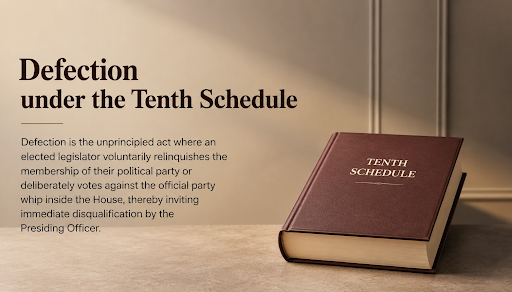
Defection is the unprincipled act where an elected legislator voluntarily relinquishes the membership of their political party or deliberately votes against the official party whip inside the House, thereby inviting immediate disqualification by the Presiding Officer.
The two-thirds rule is a mandatory numerical threshold under Paragraph 4 of the Tenth Schedule requiring at least 66.6% of a political party's elected legislators to agree to a political alignment before they can legally claim exemption from defection penalties.
The merger clause grants complete legal immunity from disqualification by establishing a legal fiction that protects both the migrating faction that crosses the two-thirds threshold and the remaining members who choose to stay with the original party.
Critics fiercely condemn the merger provision because it legitimises wholesale horse-trading while penalising retail defection, relies on an ambiguous definition that conflates legislative wings with organizational structures, and completely subverts the democratic mandate of ordinary voters.




© 2026 iasgyan. All right reserved