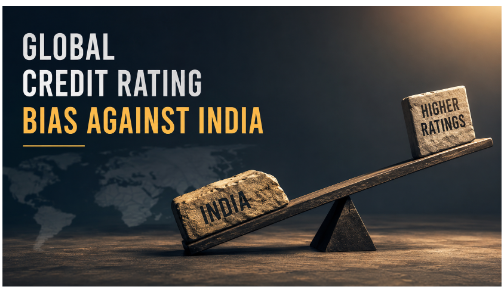
Global Credit Rating Agencies assess a country's creditworthiness. India strongly criticizes the top agencies for opaque, biased methodologies that rely heavily on subjective governance indicators, ignoring India's zero default history, robust economic fundamentals, and high foreign exchange reserves.
Why In News?
The Ministry of Finance released a document titled "Re-examining Narratives" to highlight the opaque and subjective methodologies of global Credit Rating Agencies (CRAs).
What are Credit Rating Agencies?
CRAs function as independent private entities that assess the creditworthiness of governments and corporations, determining their capacity to meet debt obligations.
These agencies provide ordinal measures of credit risk that dictate global investor confidence, borrowing costs, and capital flows.
Three major agencies—Moody’s, Standard & Poor’s (S&P), and Fitch—dominate the sovereign ratings space, forming a heavily concentrated oligopoly.
Agencies categorize countries into investment grade (e.g., BBB-/Baa3 and above) or speculative/junk grade, which dictates institutional investment limits.
Objectives: Agencies assess default risk using quantitative and qualitative data, improve market transparency via continuous monitoring, assist investment decisions, and facilitate efficient capital allocation.
Why are Credit Ratings Important for India?
Foreign Investments: Sovereign ratings directly influence Foreign Direct Investment (FDI) and Foreign Portfolio Investment (FPI) inflows; downgrades trigger capital flight, while upgrades boost equity and debt.
Sovereign Borrowing Costs: Lower ratings force the government and domestic businesses to pay higher interest rates in international markets, restricting funds for infrastructure and climate goals.
Economic Credibility: Ratings serve as a global scorecard for macroeconomic stability; the Sovereign Ceiling Doctrine artificially caps the ratings of domestic corporations based on the sovereign grade.
Investor Sentiment: Negative announcements generate market jitters, causing stock market declines and currency depreciation.
Capital Market Flows: Large institutional investors, such as pension funds, operate under mandates that restrict holdings to investment-grade instruments, effectively blocking access to capital if ratings fall below BBB-.
What are India's Major Concerns with Most Credit Rating Agencies?
Perceived Bias: Agencies consistently rate India at the lowest rung of the investment grade, which the Economic Survey 2020-21 identifies as a historical anomaly driven by home-country bias.
Disproportionate Downgrades: Over 95% of credit rating downgrades hit developing countries, inflating the "perception premium" these nations pay.
Weightage Issues: Agencies rely heavily on World Governance Indicators (WGIs) and per capita income, which disadvantages populous nations despite their large GDP and resilience.
Underestimation of Potential: CRAs ignore India’s zero sovereign default history and its massive foreign exchange reserves, which cover all external debt.
Structural Reform Oversight: Agencies utilize perception-based surveys that fail to capture the benefits of structural reforms, a deleveraged corporate sector, and a well-capitalized banking system.
Opaque Methodologies: Subjective factors dictate over 50% of rating outcomes, and agencies refuse to disclose the exact weights assigned to various parameters.
What Institutional, Legal and Policy Frameworks Govern Credit Ratings?
SEBI Regulations: The Securities and Exchange Board of India (SEBI) regulates domestic agencies to ensure compliance and prevent conflicts of interest.
Assessment Frameworks: Global agencies use proprietary models like Fitch’s Sovereign Rating Model (SRM) and Moody’s Scorecard.International Standards: The Financial Stability Board (FSB) and the Basel Committee on Banking Supervision (BCBS) use sovereign ratings to dictate bank capital requirements.
Domestic Ecosystem: India’s homegrown agencies, such as CareEdge, CRISIL, and ICRA, provide localized assessments; CareEdge assigns 50% weightage to quantitative macroeconomic factors.
BRICS Initiative: BRICS nations are developing an independent rating agency to challenge the Western oligopoly.
What Measures Can Improve the Global Credit Rating System?
Transparency: Agencies must publish the exact weights of qualitative components and minutes of rating committee meetings.
Objective Methodologies: Prioritize hard data—such as default history and foreign exchange reserves—over perception-based indices.
Global South Integration: Include data sources and expert panels from the Global South to remove cultural bias.
Independent Oversight: Establish an international regulatory body to monitor agencies and prevent pro-cyclical downgrades.
Model Transition: Shift from the issuer-pays model to an investor-pays model to minimize moral hazards.
Conclusion
To unlock full economic potential and access fair global capital, India must advocate for a transparent, objective, and unbiased global sovereign credit rating system that accurately reflects its robust macroeconomic fundamentals and impeccable debt repayment history.
Source: THEHINDU
|
PRACTICE QUESTION Q. Consider the following statements regarding Sovereign Credit Ratings: 1. The "issuer-pays model" currently dominates the global credit rating industry, which often creates moral hazard concerns. 2. Sovereign credit ratings solely rely on quantitative macroeconomic indicators like GDP growth and forex reserves. 3. A downgrade below the "BBB-" or "Baa3" threshold categorizes a sovereign's debt as speculative or "junk" grade. Which of the statements given above is/are correct? (a) 1 and 2 only (b) 2 and 3 only (c) 1 and 3 only (d) 1, 2, and 3 Answer: c Explanation: Statement 1 is correct: The "issuer-pays model" (where the entity issuing the debt pays the rating agency) dominates the global credit rating industry. This structure inherently creates moral hazard and conflicts of interest, as agencies may face pressure to inflate ratings to retain or win business. Statement 2 is incorrect: Sovereign credit ratings do not rely solely on quantitative macroeconomic indicators. They also heavily factor in qualitative, subjective assessments, such as political stability, geopolitical risks, policy effectiveness, and institutional strength. Statement 3 is correct: Bonds or debt downgraded below the "BBB-" (by S&P and Fitch) or "Baa3" (by Moody's) threshold fall out of the "investment grade" category and are officially classified as speculative, high-yield, or "junk" grade. |
A sovereign credit rating is an independent assessment provided by Credit Rating Agencies (like Moody's, Fitch, and S&P) that evaluates a national government's ability and willingness to repay its debt obligations. It assigns a letter grade (e.g., AAA to D) to quantify default risk.
India strongly criticizes global agencies for utilizing opaque methodologies that place excessive weight on subjective, perception-based metrics like the World Governance Indicators (WGIs). These biases systematically ignore India's strong macroeconomic fundamentals, high foreign exchange reserves, and perfect zero-default history.
Sovereign ratings directly dictate the interest rates a country pays to borrow. A low rating (near "junk" status) increases borrowing costs, deters Foreign Direct Investment (FDI), and forces global institutional investors—who are often mandated to hold only investment-grade assets—to pull out Foreign Portfolio Investment (FPI).
Reforms must include shifting from subjective qualitative overlays to hard, objective macroeconomic data (like default history). Additionally, transitioning to an investor-pays model, enhancing methodological transparency, creating separate scales for emerging economies, and empowering domestic CRAs will eliminate existing biases.






© 2026 iasgyan. All right reserved