Legal frameworks empower police to conduct further investigations post-final report. Recent Supreme Court rulings clarify differences between reinvestigation and further investigation, emphasizing the necessity of judicial oversight under BNSS.
Why In News?
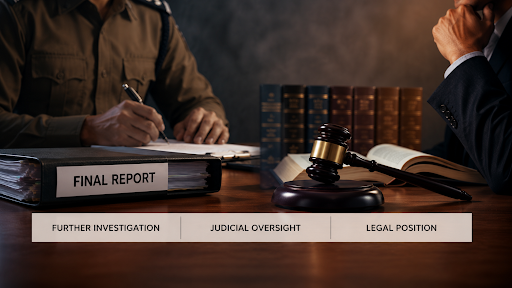
The Supreme Court in the ruling of Pramod Kumar vs State of Uttar Pradesh, clarifies that police possess no independent authority to direct further investigation without a Magistrate's prior leave once a court accepts a closure report or Final Report.
What is a Final Report?
Statutory Framework: Section 173 of the Criminal Procedure Code (CrPC), now replaced by Section 193 of the Bharatiya Nagarik Suraksha Sanhita (BNSS), mandates the submission of a final police report upon the completion of an investigation.
Comprehensive Documentation: The report includes the names of parties, the nature of the information, details of arrested persons, and the status of any bonds.
Chargesheet Submission: Police file a chargesheet to initiate the trial when evidence establishes an offence.
Closure Report Application: Investigating agencies file a closure report when a dispute appears civil in nature or lacks sufficient evidence.
Role of the Magistrate: The Magistrate exercises suo moto authority under Section 156(3) CrPC to accept the report, reject it, or order further investigation.
What is Further Investigation?
Definition and Scope: The Supreme Court defines "further investigation" as the continuation of an existing probe rather than a fresh investigation started ab initio.
Statutory Right: Investigating agencies retain the statutory right to conduct further investigation even after filing the initial chargesheet.
Collection of Evidence: Officers exercise this power when they discover new facts or must examine the case from a different angle.
Supplementary Chargesheet: The officer-in-charge must forward newly discovered oral or documentary evidence to the Magistrate via a supplementary report, which remains subject to the same legal provisions as the primary chargesheet under BNSS.
Police Powers and Judicial Approval
No Independent Authority: Police or executive authorities, including the Superintendent of Police, cannot independently order further investigation after a closure report receives judicial acceptance.
Mandatory Judicial Leave: The Pramod Kumar vs State of UP (2026) ruling quashes police communications that direct further investigation without prior judicial approval.
Doctrine of Contemporanea Expositio: As established in Vinay Tyagi vs Irshad Ali (2013), legal practice dictates that agencies must seek court leave for further investigation to maintain judicial decorum.
BNSS Mandate: Section 193(9) BNSS requires strict permission from the trial court to conduct further investigation during the trial phase.
|
Further Investigation vs Fresh Investigation Supplementary Probe: This process adds new evidence to the existing record without discarding the original chargesheet. Reinvestigation: This process wipes out the earlier investigation entirely; the Supreme Court strictly prohibits this without judicial permission. De Novo Investigation: Only Constitutional Courts (High Courts or the Supreme Court) hold the power to direct a de novo (fresh) investigation if the original probe is flawed or mala fide. |
Judicial Interventions
Vinay Tyagi vs Irshad Ali (2013): The Court establishes that seeking prior leave is a necessary implication of Section 173(8) CrPC.
Vinubhai Haribhai Malaviya vs State of Gujarat (2019): The Court expands the Magistrate's authority to direct further investigation even after cognizance, provided the trial has not commenced.
Rama Chaudhary vs State of Bihar (2024): The Court re-emphasizes that seeking permission from the concerned Magistrate is an essential legal development.
Robert Lalchungnunga Chongthu vs State of Bihar (2025): The Court upholds the Vinay Tyagi ratio, confirming that judicial leave for supplementary chargesheets is established law.
Significance
Fair Investigation: Judicial oversight ensures an impartial process and allows courts to rectify flawed initial investigations.
Prevention of Abuse: Mandatory oversight prevents police from arbitrarily submitting supplementary chargesheets to provide "clean chits" or succumbing to political pressure.
Time-Bound Investigations: Under the BNSS framework, further investigation during trial must conclude within 90 days, with extensions granted only by the court.
Conclusion
Balancing the statutory right of the police to conduct further investigation with mandatory judicial oversight guarantees an equitable criminal justice system.
Source: THEHINDU
|
PRACTICE QUESTION Q. What are the major challenges associated with prolonged and repeated criminal investigations? Suggest measures to balance the need for uncovering new evidence with the fundamental right to a speedy trial. 150 words |
The police possess a statutory right to conduct a "further investigation" even after filing a final chargesheet under Section 173(8) of the CrPC (and Section 193(9) of the Bharatiya Nagarik Suraksha Sanhita, 2023), provided they formally obtain the mandatory permission or "leave" of the concerned Magistrate before submitting newly discovered oral or documentary evidence.
A supplementary chargesheet is an additional, subsequent police report filed before the Magistrate to legally introduce fresh facts, list newly tracked evidence, or name added accused individuals discovered during a court-approved further investigation, acting as a continuation of—rather than a replacement for—the initial primary chargesheet.
A further investigation is a sequential continuation of the original inquiry aimed at supplementing the existing material with fresh findings, whereas a reinvestigation (or de novo investigation) completely erases the previous probe, starting the entire case completely from scratch ab initio as if no prior investigation ever occurred.
While a local Judicial Magistrate cannot legally order a fresh or de novo investigation and is restricted solely to directing further investigations, constitutional courts like the High Courts and the Supreme Court of India hold full judicial power to order a fresh investigation or transfer the entire case to an independent specialised agency like the CBI to guarantee complete public trust and substantial justice.




© 2026 iasgyan. All right reserved