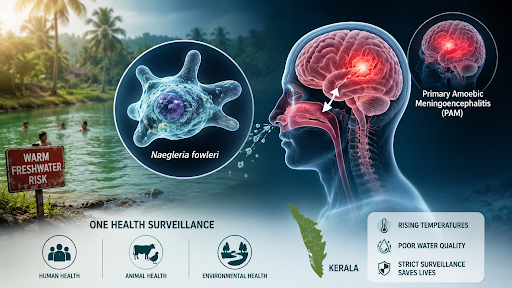
Naegleria fowleri, a thermophilic free-living amoeba, causes the highly fatal Primary Amoebic Meningoencephalitis (PAM) by entering the brain via nasal passages from warm freshwater. Rising temperatures and poor water quality have triggered an unprecedented outbreak in Kerala, necessitating strict One Health surveillance.
Kerala reports a severe 2026 outbreak of Primary Amoebic Meningoencephalitis (PAM), resulting in 33 deaths.
Disease Severity: PAM is an acute, rapidly progressing infection of the central nervous system with a global fatality rate of 95% to 97%.
Pathology: The amoebae enter through the nasal passages, penetrate the cribriform plate, and migrate along the olfactory nerves to destroy brain tissue, causing massive cerebral edema.
Clinical Timeline: Patients succumb to the infection within 7 to 10 days of symptom onset.
|
What is Naegleria fowleri? Naegleria fowleri is a microscopic, single-celled free-living amoeba that grows independently in the environment without requiring a human host. Habitat: It prefers warm freshwater environments, including lakes, ponds, and poorly maintained swimming pools, with optimal growth occurring between 25°C and 35°C. Environmental Resilience: The organism survives extreme stress by forming protective cysts and exhibits a "Trojan horse" effect, sheltering bacteria and viruses to resist disinfection. |
Drivers of the Current Surge
Climate Change: Rising global temperatures and erratic rainfall patterns expand the geographic range of these thermophilic organisms and trigger eutrophication in stagnant water bodies.
Water Quality Failures: High population density and proximity of toilet pits to open wells lead to widespread faecal contamination.
Diagnosis and Clinical Management
Diagnostic Hurdles: Clinicians often misdiagnose PAM as acute pyogenic meningitis.
Advanced Testing: Apex laboratories utilize Real-time Polymerase Chain Reaction (RT-PCR) and genomic sequencing for definitive confirmation.
Treatment Protocol: The medical regimen mandates a multi-drug approach, including Miltefosine, Amphotericin B, Azithromycin, Fluconazole, Rifampin, and Dexamethasone.
Source: INDIANEXPRESS
|
PRACTICE QUESTION Q. With reference to Primary Amoebic Meningoencephalitis (PAM) and its causative agent, consider the following statements:
Which of the statements given above is/are correct? A) 1 and 2 only B) 3 only C) 2 and 3 only D) 1, 2, and 3 Answer: B Explanation: Statement 1 is incorrect: Naegleria fowleri is a facultative parasite (specifically a free-living amoeba), not an obligate parasite. It naturally lives, feeds on bacteria, and completes its reproductive life cycle via binary fission in warm freshwater environments without requiring a human or animal host. Humans are only accidental hosts. Statement 2 is incorrect: The amoeba cannot cause infection through the consumption (swallowing) of contaminated drinking water. It strictly infects humans through the intranasal route—when contaminated water enters the nasal cavity, allowing the amoeba to travel up the olfactory nerve to reach the brain. Statement 3 is correct: Naegleria fowleri is thermophilic (heat-loving). It thrives and rapidly multiplies in warm freshwater environments at temperatures up to 46c. Consequently, its proliferation and geographic spread are highly vulnerable to climate change and rising global freshwater temperatures. |
The brain-eating amoeba, scientifically named Naegleria fowleri, is a heat-loving, single-celled microscopic protozoan that triggers Primary Amoebic Meningoencephalitis (PAM), a rapid and nearly 97% fatal central nervous system infection.
The organism infects humans exclusively when contaminated freshwater is forced up the nasal cavity, allowing the amoeba to cross the olfactory nerve and travel straight into the brain to violently destroy neural tissues.
The Kerala Department of Health Services reports a sharp rise to 133 cases and 33 deaths in early 2026 due to a combination of aggressive diagnostic screening of all unidentified encephalitis cases, deteriorating surface water quality, and tropical climate change driving higher stagnant water temperatures.
Individuals can completely prevent infection by wearing tight nose clips or keeping their heads entirely above water when bathing in local ponds, avoiding stirring up underwater sediment, and using exclusively boiled or distilled water for routine ritual nasal rinsing.






© 2026 iasgyan. All right reserved