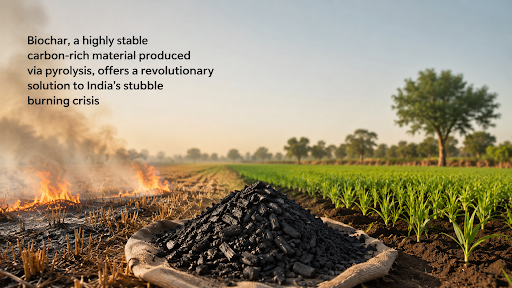
Biochar, a highly stable carbon-rich material produced via pyrolysis, offers a revolutionary solution to India's stubble burning crisis. Biochar's potential in carbon sequestration, soil fertility enhancement, multi-sectoral applications, and its vital role in the upcoming Indian Carbon Market.
Why In News?
Converting open-field crop residue into biochar addresses agricultural air pollution and enhances degraded soils, offering a sustainable alternative to burning.
What is Biochar?
Biochar is a charcoal-like, highly porous, and structurally stable substance produced from agricultural residues, forestry waste, or organic municipal solid waste.
Thermochemical Conversion: Producers create biochar through pyrolysis, heating organic biomass at temperatures between 350°C and 800°C in an oxygen-limited environment.
Recalcitrant Carbon Matrix: The material possesses a stable aromatic carbon structure that resists microbial degradation, functioning as a long-lasting terrestrial carbon sink.
Microscopic Habitat: The intense heating process creates a massive internal surface area that absorbs nutrients and moisture while providing a sanctuary for beneficial soil microorganisms.
Production and Agricultural Integration
Biomass Collection: Farmers mechanically harvest surplus biomass—including rice husks, wheat straw, sugarcane bagasse, and corn cobs—diverting them from open-field incineration.
Controlled Pyrolysis: Operators feed residue into portable cone kilns or mechanized pyrolyzers, where the absence of oxygen drives off volatile gases and moisture, leaving behind a stable carbon skeleton.
Soil Fertility Enhancement: Biochar increases Cation Exchange Capacity (CEC), traps essential nutrients (Nitrogen, Phosphorus, Potassium), and acts as a liming agent to neutralize acidic soils.
Yield Gains: Field trials confirm yield increases of 10% to 25%, with specific improvements of 18% in chickpeas and 40% in soybeans.
Water Retention: The porous matrix increases moisture retention by up to 18% in semi-arid lands.
Emission Suppression: Biochar integration reduces soil nitrous oxide (N2O) emissions by 30% to 50% and suppresses methane release.
Fertilizer Efficiency: By optimizing nutrient release, biochar reduces synthetic chemical fertilizer requirements by 20% to 40%.
Climate Significance and Carbon Sequestration
Permanent Removal: Every 1 tonne of biochar applied to farmland sequesters approximately 3 tonnes of CO2 equivalent for centuries.
Negative Emission Technology: Biochar functions as an aggressive Negative Emission Technology (NET), withdrawing atmospheric CO2 through photosynthesis and burying it in the biosphere.
Net-Zero Contribution: Utilizing 30–50% of India’s agricultural waste to generate 15-26 million tonnes of biochar can remove up to 0.1 gigatonnes of CO2-equivalent annually, supporting India’s 2070 Net-Zero targets.
Agroforestry Synergy: Biochar application increases young tree survival rates by up to 30% in degraded environments.
Diverse Applications
Wastewater Treatment: 1 kilogram of high-quality biochar purifies 200 to 500 liters of toxic wastewater.
Environmental Remediation: Biochar immobilizes heavy metals like lead (Pb), cadmium (Cd), and chromium (Cr), preventing groundwater leaching.
Green Construction: The industry incorporates 2-5% biochar into concrete to enhance mechanical strength and improve thermal resistance by 20%.
Bioenergy: Pyrolysis captures syngas and bio-oil, which rural communities use to power micro-grids and replace diesel generators.
Challenges to Adoption
Capital Constraints: High upfront costs for portable, tractor-mounted kilns limit accessibility for smallholder farmers.
Knowledge Gaps: A lack of awareness regarding long-term agronomic benefits restricts widespread adoption.
Market Development: The absence of structured domestic demand forces producers to rely on international carbon credit exports.
Quality Control: The lack of mandated, government-regulated standards risks the production of low-quality, high-ash biochar that can damage soil health.
Way Forward
Policy Subsidies: The government must subsidize indigenous pyrolysis machinery and integrate biochar targets into National Crop Residue Management programs.
Carbon Market Integration: Policymakers must certify biochar as a fully monetizable carbon removal pathway under the 2026 Indian Carbon Market.
Capacity Building: Krishi Vigyan Kendras (KVKs) and agri-tech platforms must launch on-ground demonstration programs for farmers.
Standardization: The Ministry of Agriculture must enforce strict, agro-climatic zone-wise certification frameworks to ensure environmental safety and consistent performance.
Conclusion
Biochar offers a scientifically validated, multi-sectoral solution that simultaneously eliminates the toxic stubble burning crisis, revitalizes degraded soils, and accelerates transition toward a sustainable, carbon-negative agricultural economy.
Source: THEHINDU
|
PRACTICE QUESTION Q. With reference to "Biochar" and its applications in sustainable agriculture, consider the following statements:
Which of the statements given above is/are correct? A) 1 and 2 only B) 2 and 3 only C) 1 and 3 only D) 1, 2, and 3 Answer: B Explanation: Statement 1 is incorrect: Pyrolysis is the thermochemical decomposition of organic material at high temperatures in the absence of oxygen (or with significantly limited oxygen). It does not involve a highly oxygenated environment or complete combustion. Complete combustion would completely turn the biomass into ash and carbon dioxide rather than producing stable biochar. Statement 2 is correct: High-quality biochar has a high surface area and porous structure containing functional groups that carry negative charges. This significantly increases the Cation Exchange Capacity (CEC) of the soil, allowing it to hold onto essential nutrients and reduce leaching. Statement 3 is correct: Biochar is highly stable and resistant to biological degradation. When added to agricultural soils, it effectively locks carbon into a solid form for centuries or even millennia, acting as a viable negative emission technology by removing carbon from the short-term bio-atmospheric cycle. |
Biochar is a fine-grained, highly porous, and lightweight carbon-rich charcoal-like substance created by thermal decomposition of organic agricultural waste at temperatures above 500°C through an oxygen-deprived heating process known as pyrolysis.
Biochar curbs stubble burning by providing an economically lucrative alternative for farmers, allowing companies like Prince William’s Earthshot Prize winner Takachar to intercept crop residues using mobile reactors and process up to one metric tonne of paddy straw per hour directly at the village level.
Biochar is universally termed black gold because it acts as an extraordinarily precious soil amendment that permanently increases water-holding capacity by up to 25%, drastically stimulates beneficial microbial diversity, reduces dependence on chemical fertilisers, and opens up profitable new revenue streams.
Biochar combats global warming as an IPCC-endorsed negative-emissions technology that structurally locks unstable carbon from decomposing biomass into a highly stable, immutable solid matrix, effectively sequestering carbon dioxide deep inside agricultural soils for hundreds to thousands of years.


© 2026 iasgyan. All right reserved