Stubble burning severely degrades air quality and soil health across Northern India. By adopting sustainable technologies, providing Minimum Support Price for paddy residue, and leveraging shared-economy machinery, the government aims to mitigate farm fires and enhance environmental conservation effectively.
The Commission for Air Quality Management in NCR and Adjoining Areas (CAQM) reviewed state plans and enforcement strategies in Punjab, Haryana, and Uttar Pradesh to eliminate stubble burning through better residue management
|
Read all about: Stubble Burning Crisis: Impacts & Policies l Stubble Burning in India: Causes, Impacts, and Solutions |
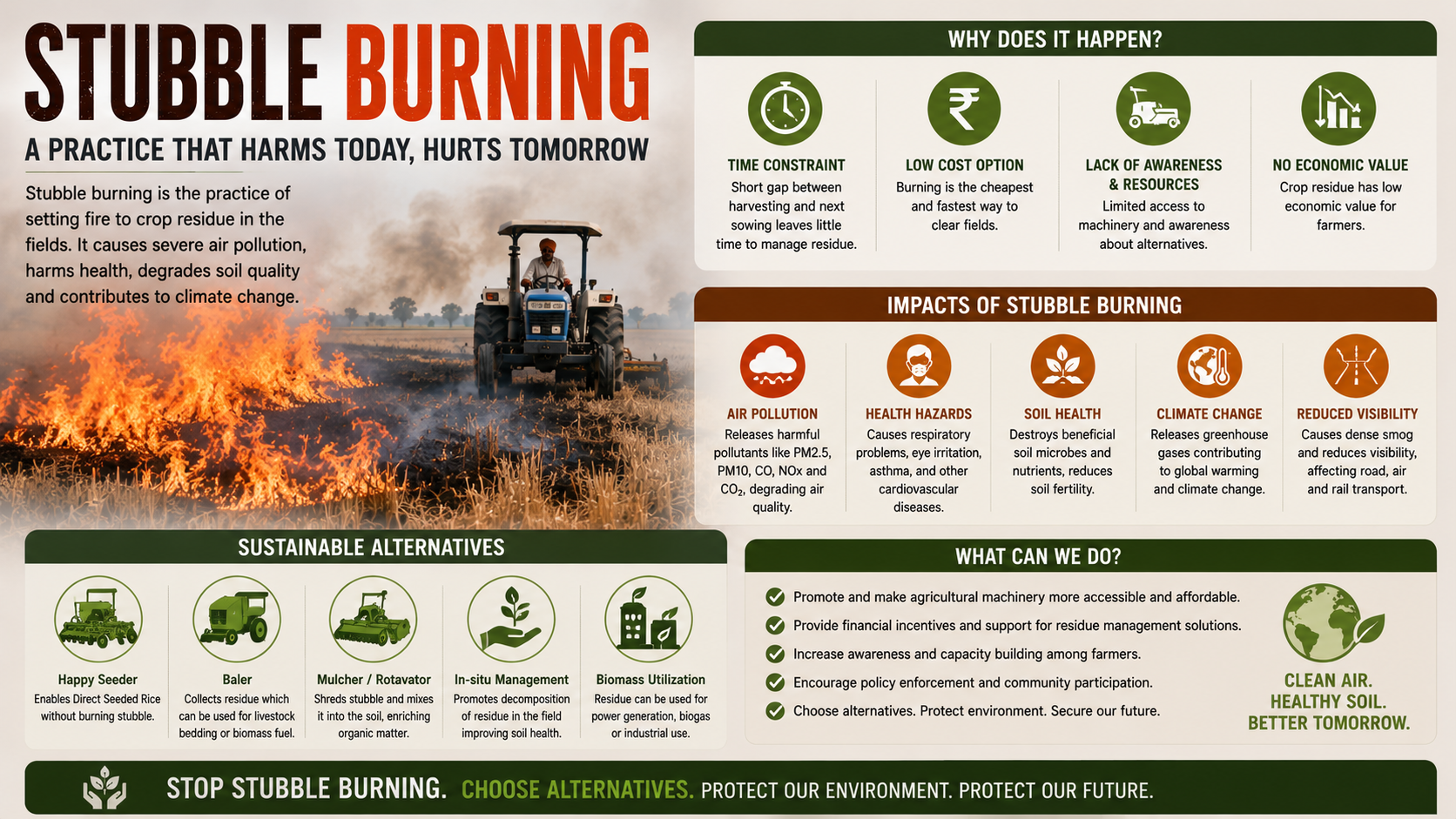
Stubble burning is the practice of burning the leftover crop residue (chaff/straw) remaining in agricultural fields after harvesting.
It is highly prevalent in Punjab, Haryana, and Uttar Pradesh during October and November, despite being a punishable offense under the Air (Prevention and Control of Pollution) Act of 1981.
Tight Sowing Timeline: A brief 20–25 days gap between paddy harvest and wheat sowing drives farmers to use fire for rapid field clearance.
High Machinery Costs: Expensive rental and fuel for equipment like the Happy Seeder make burning the most economical choice for marginal farmers.
Post-Harvest Residue: Combine harvesters leave tall, rooted stubble that is too labor-intensive and costly to remove manually.
Inedible Rice Straw: High silica content in non-basmati straw makes it unsuitable for cattle fodder, unlike wheat straw.
MSP and Crop Bias: The Minimum Support Price (MSP) favors the wheat-paddy cycle, discouraging shifts to crops with less residue.
Infrastructure Gaps: Lack of Custom Hiring Centres (CHCs), storage, and supply chains hinders sustainable ex-situ residue management.
Air Pollution and Smog: Burning releases toxic pollutants like PM2.5, CO, VOCs, and NOx, creating dense smog and degrading air quality.
Climate Change: It emits greenhouse gases and black carbon, trapping heat and accelerating glacier melt.
Soil Degradation: Intense heat destroys key soil nutrients (nitrogen, phosphorus, potassium), harming long-term fertility.
Health Risks: Particulate matter and gases increase risks of respiratory diseases like asthma, and lung cancer.
Microbial Loss: Fire kills beneficial bacteria and fungi while reducing moisture, potentially increasing harmful pests.
Economic Waste: Valuable biomass is destroyed instead of being used for fertilizers, fodder, or bioenergy.
Agricultural Machinery Subsidies: The Sub-Mission on Agricultural Mechanization offers 50% subsidies to farmers and 80% to Custom Hiring Centres (CHCs) for in-situ management equipment.
Pusa Bio-Decomposer Deployment: Authorities utilize Pusa Bio-decomposer, a fungi-based microbial solution, to quickly convert crop residue into field organic compost.
CAQM Mandates and Co-firing: The Commission for Air Quality Management (CAQM) enforces in-situ and ex-situ plans, including co-firing paddy straw biomass pellets in thermal plants and kilns.
Crop Diversification Incentives: States like Haryana provide cash support for crop diversification and direct rice seeding to reduce traditional paddy cultivation residue.
Enforcement and Penalties: Compliance is logged via monitoring portals, village-level nodal officers, and the collection of environmental compensation fines.
Ex-Situ Industrial Markets: Policies promote converting waste into compressed biogas (CBG), 2G ethanol, and packaging to create alternative income streams.
Inaccurate Satellite Tracking: Polar-orbiting satellites pass midday, missing 90% of farm fires as farmers delay burning until late afternoon. (Source: iFOREST)
Ex-Situ Management Costs: Even with community models, ex-situ baling remains roughly 48% to 67% more expensive than burning, making it financially unsustainable. (Source: CII-ITC-CESD Report)
Partial Burning Habits: Half of large-scale farmers use partial burning before in-situ management to manage heavy straw, sustaining high emissions.
CHC Logistics: Custom Hiring Centres (CHCs) fail to meet the extreme machinery demand during the short 25-day harvest window.
Vague Regulation: Punitive measures and complex compliance (e.g., Red Entry) discourage cooperation and grassroots enforcement.
Extension Gaps: Poor information leads farmers to fear pests or increased chemical use from mulch, despite soil benefits.
MSP for Paddy Residue: Implement a pre-Kharif Minimum Support Price (MSP) to cover transport and collection costs, providing straw with direct economic value.
Torrefaction Technology: Use torrefaction to convert rice straw into high-energy fuel for coal-equivalent co-firing in power plants.
Geostationary Satellite Monitoring: Replace polar satellites with geostationary data and burnt-area mapping to track late-afternoon fires and predict air quality.
Subsidized Machinery Models: Fully subsidize Custom Hiring Centres (CHCs) to provide Happy Seeders and balers to marginal farmers free of rental costs.
Build Logistics Infrastructure: Establish interim biomass storage within 20–50 km of farms to link rural supply with industrial users.
Incentivize Diversification: Use subsidies to promote short-duration paddy and alternate crops like maize to extend the harvest window.
Create Value-Added Products: Develop "Rice Bio Parks" to employ youth in converting residue into biochar, biofuel, and organic fertilizer.
Enhance Communication: Launch university-led campaigns to debunk myths about nitrogen immobilization and pests in mulched fields.
To end stubble burning, India must shift from penalties to an incentive-based bio-economy that ensures an MSP for residue, expands machinery networks, and adopts technologies like bio-decomposers and torrefaction.
Source: PIB
|
PRACTICE QUESTION Q. Analyze the multifaceted impacts of stubble burning on both air pollution and soil fertility. Suggest sustainable ex-situ and in-situ management techniques to address this crisis. 150 words |
Stubble burning is the intentional burning of leftover paddy straw to quickly prepare the fields for wheat sowing due to a short 25-day turnaround window.
The practice emits massive quantities of greenhouse gases, PM2.5, and black carbon, contributing to severe Delhi smog, while simultaneously destroying essential soil microbes and nutrients.
The Pusa Bio-Decomposer is a fungi-based microbial solution developed to rapidly soften hard stubble and convert it into organic compost within the field.



© 2026 iasgyan. All right reserved