Stubble burning highlights a structural crisis where limited time and high machinery costs force farmers into a "matchstick solution," necessitating a shift toward "waste-to-wealth" models and direct financial incentives.
Madhya Pradesh leads in wheat stubble burning with a 30% increase, accounting for 69% of reported incidents due to higher production and reliance on combine harvesters.
|
Read all about: STUBBLE BURNING IN INDIA: CAUSES, IMPACTS, AND SOLUTIONS |
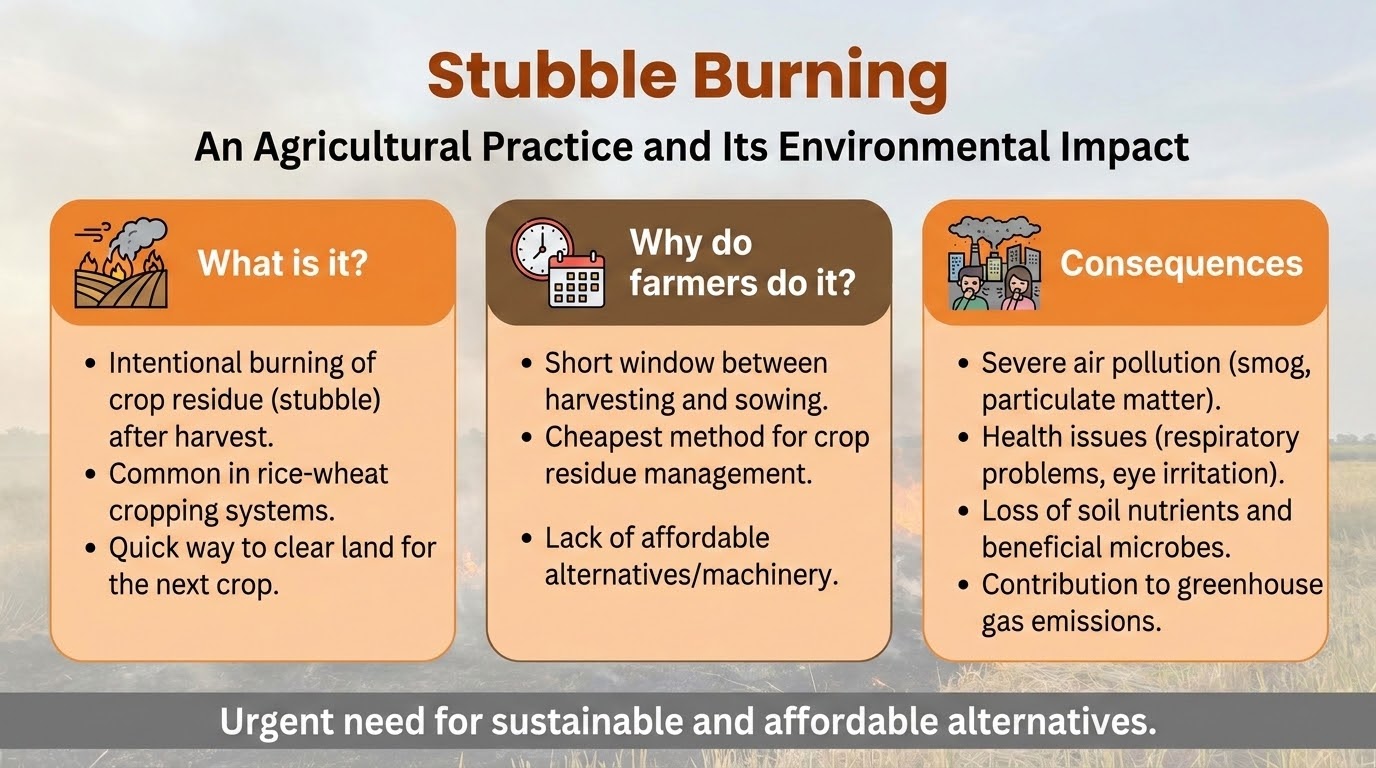
Stubble burning is the deliberate setting on fire of the straw stubble (residue) that remains after grains like wheat or paddy have been harvested.
Why is it practiced?
Despite the environmental costs, farmers continue this practice for several pragmatic reasons:
Historically centered in the Punjab-Haryana-NCR belt during winter paddy burning, the stubble crisis is expanding to Central India (MP and UP) with summer wheat burning.
Changing Harvesting Methods: Increased use of Combine Harvesters in Madhya Pradesh creates massive loose residue unlike traditional manual methods.
"Rice-Wheat" Monoculture: MSP policies promote continuous cropping, leaving insufficient time for natural stubble decomposition.
Labour Deficit: High rural labour costs make manual stubble removal unaffordable for smaller farmers.
Poor Ex-Situ Management: Existing supply chains for Bio-Ethanol or compressed biogas (CBG) are currently too weak to handle MP's residue volume.
Weather Factors: The 2026 summer heatwave dried stubble excessively, leading to faster-spreading and uncontrollable fires.
Lack of Secondary Market: Central India lacks established supply chains to sell wheat straw to industries, treating it as waste rather than an asset.
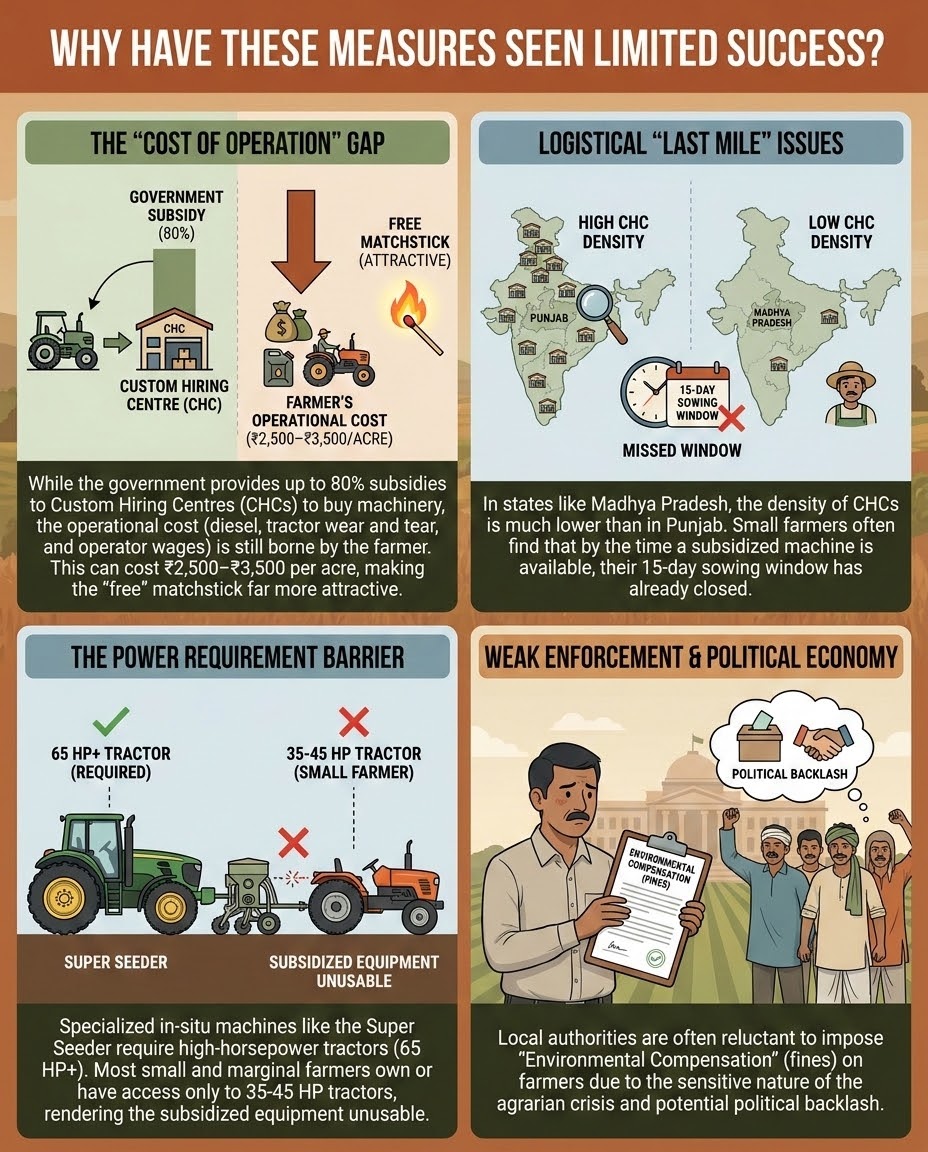
Small Landholdings: Since 85% of Indian farmers are small-scale, they lack capital for specialized machinery like "Super Seeders," despite available subsidies.
Loss of Soil Fertility: Fires penetrate the top 1 cm of soil, heating it to 33.8–42.2 °C. This eradicates microorganisms and earthworms while destroying NPK nutrients. Burning 1 tonne of straw wastes approximately 5.5 kg of Nitrogen and 25 kg of Potassium. (Source: Indian Agricultural Research Institute)
Greenhouse Gas Emissions: Stubble burning emits Carbon Dioxide (CO2), Methane (CH4), and Nitrous Oxide (N2O). Burnt straw releases roughly 1,460 kg of CO2 per tonne. (Source: Indian Biogas Association)
Global Warming: Fires release Black Carbon (soot), which absorbs solar energy and accelerates Himalayan glacier melting.
Water Retention Loss: Burning destroys humus, making soil less porous and reducing water absorption. This causes groundwater depletion due to increased irrigation needs.
Public Health Impact
The smoke from stubble burning is a toxic cocktail of Particulate Matter (PM2.5 and PM10), Carbon Monoxide (CO), and Polycyclic Aromatic Hydrocarbons (PAHs).
Respiratory & Cardiovascular Diseases: Inhalation of PM2.5 leads to aggravated asthma, chronic bronchitis, and decreased lung function.
Vulnerability of Children: Children in rural burning zones face a higher risk of cognitive developmental delays and stunted lung growth.
Economic Consequences
Health Expenditure Costs: Air pollution from crop burning causes an annual economic loss of $30 billion in North India alone due to increased health costs and loss of productivity. (Source: International Food Policy Research Institute)
Increased Input Costs for Farmers: Because burning depletes soil nutrients, farmers are forced to buy more chemical fertilizers to maintain yields, creating a vicious cycle of debt and soil degradation.
Impact on Transportation: Thick smog reduces visibility, leading to highway accidents and delays in rail and air travel, disrupting logistics and trade chains.
Technical & In-Situ Management (On-field)
Crop Residue Management (CRM) Scheme: This Central Sector Scheme offers 50% subsidy to farmers and 80% to Custom Hiring Centres for machinery like Happy Seeders and Mulchers.
Pusa Decomposer: Developed by Indian Agricultural Research Institute (IARI), this microbial consortium decomposes stubble into manure in 20-25 days.
Ex-Situ Management (Off-field)
Biomass Co-firing: The Ministry of Power has mandated that thermal power plants must use a 5-10% blend of biomass pellets (made from agricultural residue) alongside coal.
SATAT Scheme: The "Sustainable Alternative Towards Affordable Transportation" initiative encourages setting up Compressed Bio-Gas (CBG) plants using crop residue as feedstock.
Legal & Monitoring Measures
Satellite Monitoring: The IARI-CREAMS platform utilizes NASA and ISRO data to send real-time fire alerts to state authorities.
Legal Penalties: Illegal under the Air (Prevention and Control of Pollution) Act, 1981, the National Green Tribunal (NGT) mandates fines between ₹2,500 and ₹15,000 depending on land size.
CAQM Guidelines: The Commission for Air Quality Management enforces strict NCR-specific rules, though its regional jurisdiction limits national impact.
 What Are the Possible Sustainable Solutions?
A transition from "Penalty" to "Profit" is required to change farmer behavior.
Incentivizing the "Retention" of Residue
Developing a "Waste-to-Wealth" Supply Chain (Ex-Situ)
Crop Diversification
Technological Scaling of Pusa Decomposer
Integrated Farming Systems (IFS)
The surge of stubble burning proves that until agricultural residue is transformed from a disposable waste into a tradable commodity through industrial linkages and direct incentives, the "matchstick solution" will continue to undermine soil health and air quality.
Source: THEHINDUBUSINESSLINE
|
PRACTICE QUESTION Q. The shifting geography of stubble burning from the Northwest to Central India indicates that the problem is rooted in agricultural economics rather than regional culture. Discuss. 150 words |
Stubble burning is the intentional setting of fire to crop residue (stalks and roots) left after harvesting. Farmers in North India practice it to quickly and cheaply clear their fields for the next sowing cycle, as the window between harvesting paddy (Kharif) and sowing wheat (Rabi) is extremely narrow, often just 15 to 20 days.
Developed by the Indian Agricultural Research Institute (IARI), the Pusa Decomposer is an innovative microbial spray. It accelerates the natural breakdown of stubble, converting it into organic manure right on the field within 15-20 days, thereby eliminating the need to burn the residue.
In-situ (on-field) management involves dealing with the stubble where it lies using heavy machinery like Happy Seeders or Super Seeders to incorporate it back into the soil. Ex-situ (off-field) management involves collecting, baling, and transporting the straw away for industrial uses, such as producing bio-ethanol, bio-CNG, or biomass pellets for power plants.



© 2026 iasgyan. All right reserved