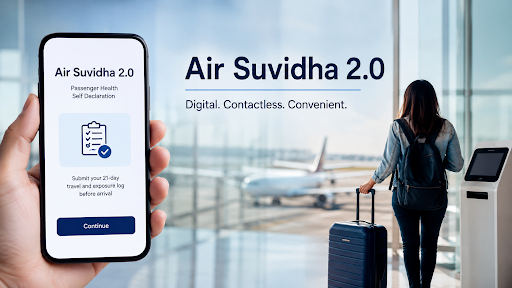
India launches AIR SUVIDHA 2.0 to conduct real-time, contactless health screening of international passengers. Driven by the WHO's declaration of the Bundibugyo Ebola outbreak as a global emergency, the portal captures 21-day travel histories to seamlessly intercept infected travelers at entry points.
Why In News?
The Ministry of Civil Aviation and Delhi International Airport Limited (DIAL) launched the AIR SUVIDHA 2.0 digital portal, to enforce real-time, contactless health screening of international passengers.
What is Air Suvidha 2.0?
Air Suvidha 2.0 is an upgraded, contactless, and paperless health self-declaration portal launched by the Indian government for international arrivals.
The government repurposes the original 2020 COVID-19 portal, upgrading it to target the specific epidemiology of the Ebola virus.
Core Objectives: The system automates the screening of international travelers, prevents cross-border transmission of infectious diseases, and identifies at-risk individuals without creating immigration bottlenecks.
Operational Mechanism: It functions as a mandatory, paperless Passenger Health Self-Declaration web portal, requiring all arrivals to submit health and travel logs before clearing immigration.
Why was Air Suvidha 2.0 Introduced?
Ebola Outbreak Preparedness: The World Health Organization (WHO) declared the Bundibugyo Virus Disease (BVD) outbreak in the Democratic Republic of the Congo (DRC) and Uganda a Public Health Emergency of International Concern (PHEIC).
International Health Regulations (IHR) 2005: The portal aligns India’s border policies with the IHR 2005, which mandates that 196 member countries proactively detect and respond to public health risks.
Public Health Protection: Authorities designate countries bordering the DRC and Uganda, including South Sudan, as high-risk zones, allowing the government to intercept asymptomatic carriers before they enter the general population.
Key Features
Online Health Self-Declaration: Passengers complete the Self-Declaration Form (SDF) online up to 24 hours before arrival, providing a mandatory 21-day travel history and symptom mapping.
Risk-Based Passenger Screening: The Airport Health Organization (APHO) categorizes travelers into three tiers:
Real-Time Data Integration: The platform streams health logs to the APHO, the Bureau of Immigration, the Integrated Disease Surveillance Programme (IDSP), and the National Centre for Disease Control (NCDC).
Contactless Validation: Passengers present a digital PDF or QR code at the International Travel Health Desk, eliminating the need for physical paper forms.
About Ebola Virus Disease (EVD)
The Bundibugyo ebolavirus (BDBV), a species of the Orthoebolavirus genus, causes the outbreak with an estimated case fatality rate of 25% to 50%.
First identified in 1976 in Central Africa, it is a zoonotic disease that jumps from natural reservoirs (fruit bats) to humans, spreading further through direct contact with infected bodily fluids.
The disease gets its name from the Ebola River in the Democratic Republic of Congo (DRC), where the initial 1976 outbreak occurred.
Symptoms: Incubation takes 2 to 21 days, followed by fever, fatigue, and pain, progressing to vomiting, diarrhea, and hemorrhaging.
Treatment: Focuses on early supportive care to manage symptoms. Specific treatments like vaccines and monoclonal antibodies (e.g., Inmazeb, Ebanga) are used for certain strains.
Source: NDTV
|
PRACTICE QUESTION Q. Consider the following statements regarding the AIR SUVIDHA 2.0 portal: 1. It is jointly launched by the Ministry of Health and Family Welfare and the World Health Organization (WHO). 2. It requires incoming international passengers to declare a 21-day travel history, matching the incubation period of the Ebola virus. 3. It shares passenger data in real-time with the Integrated Disease Surveillance Programme (IDSP). Which of the statements given above is/are correct? (a) 1 and 2 only (b) 2 and 3 only (c) 1 and 3 only (d) 1, 2, and 3 Answer: (b) Explanation: Statement 1 is incorrect: AIR SUVIDHA 2.0 was launched by the Ministry of Civil Aviation in collaboration with Delhi International Airport Limited (DIAL) and developed with the Directorate General of Health Services (DGHS) under the Ministry of Health and Family Welfare. Statement 2 is correct: Passengers arriving from or transiting through Ebola-affected countries must declare a detailed 21-day travel and exposure history. This duration aligns perfectly with the 2 to 21-day incubation period of the Ebola/Bundibugyo virus. Statement 3 is correct: The portal is equipped with an integrated multi-agency data pipeline that automatically shares passenger data in real-time with the Airport Health Officer, Bureau of Immigration, State Surveillance Officers, and the Integrated Disease Surveillance Programme (IDSP) to allow for rapid medical referrals. |



© 2026 iasgyan. All right reserved