The global order is shifting from US unipolarity to a fluid multipolar system shaped by US–China rivalry. The United States refocuses strategy, China expands influence, and Russia plays a revisionist swing role. For India, multi-alignment remains essential to preserve strategic autonomy.
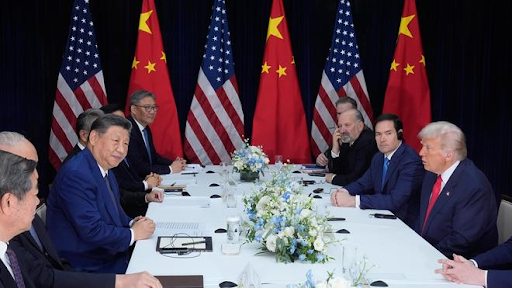
Copyright infringement not intended
Picture Courtesy: THEHINDU
The global order is shifting from US-led unipolarity to a multipolar system shaped mainly by intense US–China rivalry, giving it clear bipolar characteristics despite multiple power centres.
|
Read all about: INDIA'S STRATEGIC AUTONOMY IN A MULTIPOLAR WORLD l MULTI-POLAR WEST: OPPORTUNITY FOR INDIA l INDIA IN AN UNCERTAIN WORLD: CHALLENGES AND WAY FORWARD l |
The post-Cold War era of a "unipolar moment," characterized by uncontested American dominance, has definitively ended.
The contemporary international system is best described as a multipolar world with distinctly bipolar characteristics.
Nations like the US, China, Russia, the EU, India, and Japan constitute multiple power centers, however, global geopolitics competition is escalating between the United States and China.
Unlike the rigid ideological blocs of the Cold War, this new order is more fluid, with nations navigating the US-China rivalry rather than being locked into fixed alliances.
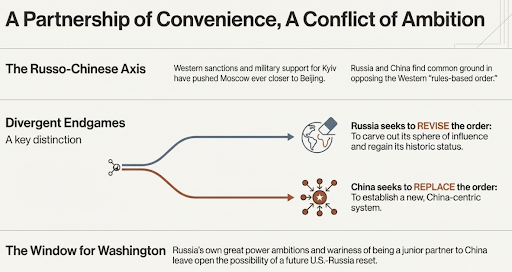
The current global order is largely shaped by the strategic actions of the United States, China, and Russia. Each power is pursuing distinct objectives to secure its interests in this competitive environment.
United States: Strategic Competition and Alliance Realignment
Washington is moving from a "global policeman" role to a focused strategy of countering its main geopolitical rivals. Key aspects include:
China: Reshaping the Global Order
Beijing systematically uses its economic power to boost military and geopolitical influence, seeking a Sino-centric world order. Its strategy includes:
Russia: The Revisionist "Swing Power"
Despite economic limitations, Russia uses its significant military, nuclear, and energy power to challenge the security structure and project influence. Its role is defined by:
Rise of Middle Powers and "Fluid" Geopolitics
The global order is now "fluid" due to middle powers' rising influence and autonomy. Unlike the Cold War, countries avoid rigid blocs, adopting flexible foreign policies to prioritize their own interests.
India has responded to the complex global order by moving from a policy of non-alignment to a more proactive and dynamic strategy of "multi-alignment" or "strategic autonomy."
This approach allows India to engage with multiple power centers based on its national interests, rather than being confined to a single camp.
Multi-Alignment in Action: Case Study
Navigating Competing Blocs
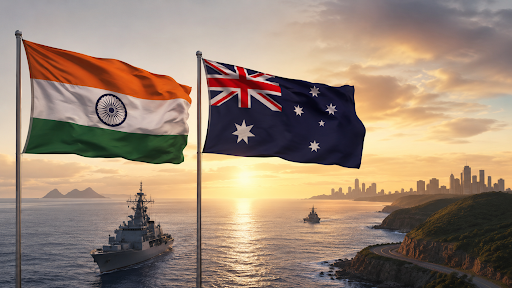
India is a vital member of the Quadrilateral Security Dialogue (Quad) with the US, Japan, and Australia, which is largely seen as a counter to China's influence.
Simultaneously, it remains a key player in the Shanghai Cooperation Organisation (SCO) and BRICS, platforms where China and Russia are dominant.
Independent Stance on Ukraine
India holds a principled, independent stance on the Russia-Ukraine conflict, supporting sovereignty and territorial integrity while abstaining from UN votes condemning Russia and avoiding Western sanctions.
This approach protects long-standing defense and energy ties with Moscow while urging diplomacy.
Promoting Alternative Connectivity
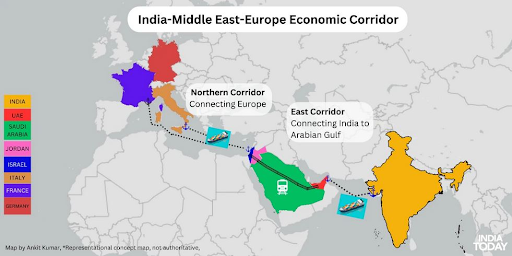
India supports the India-Middle East-Europe Economic Corridor (IMEC), which was announced at the 2023 G20 Summit.
IMEC is a transparent and viable alternative to China’s Belt and Road Initiative (BRI), it aims to enhance connectivity and economic integration between Asia, the Gulf, and Europe.
The world is in a volatile geopolitical transition, marked by central US-China competition within a multipolar structure. Old certainties are gone, and new rules are emerging.
India should pursue multi-alignment, strengthening its comprehensive national power (economic, military, diplomatic) rather than choosing sides.
India can cement its role as a leading 21st-century power by effectively navigating the new world order through diverse, issue-based coalitions and strategic autonomy.
Source: THEHINDU
|
PRACTICE QUESTION Q. India's shift from a policy of non-alignment to 'multi-alignment' is a pragmatic response to contemporary geopolitical realities. Elaborate (250 words) |
The new global order is shifting from the post-Cold War unipolar moment (US-dominated) to a complex multipolar system with bipolar characteristics. Multiple major powers exist (US, China, Russia, EU, India), but US-China strategic competition is the central organizing feature.
Non-alignment was a Cold War policy of distance from the US/USSR blocs. Multi-alignment is a modern, proactive strategy where India actively engages with multiple competing powers and groups simultaneously to maximize strategic options and national interests.
Russia is termed a 'swing power' due to its ability to decisively influence the Eurasian power balance, despite economic weakness relative to the US and China. Its influence stems from a formidable military, nuclear capability, and strategic location. Although currently aligned with China against the US-led order, its great power aspirations suggest potential future realignments, maintaining its pivotal role.

© 2026 iasgyan. All right reserved