India has launched the world's first hydrogen production facility driven by nuclear process heat at IGCAR, Kalpakkam. Utilizing the Copper-Chlorine thermochemical cycle and the Fast Breeder Test Reactor, it pioneers round-the-clock, carbon-free "pink hydrogen" for hard-to-abate industries.
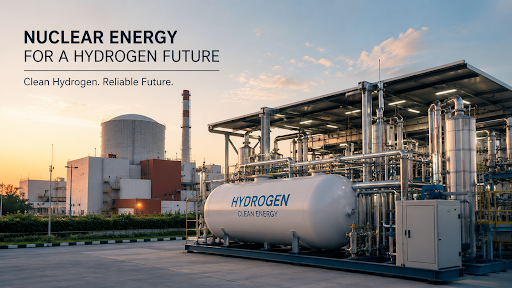
The Department of Atomic Energy inaugurated the world’s first hydrogen production facility utilizing nuclear process heat from the Fast Breeder Test Reactor (FBTR) at IGCAR, Kalpakkam.
Strategic Location: The plant operates at the Indira Gandhi Centre for Atomic Research (IGCAR) in Kalpakkam, Tamil Nadu, leveraging existing nuclear infrastructure.
Indigenous Development: The Bhabha Atomic Research Centre (BARC) developed the core Copper-Chlorine (Cu-Cl) thermochemical cycle, while IGCAR engineered the reactor interface.
Reactor Coupling: The facility links the 40 MWt Fast Breeder Test Reactor (FBTR) directly to a chemical plant, utilizing reactor heat instead of external electricity.
Technology: The pilot plant gathers operational data and optimizes processes for future commercial-scale deployment alongside the 500 MWe Prototype Fast Breeder Reactor (PFBR).
Safety Protocols: Engineers utilize an intermediate heat exchanger to physically isolate the chemical plant from the nuclear core, preventing cross-contamination.
Direct Heat Utilization: The facility taps thermal energy from the FBTR’s liquid sodium coolant, operating at 500°C to 530°C, to drive chemical reactions.
Cu-Cl Thermochemical Cycle: A closed-loop system reacts with water with copper and chlorine compounds. Heat breaks down water into hydrogen and oxygen while recycling the chemical agents.
Zero Emissions: The process relies on nuclear fission heat, ensuring zero carbon dioxide release compared to fossil-fuel-based methods.
Efficiency Gains: The electrochemical step requires only 0.5 to 1.0 volts, significantly lower than the 1.23 volts needed for conventional electrolysis.
Thermodynamic Superiority: By bypassing electricity conversion, the system achieves expected efficiencies of 40-50%.
Grey Hydrogen: Extracted from natural gas or coal via steam methane reforming; it accounts for over 90% of global production and releases high CO2.
Blue Hydrogen: Produced from fossil fuels but utilizes Carbon Capture and Storage (CCS) to trap greenhouse gases.
Green Hydrogen: Generated by splitting water using electricity from renewable sources like solar or wind.
Pink (Nuclear) Hydrogen: Produced via electrolysis or thermochemical cycles powered strictly by nuclear energy.
Yellow and Brown Hydrogen: Yellow hydrogen utilizes solar-specific or mixed-grid nuclear power, while brown hydrogen involves gasifying polluting lignite coal.
Clean Energy Transition: It provides a continuous, scalable alternative to weather-dependent green hydrogen.
Decarbonizing Heavy Industry: Clean hydrogen replaces carbon-heavy feedstocks in petroleum refining, steel manufacturing, and green ammonia production.
Energy Security: Scaling nuclear hydrogen reduces India’s dependence on imported energy, which currently costs approximately $90 billion annually.
Technological Leadership: India leapfrogs global competitors like the USA, Japan, and South Korea by moving beyond laboratory-scale testing.
Export Potential: Mastering pink hydrogen positions India as a global exporter of Green Methanol and Green Ammonia.
National Green Hydrogen Mission: The government targets an annual production capacity of 5 Million Metric Tonnes (MMT) by 2030.
Net-Zero Commitment: This technology supports India’s Panchamrit pledge to achieve net-zero carbon emissions by 2070.
Hydrogen Economy: The state plans to establish "Hydrogen Highways" to support Fuel Cell Electric Vehicles (FCEVs).
SIGHT Programme: The Strategic Interventions for Green Hydrogen Transition (SIGHT) initiative provides financial subsidies for domestic electrolyzer manufacturing.
Source: newsonair
|
PRACTICE QUESTION Q. In the context of clean energy transition, "Pink Hydrogen" refers to: A) Hydrogen extracted from natural gas using Carbon Capture and Storage (CCS) technologies. B) Hydrogen generated by electrolyzing water using power strictly from solar and wind farms. C) Hydrogen produced through electrolysis or thermochemical cycles powered exclusively by nuclear energy. D) Hydrogen extracted from lignite coal gasification with added chemical colorants for safety tracing. Answer: C Explanation: Pink hydrogen is generated using nuclear power (either via electricity for electrolysis or process heat for thermochemical cycles). Grey is from fossil fuels, Blue uses fossil fuels with CCS, Green uses renewables, and Brown utilizes lignite. |
Pink hydrogen is clean, zero-emission hydrogen gas produced by splitting water using nuclear energy as the primary source of power.
While green hydrogen relies on variable solar or wind electricity to run standard water electrolysers, nuclear-powered pink hydrogen utilizes constant 24/7 baseload atomic energy, allowing facilities to bypass electricity grid conversion altogether by harnessing high-temperature nuclear process heat directly to split water.
The Indira Gandhi Centre for Atomic Research (IGCAR) in Kalpakkam achieved a historic global milestone on June 26, 2026, by commissioning the world's first hydrogen production plant powered by nuclear process heat, integrating the Fast Breeder Test Reactor (FBTR) with an indigenously developed Copper-Chlorine (Cu-Cl) thermochemical cycle to split water with extreme thermodynamic efficiency at 500°C.
Hydrogen serves as the ultimate decarbonisation tool to meet India's net-zero emissions target by 2070 by replacing fossil fuels in heavily polluting, hard-to-abate sectors like steel manufacturing, chemical refining, and long-haul shipping where direct battery electrification is not technically viable.

© 2026 iasgyan. All right reserved