India’s PFBR at Kalpakkam has achieved criticality, launching Stage II of its nuclear programme. By using MOX fuel and liquid sodium to breed more fuel than consumed, this milestone secures strategic energy autonomy and a path toward Net-Zero 2070.
Why In News?
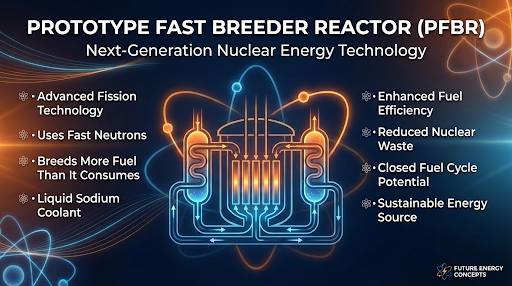
India's 500 MWe Prototype Fast Breeder Reactor (PFBR) at Kalpakkam, Tamil Nadu, successfully achieved criticality.
What is Fast Breeder Reactor (FBR) Technology?
A Fast Breeder Reactor (FBR) is an advanced category of nuclear reactor designed to produce more fuel than it consumes while generating electricity.
Key Working Principles
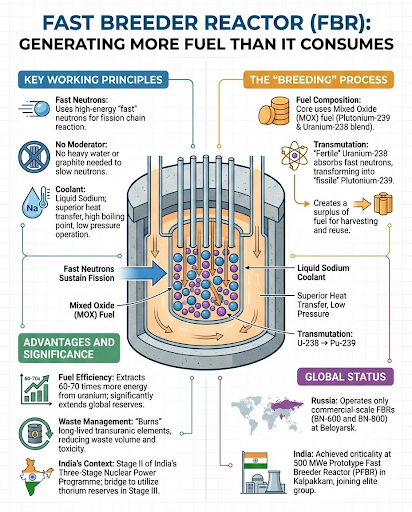
Fast Neutrons: Unlike conventional reactors that use "thermal" (slow) neutrons, FBRs use high-energy "fast" neutrons to sustain the fission chain reaction.
No Moderator: Because they rely on fast neutrons, FBRs do not require a moderator like heavy water or graphite to slow down neutrons.
Coolant: They use Liquid Sodium as a coolant due to its superior heat transfer properties and high boiling point, which allows the reactor to operate at low pressure.
The "Breeding" Process
Fuel Composition: The core generally uses Mixed Oxide (MOX) fuel, a blend of Plutonium-239 and Uranium-238.
Transmutation: During operation, the "fertile" Uranium-238 atoms absorb fast neutrons and transform into "fissile" Plutonium-239. This creates a surplus of fuel that can be harvested and reused.
Advantages
Fuel Efficiency: FBRs can extract up to 60-70 times more energy from uranium than traditional reactors, extending the life of global uranium reserves.
Waste Management: These reactors can "burn" long-lived radioactive transuranic elements, effectively reducing the volume and toxicity of nuclear waste.
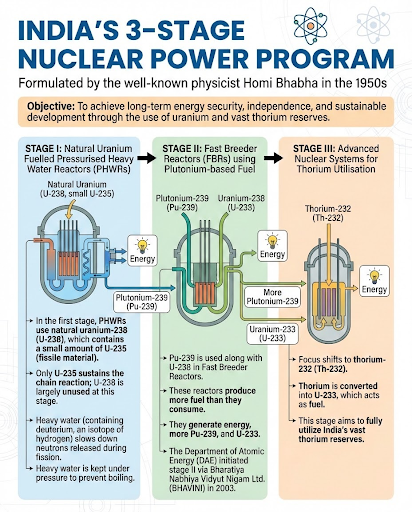
FBRs represent Stage II of India’s Three-Stage Nuclear Power Programme, acting as a bridge to utilize India's massive thorium reserves in Stage III.
Global Status
Russia currently operates the only commercial-scale FBRs (BN-600 and BN-800) at the Beloyarsk Nuclear Power Plant.
India recently achieved criticality at its 500 MWe Prototype Fast Breeder Reactor (PFBR) in Kalpakkam, joining an elite group of nations with this technology.
Source: PIB
|
PRACTICE QUESTION Q. Consider the following statements regarding the Prototype Fast Breeder Reactor (PFBR): 1. It uses water as a moderator to slow down fast neutrons. 2. It uses a Mixed Oxide (MOX) fuel consisting of Plutonium-239 and Uranium-238. 3. It generates more fissile material than it consumes during its operation. Which of the statements given above is/are correct? a) 1 and 2 only b) 2 and 3 only c) 1 and 3 only d) 1, 2, and 3 Answer: b Explanation: Statement 1 is incorrect: Fast Breeder Reactors (FBRs) are specifically designed to use fast neutrons to sustain the nuclear chain reaction. Using water (or any other moderator) would slow down these neutrons into "thermal" neutrons, which is counterproductive for the "breeding" process. Statement 2 is correct: The PFBR uses Mixed Oxide (MOX) fuel, which is a blend of Plutonium-239 (the fissile component that provides the energy) and Uranium-238 (the fertile component that eventually turns into more fuel). Statement 3 is correct: This is the defining characteristic of a "breeder" reactor. During operation, the Uranium-238 in the fuel blanket absorbs neutrons and transmutes into Plutonium-239. The reactor is designed so that it produces (breeds) more fissile material than it consumes as fuel. |
Criticality is the state in which a nuclear reactor sustains a stable, controlled chain reaction. It means that every nuclear fission event produces exactly enough neutrons to trigger the next set of fissions, ensuring a steady, continuous release of energy without needing an external trigger.
Conventional reactors use "slow" or thermal neutrons that are slowed down by moderators like heavy water. An FBR uses unmoderated, "fast" neutrons. An FBR generates (or "breeds") more fissile nuclear fuel than it consumes by converting non-fissile materials (like Uranium-238) into fissile materials (like Plutonium-239).
Liquid sodium is chosen because it has exceptional heat transfer properties and, crucially, does not slow down (moderate) fast-moving neutrons. Fast neutrons are strictly required for the breeding process to occur in the reactor.



© 2026 iasgyan. All right reserved