The Price Support Scheme (PSS), a core component of the PM-AASHA framework, empowers central agencies like NAFED and NCCF to procure pulses, oilseeds, and copra at MSP. It protects farmers from distress sales during price crashes while promoting crop diversification and domestic self-sufficiency.
The Union Government approves large-scale procurement of pulses and oilseeds under the Price Support Scheme (PSS) across Uttar Pradesh, Gujarat, Haryana, and Tamil Nadu.
It is implemented by the Department of Agriculture & Cooperation under the umbrella scheme “PM-AASHA” (Pradhan Mantri Annadata Aay Sanrakshan Abhiyan), launched in 2018.
Core Objective: The PSS safeguards farmers from drastic price fluctuations caused by market asymmetry and monsoon volatility.
Economic Incentive: The scheme provides remunerative prices to farmers, directly encouraging higher investment in agriculture and boosting overall productivity.
Nodal Agencies: The National Agricultural Cooperative Marketing Federation of India (NAFED) serves as the central nodal agency, while the Food Corporation of India (FCI) conducts operations in designated states and districts.
Procurement Mechanism: Agencies purchase commodities directly from farmers at the Minimum Support Price (MSP) when market rates fall below this threshold.
Quality Standards: Procurement adheres to Fair Average Quality (FAQ) norms to ensure market stability.
Financial Responsibility: The Central Government bears all procurement expenditures and losses incurred during operations.
Key Features of PSS
MSP Procurement: Procurement triggers when the market price of Fair Average Quality (FAQ) stocks drops at or below the centrally declared Minimum Support Price (MSP).
Operational Duration: Central Nodal Agencies continue procurement until market prices stabilize above the MSP or the 90-day harvesting period concludes.
Procurement Caps: The government caps procurement of notified pulses, oilseeds, and copra at 25% of national production, though it removes this ceiling entirely for Tur, Urad, and Masur for the 2024-25 season to reduce import reliance.
Digital Integration: The scheme mandates direct procurement via transparent digital platforms, specifically NAFED’s eSamridhi portal and NCCF’s eSamyukti portal.
Sovereign Guarantee: The government enhances the sovereign guarantee to ₹45,000 crore to facilitate massive procurement operations
Source: PIB
|
PRACTICE QUESTION Q. Consider the following statements regarding the Price Support Scheme (PSS) in India:
Which of the statements given above is/are correct? (a) 1 and 2 only (b) 2 and 3 only (c) 1 and 3 only (d) 1, 2, and 3 Answer: (b) Explanation: Statement 1 is incorrect: Under the Price Support Scheme (PSS), the procurement of notified pulses and oilseeds is subject to a specific ceiling limit, which is capped at 25% of the total production of that particular crop in a state. There is no 100% mandated procurement ceiling. Statement 2 is correct: The National Agricultural Cooperative Marketing Federation of India Ltd. (NAFED) and the National Cooperative Consumers' Federation of India (NCCF) are designated as the central nodal agencies to carry out PSS operations on behalf of the Government. Statement 3 is correct: PSS operations are primarily a price-safety mechanism for farmers. They are triggered and procurement begins only when the market price of Fair Average Quality (FAQ) stocks falls below or is equal to the declared Minimum Support Price (MSP). |
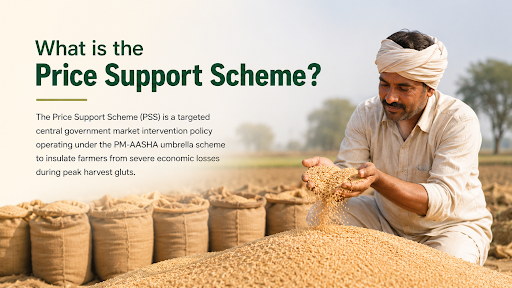
The Price Support Scheme (PSS) is a targeted central government market intervention policy operating under the PM-AASHA umbrella scheme to insulate farmers from severe economic losses during peak harvest gluts.
The PSS links directly to the Minimum Support Price (MSP) by triggering physical crop procurement from pre-registered farmers the exact moment open market wholesale prices plummet below the government-declared floor price.
The PSS specifically covers 16 notified agricultural commodities comprising major pulses (like gram, arhar, moong, urad, and lentil), oilseeds (including groundnut, mustard, soyabean, and sunflower), cotton, and varieties of copra.
The National Agricultural Cooperative Marketing Federation of India (NAFED) acts as the apex central nodal agency responsible for deploying state-level cooperative networks, checking Fair Average Quality (FAQ) standards, and executing direct bank transfers to farmers.



© 2026 iasgyan. All right reserved