The PRAGATI platform, an ICT-based multi-modal system chaired by the Prime Minister, accelerates stalled mega-infrastructure projects and resolves citizen grievances. Utilizing geo-spatial tech and video-conferencing, it strengthens cooperative federalism, recently fast-tracking ₹30,000 crore projects in its 52nd meeting.
Why In News?
Prime Minister Narendra Modi recently chaired the 52nd PRAGATI meeting, where he fast-tracked four major infrastructure projects worth ₹30,000 crore across four states.
What is PRAGATI?
The Prime Minister's Office (PMO) launched the PRAGATI (Pro-Active Governance and Timely Implementation) platform in 2015, in collaboration with the National Informatics Centre (NIC) to eliminate bureaucratic silos and resolve chronic project delays.
Objectives: The platform focuses on three pillars: Project Implementation (accelerating stalled initiatives), Project Monitoring (real-time data tracking), and Grievance Redressal (resolving citizen complaints).
Key Features of PRAGATI
ICT-Based Governance: The platform integrates Digital data management, Video-conferencing, and Geo-spatial mapping, consolidating data from the Project Monitoring Group (PMG) portal and CPGRAMS.
Real-Time Monitoring: The Prime Minister utilizes drone feeds and GPS tracking to monitor ground-level progress, ensuring data aligns with the PM GatiShakti National Master Plan.
Multi-Level Coordination: The system operates via a 3-tier structure involving the Prime Minister, Union Secretaries, and State Chief Secretaries, meeting every fourth Wednesday at 3:30 PM on 'PRAGATI Day'.
Citizen Grievance Redressal: The platform pulls data from CPGRAMS to resolve issues across 36 sectors, including COVID-19 management, banking, insurance, RERA, and cyber fraud.
Significance and Impact
Faster Infrastructure Delivery: The platform has reviewed 3,300 delayed projects worth ₹85 lakh crore. It accelerated 340 high-priority projects valued at $205 billion, contributing to the completion of 50,000 km of National Highways.
Cooperative Federalism: The platform creates a "Team India" space, resolving Centre-State friction regarding resource allocation and project clearances.
Governance Reforms: Out of 7,735 critical issues, the platform resolved 7,156. It triggered systemic reforms, such as the Ministry of External Affairs reducing passport processing time from 16 to 7 days.
Accountability: The prospect of PMO scrutiny forces stakeholders to clear bottlenecks, such as the National Broadband Mission resolving 50% of pending Right-of-Way permissions prior to review.
Conclusion
PRAGATI has transformed digital governance through technology and leadership, accelerating development by resolving bureaucratic delays to improve citizen welfare.
Source: PIB
|
PRACTICE QUESTION Q. Consider the following statements regarding the PRAGATI platform: 1. It is a three-tier system comprising the Prime Minister, Union Ministers, and State Chief Ministers. 2. It completely replaces the CPGRAMS portal for addressing citizen grievances. 3. Meetings under this platform are conventionally held on the fourth Wednesday of every month. Which of the statements given above is/are correct? (a) 1 and 2 only (b) 3 only (c) 2 and 3 only (d) 1, 2, and 3 Answer: (b) Explanation: Statement 1 is incorrect: PRAGATI is indeed a three-tier system, but it comprises the Prime Minister's Office (PMO), Union Government Secretaries, and Chief Secretaries of the States. It does not typically involve Union Ministers or State Chief Ministers directly in the interactive video conferencing sessions; rather, it allows the PM to interact directly with the bureaucratic heads (Secretaries) to bypass silos and expedite implementation. Statement 2 is incorrect: PRAGATI does not replace the CPGRAMS (Centralized Public Grievance Redress and Monitoring System) portal. Instead, it integrates and "rides on" the CPGRAMS database. CPGRAMS remains the primary portal for citizens to lodge grievances, while PRAGATI is used by the Prime Minister to review and select grievances from that database to ensure high-level monitoring and accountability. Statement 3 is correct: The PRAGATI meetings are conventionally held once every month on the fourth Wednesday (known as "PRAGATI Day") at 3:30 PM. |
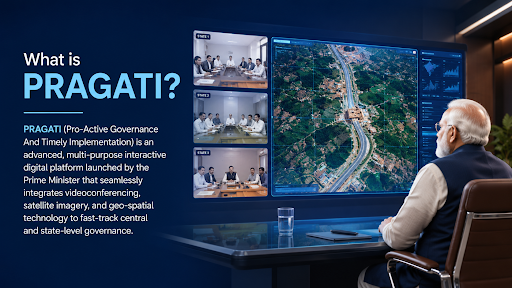
PRAGATI (Pro-Active Governance And Timely Implementation) is an advanced, multi-purpose interactive digital platform launched by the Prime Minister that seamlessly integrates videoconferencing, satellite imagery, and geo-spatial technology to fast-track central and state-level governance.
The platform uniquely aims to dismantle bureaucratic silos, resolve long-pending inter-departmental bottlenecks, monitor mega-infrastructure developments in real-time, and directly address public grievances registered on central databases.
PRAGATI revolutionises governance by enforcing absolute accountability directly from the Prime Minister’s Office, bringing union secretaries and state chief secretaries onto a single screen to eliminate systemic delays, and replacing sluggish paperwork with instant decision-making.
The Prime Minister monitors high-impact, mega-investment projects including national highway expansions, railway corridors, metro rail construction, cross-country oil pipelines, and vital social sector flagship programs like PM-AWAS and PM-KISAN.





© 2026 iasgyan. All right reserved