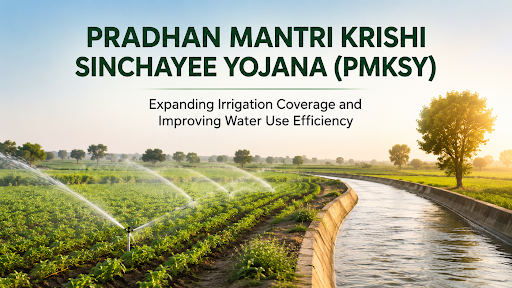
The Pradhan Mantri Krishi Sinchayee Yojana (PMKSY) aims to enhance irrigation coverage and water-use efficiency in India. Through components like AIBP and Har Khet Ko Pani, it ensures farm-level water security, boosts agricultural productivity, and mitigates climate-induced water stress.
Why In News?
Over the past decade, Pradhan Mantri Krishi Sinchayee Yojana (PMKSY) has played a pivotal role in strengthening irrigation infrastructure and promoting efficient water management across India.
What is PMKSY?
It is an umbrella irrigation scheme that integrates water sources, distribution, and precision technology to achieve the goals of "Har Khet Ko Pani" (water for every farm) and "Per Drop More Crop."
Launch Date: The Government of India launches the centrally sponsored scheme on July 1, 2015.
Core Objectives:
Irrigation Coverage: Expands cultivable areas under assured irrigation and bridges the gap between irrigation potential and actual utilization.
Water Efficiency: Enhances on-farm water-use efficiency to minimize wastage.
Sustainable Management: Recharges aquifers, treats wastewater for peri-urban agriculture, and fosters rainwater harvesting (Jal Sanchay).
Key Features and Components
Accelerated Irrigation Benefit Programme (AIBP): Focuses on completing major and medium irrigation projects under the Ministry of Jal Shakti, targeting 30.23 lakh hectares for command area development.
Har Khet Ko Pani: Creates new water sources through minor irrigation (surface and groundwater), targeting 4.5 lakh hectares of irrigation potential.
Watershed Development: Implemented by the Ministry of Rural Development, this component enhances the productivity of rainfed lands, benefiting 1.34 million farmers with ₹12,432.09 crore in central assistance.
Per Drop More Crop (PDMC): Focuses on precision devices like drip and sprinkler systems. Since 2022-23, the government integrates this into the Rashtriya Krishi Vikas Yojana (PM-RKVY), providing 55% financial assistance to small/marginal farmers and 45% to others.
Modernization of Command Area Development and Water Management (M-CADWM): A new sub-scheme with a ₹1,600 crore initial outlay that builds backend infrastructure for micro-irrigation (up to 1 Ha) Internet of Things (IoT) technology for precise water accounting.
Significance of the Scheme
Agricultural Productivity: The scheme restores irrigation potential across 24.61 million hectares over the last decade, improving efficiency from 30-35% in surface irrigation to 80-90% in drip irrigation.
Drought Resilience: By covering 110.92 lakh hectares under micro-irrigation, the scheme buffers 7.98% of India’s net sown area against erratic monsoons.
Economic Impact: Interventions benefit over 27 million farmers since 2016-17. Case studies in Barabanki, UP, show that micro-irrigation slashes labor costs by 50-60% and increases profits to ₹60,000-70,000 per hectare.
Fertilizer Efficiency: Through fertigation, the scheme minimizes nutrient leaching and boosts fertilizer efficiency by up to 80%.
What are the challenges faced by the irrigation sector?
Groundwater Depletion: Agriculture consumes 688 billion cubic metres of water annually; currently, 17% of India’s groundwater assessment units remain 'overexploited.'
Project Delays: Bureaucratic hurdles and land acquisition disputes delay major projects, such as the Sardar Sarovar Project, which took decades to complete.
Climate Variability: A 43% rainfall deficit triggers contingency plans in 315 districts, stressing both command and non-command areas.
Regional Imbalances: Northern states maintain 95.3% developed irrigation potential, whereas North-Eastern states remain at 28.6% due to terrain and investment deficits.
Capital Costs: High upfront costs for IoT sensors and drip pipelines deter smallholder farmers from adopting precision technology.
|
Government Initiatives and Related Frameworks Jal Shakti Abhiyan: Drives community-led water conservation and rainwater harvesting. Atal Bhujal Yojana: Targets groundwater recharge in water-stressed regions across seven states. National Water Mission: Aims to optimize water use efficiency by 20%. Micro-Irrigation Fund (MIF): Provides a ₹5,000 crore corpus under NABARD to assist states in expanding micro-irrigation systems. |
Way Forward
Expansion: States must utilize the NABARD Micro-Irrigation Fund to transition from supply-side infrastructure to demand-side efficiency.
Crop Diversification: Farmers must shift from water-guzzling monocultures to climate-resilient crops like millets (Shree Anna) and pulses.
Digital Monitoring: Scale up the National MIS Portal to utilize IoT and SCADA for real-time asset management.
Community Governance: Transfer irrigation management to Water User Societies (WUS) linked with Farmer Producer Organizations (FPOs).
Scheme Convergence: Align PMKSY with PM-KUSUM (solar pumps) and MGNREGS (water storage) to provide sustainable, zero-electricity farming solutions.
Conclusion
The Pradhan Mantri Krishi Sinchayee Yojana drives India's transition toward climate-resilient agriculture by transforming every drop of water into elevated crop yields and enhanced farmer prosperity.
Source: PIB
|
PRACTICE QUESTION Q."Efficient irrigation is essential for ensuring agricultural sustainability and water security in India." Discuss (150 Words, 10 Marks) |
PMKSY is a centrally sponsored scheme launched in 2015. It aims to expand physical access to water on farms, expand cultivable areas under assured irrigation, and promote sustainable water conservation practices.
'Per Drop More Crop' (PDMC) is an initiative promoting precision micro-irrigation technologies like drip and sprinkler systems. It focuses on maximizing water-use efficiency at the farm level, reducing water and fertilizer wastage, and increasing yield.
The major components include the Accelerated Irrigation Benefit Programme (AIBP), Har Khet Ko Pani (HKKP), Watershed Development, and Per Drop More Crop (PDMC, now under PM-RKVY). A newly added component is Modernization of Command Area Development and Water Management (M-CADWM).
PMKSY is executed by an inter-ministerial framework. The Ministry of Jal Shakti implements AIBP and Har Khet Ko Pani, the Ministry of Rural Development manages Watershed Development, and the Ministry of Agriculture and Farmers Welfare handles Per Drop More Crop.






© 2026 iasgyan. All right reserved