The Performance Grading Index (PGI) 2.0, released by the Ministry of Education, assesses state and district-level school education. By evaluating 70 indicators, it promotes competitive federalism, highlights infrastructure improvements, and identifies crucial learning outcome gaps to guide evidence-based policymaking.
Why In News?
The Union Ministry of Education released the Performance Grading Index 2.0 for States/UTs (PGI-S) and the Performance Grading Index for Districts (PGI-D) for the academic year 2025-26.
What is Performance Grading Index (PGI) 2.0?
Evidence-Based Assessment: The framework evaluates the performance of the school education system across all States, Union Territories (UTs), and Districts using a grading system instead of traditional rankings.
Evolutionary Background: The government launched the index in 2017 and updates it to PGI 2.0 in 2021 to eliminate redundant indicators and align with evolving global and national standards.
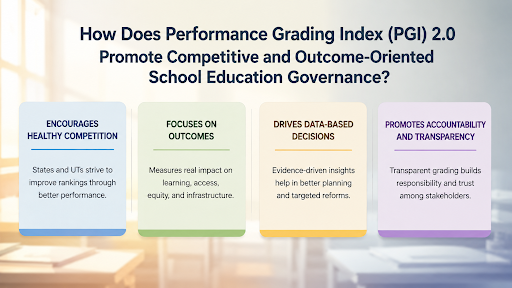
Objectives: The index catalyzes transformational change, provides deep insights into school education status, propels States and UTs to undertake multi-pronged interventions, and promotes evidence-based policymaking.
Key Features of PGI 2.0
Multi-Dimensional Assessment: The state-level structure utilizes a total weightage of 1,000 points across 70 indicators, classifying performance into 10 ascending grades from 'Akanshi-3' (lowest) to 'Daksh' (highest).
Dual-Level Evaluation: The framework deploys PGI-S (State Level) across 2 broad categories (Outcome and Governance & Management) and 6 domains, while PGI-D (District Level) evaluates districts on 600 points across 70 indicators grouped into 6 categories and 11 domains.
Learning Outcome Focus: The index allocates a significant weightage of 240 points to foundational learning outcomes based on assessments like the PARAKH Rashtriya Sarvekshan 2024.
Governance and Management: The system evaluates digital attendance, financial convergence, transparent fund utilization under Samagra Shiksha, and adherence to head-teacher norms.
Infrastructure and Equity: Parameters measure equitable access using metrics like ramps for disabled students, clean drinking water, computer-assisted teaching, and SC/ST enrollment parity.
Major Findings of PGI 2.0 (2025-26)
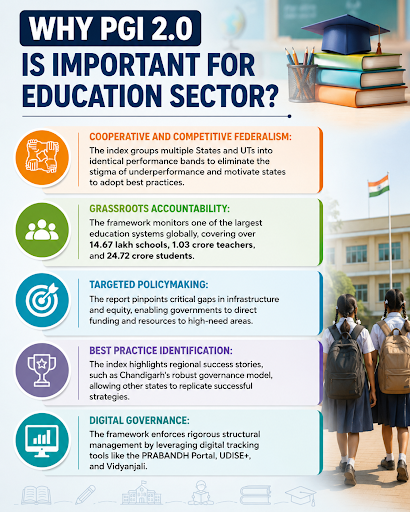
Chandigarh Leads: Chandigarh emerges as the sole territory to enter the top-tier "Uttam-3" grade, scoring 766 out of 1,000 points.
Absence of Top Grades: No State or UT reaches the highest grades of Daksh (941-1000), Utkarsh, or Ati-Uttam.
Administrative Progress: Overall scores improve in 32 out of 36 States/UTs, driven by Governance Processes with an average gain of 13.6 points.
Digital Infrastructure Surge: School computer access rises to 69.9% and internet connectivity increases to 67.4%
Stagnant Learning Outcomes: The 240-point learning outcomes domain remains completely frozen, indicating a critical lack of progress in foundational literacy and numeracy.
Significance of PGI 2.0
Objective Benchmarking: The 10-tier grading framework replaces arbitrary comparisons with targeted, objective goal-setting.
Tailored Policy Interventions: The index exposes specific weak links, such as identifying Meghalaya as the lowest performer at 525.7 points, to guide rescue interventions.
Administrative Innovation: The framework drives local authorities to innovate, resulting in a 29% drop in zero-enrollment schools and ensuring Pupil-Teacher Ratios surpass the 30:1 mandate.
Quality Enhancement: The index measures teacher development, tracking a national teacher workforce of 1.02 crore where women comprise a 54.9% majority.
NEP 2020 Alignment: The indicators map directly to the targets of the National Education Policy (NEP) 2020 and Sustainable Development Goal 4 (SDG-4).
What are the Major Concerns Associated with PGI 2.0?
State Capacity Disparities: A 31.4% gap between Chandigarh (top) and Meghalaya (lowest) highlights severe inequalities in institutional and financial capacities.
Data Reliability Risks: The index relies heavily on self-reported data from portals like UDISE+ and PRABANDH, leading the ministry to disclaim liability for errors or omissions.
Frozen Learning Outcomes: Rapid physical infrastructure improvements fail to translate into cognitive student capabilities, which remain stagnant.
Persistent Regional Disparities: States like Bihar, West Bengal, Jharkhand, and several North-Eastern states consistently lag in the lower "Akanshi" categories.
Resource Constraints: Lagging districts face severe capital constraints when upgrading to digital smart classrooms, CWSN-friendly toilets, and continuous teacher training.
Measures to Strengthen PGI 2.0
Prioritize Learning Outcomes: Shift from physical expansion to deep pedagogical interventions to improve PARAKH assessment scores.
Upskill Teacher Workforce: Focus on continuous professional development for the 1.02 crore teacher workforce in digital tools and supplementary materials.
Enhance Data Verification: Implement independent, third-party audits of data fed into the PRABANDH and Vidyanjali portals to ensure accuracy.
Empower District Monitoring: Strengthen PGI-D by equipping District Project Directors of Samagra Shiksha with decentralized funds to address early warning signs.
Foster Cross-State Collaboration: Establish task forces where leading regions like Kerala, Delhi, and Chandigarh mentor "Akanshi" states in digital learning and governance.
Conclusion
The Performance Grading Index 2.0 acts as a catalytic barometer for education. By shifting focus from inputs to outcomes, this framework transforms traditional schooling into an accountable, data-driven, and competitive ecosystem aligned with NEP 2020.
Source: PIB
|
PRACTICE QUESTION Q. The data for the Performance Grading Index for Districts (PGI-D) is drawn primarily from which of the following sources? 1. PARAKH Rashtriya Sarvekshan 2. Unified District Information System for Education Plus (UDISE+) 3. PRABANDH Portal 4. PM POSHAN Portal Select the correct answer using the codes below: A) 1, 2, and 3 only B) 2, 3, and 4 only C) 1, 2, and 4 only D) 1, 2, 3, and 4 Answer: A Explanation: The Performance Grading Index for Districts (PGI-D) evaluates district-level school education. Its data is primarily drawn from three sources:
|
PGI 2.0 is an evidence-based index that assesses the performance of school education systems across all Indian States, UTs, and Districts. It assigns states into specific grading bands (ranging from Daksh to Akanshi) based on 70 specific educational indicators.
The index is developed and released by the Department of School Education & Literacy, under the Union Ministry of Education.
The core purpose of PGI 2.0 is to promote competitive federalism, pinpoint exact infrastructural and governance gaps in school education, and enforce data-driven, evidence-based policy interventions without the stigma of traditional state rankings.
PGI was restructured into PGI 2.0 specifically to align its metrics and indicators with the modern educational milestones and inclusive foundational learning targets established by the National Education Policy (NEP) 2020 and the Sustainable Development Goal 4 (SDG-4).






© 2026 iasgyan. All right reserved