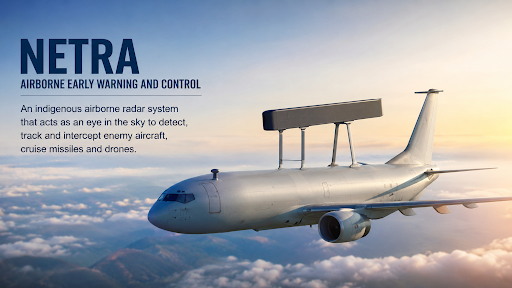
DRDO granted Final Operational Clearance to the indigenous NETRA AEW&C system, fully certifying it for the IAF. Mounted on Embraer ERJ-145 jets, the "Eye in the Sky" features an AESA radar, tracking 200+ targets over 250 km, ensuring dominant network-centric battle management.
Why In News?
The Defence Research and Development Organisation (DRDO) successfully hands over the Final Operational Clearance (FOC) certificate of the indigenous Netra Airborne Early Warning and Control (AEW&C) system to the Indian Air Force (IAF)
What is the NETRA AEW&C System?
Known as the IAF’s "Eye in the Sky," NETRA serves as India’s first indigenously developed airborne surveillance, command-and-control, and battle management platform.
Engineers build the system upon a modified twin-engine Embraer ERJ-145 regional jet airframe. The platform features customized in-flight refueling probes, enhanced electrical generators, and high-capacity climate cooling systems.
Key Features
Airborne Surveillance: The Active Electronically Scanned Array (AESA) radar provides a 240° to 270° azimuthal coverage, detecting aerial threats at ranges between 250 and 375 kilometers.
Early Threat Detection: The mission suite tracks over 200 distinct aerial targets simultaneously, neutralizing threats from stealth fighters, cruise missiles, and UAVs.
Battle Management: The system executes Intercept Control and Battle Management (IC&BM), directing fighter groups and organizing regional air defense configurations.
Network-Centric Warfare: The platform integrates Software-Defined Radios (SDRs) and secure data links to stream real-time data to the Integrated Air Command and Control System (IACCS).
Radar Systems: A multi-mode S-band AESA radar utilizes solid-state transmitters and dual-channel monopulse receivers to bypass terrain blockages.
Airspace Monitoring: Operating above 40,000 feet, the aircraft employs Electronic Support Measures (ESM) and Communication Support Measures (CSM) to map enemy radar positions without emitting its own signals.
Strategic Importance
Air Defence: NETRA integrates with ground-based systems like MRSAM and S-400 to create a layered defensive umbrella.
Force Multiplication: During the 2019 Balakot airstrikes, NETRA guided 12 Mirage 2000 jets deep into enemy territory. In 2025, it tracked ground targets up to 240 km away during Operation Sindoor.
Maritime and Border Security: The system provides over-the-horizon naval detection and monitors troop mobilizations along the LoC and LAC.
Source: PIB
|
PRACTICE QUESTION Q. Consider the following statements regarding the 'Netra' Airborne Early Warning and Control (AEW&C) system: 1. It is mounted on a modified Russian IL-76 aircraft to provide 360-degree radar coverage. 2. It integrates an indigenous Active Electronically Scanned Array (AESA) radar developed by DRDO. 3. It has the capability to track sea-surface targets in addition to airborne threats. Which of the statements given above are correct? (a) 1 and 2 only (b) 2 and 3 only (c) 1 and 3 only (d) 1, 2, and 3 Answer: (b) Explanation: Statement 1 is incorrect: The Netra AEW&C system is mounted on the Brazilian Embraer EMB-145 aircraft platform, not a Russian IL-76. It provides a 240-degree radar coverage sector (120 degrees on each side) rather than full 360-degree coverage. Statement 2 is correct: The system integrates an indigenous Active Electronically Scanned Array (AESA) primary radar developed natively by the Defence Research and Development Organisation (DRDO). Statement 3 is correct: According to DRDO specifications, the Netra AEW&C system functions multi-modally. It possesses the distinct electronic capability to detect, identify, and track sea-surface targets (like naval ships and merchant vessels) alongside incoming airborne threats (such as enemy jets, drones, and cruise missiles). |






© 2026 iasgyan. All right reserved