The National Statistical Commission (NSC), established in 2005 based on the Rangarajan Commission's recommendations, serves as India's apex advisory body for official statistics. It formulates policies, ensures data quality, and coordinates statistical activities across government agencies to foster evidence-based policymaking.
The Appointments Committee of the Cabinet (ACC) appointed Dr. Saibal Chattopadhyay as Chairperson of the National Statistical Commission (NSC).
Origin: The Government establishes a high-level commission in January 2000 to address deficiencies in the Indian Statistical System.
Rangarajan Commission: This body outlines a five-fold strategy to revitalize official statistics, focusing on administrative reform, infrastructure upgrades, and the adoption of alternative statistical techniques.
Establishment: Following an executive resolution on June 1, 2005, the NSC officially began its mandate on July 12, 2006, serving as the central nodal body for all core statistical activities.
Functions of the NSC
Policy Formulation: The NSC evolves national policies and strategic priorities for the entire statistical framework.
Data Quality: It sets strict national standards for socio-economic indices, such as inflation and national income, to bolster public trust.
Coordination: The commission lead horizontal coordination between central ministries and vertical cooperation with State and Union Territory administrations.
Statistical Audits: The NSC executes independent audits to verify the integrity of national data products.
Source: PIB
|
PRACTICE QUESTION Q. Consider the following statements regarding the National Statistical Commission (NSC):
Which of the statements given above are correct? (a) 1 and 2 only (b) 2 and 3 only (c) 1 and 3 only (d) 1, 2, and 3 Answer: (b) Explanation: Statement 1 is incorrect: The National Statistical Commission (NSC) is an autonomous advisory body, not a statutory body. It was established by a Government of India resolution on June 1, 2005, following the recommendations of the Rangarajan Commission. Statement 2 is correct: The Chief Executive Officer (CEO) of NITI Aayog is a permanent ex-officio member of the NSC. Statement 3 is correct: The Chief Statistician of India (CSI), who heads the National Statistical Office (NSO) and serves as the Secretary to the Ministry of Statistics and Programme Implementation, acts as the formal Secretary to the NSC. |
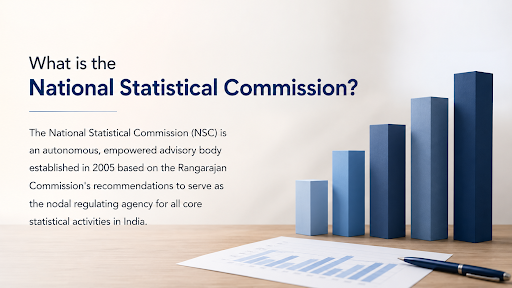
The National Statistical Commission (NSC) is an autonomous, empowered advisory body established in 2005 based on the Rangarajan Commission's recommendations to serve as the nodal regulating agency for all core statistical activities in India.
The NSC functions by formulating national data policies, setting strategic statistical priorities, standardising classification concepts, and executing extensive inter-agency coordination across central ministries and state administrations.
Official statistics are vitally important because they reveal accurate socio-economic dynamics, provide an unbiased baseline for economic planning, shape impactful public policies, and instil critical public trust in government-released data.
The NSC enhances data quality by mandating strict national quality benchmarks for economic metrics, standardising data collection methodologies, and conducting independent statistical audits over compilation systems to guarantee data integrity.






© 2026 iasgyan. All right reserved