Global mangrove forests are recovering, gaining over 2,000 sq km since 2010. In India, the MISHTI scheme accelerates this through community-funded afforestation. Despite threats from aquaculture and sea-level rise, these vital "blue carbon" sinks remain critical for coastal protection and biodiversity.
Why In News?
A Tulane University (US) study reveals an unexpected global recovery of mangrove forests, previously among the most threatened ecosystems.
What are Mangrove Forests?
Mangroves are a unique group of salt-tolerant, halophytic plant species that thrive in the dynamic transition zones between land and sea, specifically adapting to anaerobic coastal mudflats.
Distribution: These ecosystems span 14.8 million hectares globally, restricted to tropical and subtropical latitudes (25°N to 25°S). Indonesia holds 21% of the global share, while India accounts for approximately 3.3%.
Key Characteristics:
Vivipary: Seeds germinate while attached to the parent tree, dropping as fully formed propagules.
Pneumatophores: Specialized roots grow upward out of mud to absorb atmospheric oxygen.
Root Networks: Prop and stilt roots anchor trees against wave action and trap sediment.
Salinity Regulation: Specialized leaf glands and root-level ultra-filtration allow survival in hypersaline environments.
Why are Mangroves Important?
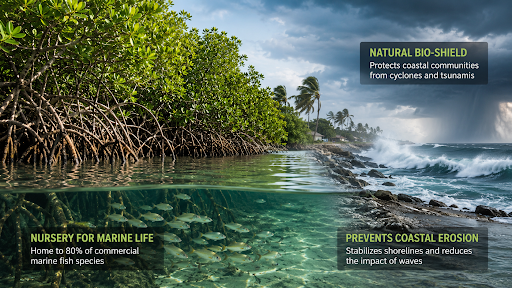
Blue Carbon Sinks: Mangroves store 394 tonnes of carbon per hectare, sequestering two to four times more carbon than terrestrial tropical rainforests.
Coastal Protection: They function as natural bioshields, reducing flood depths by 15% to 70% and providing $855 billion in annual global flood protection.
Biodiversity Hotspots: In India, these ecosystems host 5,746 documented species, including the Royal Bengal Tiger, Saltwater Crocodile, and the endangered Dugong.
Fishery Nurseries: Mangroves support the breeding of 800 billion juvenile aquatic organisms annually, sustaining over 210 million coastal inhabitants.
Water Purification: Root networks act as a "kidney," filtering agricultural pollutants and heavy metals to protect offshore coral reefs.
Global Recovery Trends
Structural Recovery: Global extent rose from 151,928 sq km in 2010 to 153,961 sq km by 2023.
Canopy Density: The proportion of dense, closed-canopy forests increased from 50% in the 1980s to 58% by 2023.
Regional Dynamics: Southeast Asia shows stabilization, while West and Central Africa (notably Nigeria) face accelerated deforestation.
Natural Recolonization: Mangroves actively reclaim abandoned shrimp ponds and colonize new river delta mudflats.
Mangroves in India
National Coverage: India State of Forest Report (ISFR) 2023 records 4,991.68 sq km of mangrove cover, a net increase of 363.68 sq km since 2013.
Major Regions:
Threats to Mangroves
Aquaculture: Conversion to shrimp ponds accounts for 26% of global loss (2000–2020).
Agriculture: Rice paddies and oil palm plantations drive 43% of global destruction.
Coastal Development: Unregulated urbanization and port expansions threaten sites like Thane Creek.
Climate Change: Sea-level rise causes "coastal squeeze," particularly endangering southern coasts like Lakshadweep and Tamil Nadu.
Invasive Species: Prosopis juliflora outcompetes native species, altering soil salinity and hydrology.
Government Initiatives
MISHTI Scheme: Launched in 2023, it targets the afforestation of 540 sq km across 11 states and 2 UTs by 2028 using CAMPA and MGNREGS funds.
National Coastal Mission: Receives Rs 10 crore in 2026-27 to build resilient infrastructure.
Coastal Regulation Zone (CRZ) 2019: Classifies mangroves as Ecologically Sensitive Areas (ESAs), mandating a 50-meter buffer (CRZ-IA) and a three-fold replantation penalty.
Mangrove Alliance for Climate (MAC): India joined at COP27 to scale nature-based climate solutions.
Way Forward
Community-Based Conservation: Institutionalize Community-Based Mangrove Management (CBMM) to empower local stewardship.
Nature-Based Solutions: Deploy permeable brushwood structures to dampen wave energy instead of concrete sea walls.
Blue Economy Integration: Scale the SAIME project to integrate mangrove coverage into aquaculture, resolving the "shrimp vs. mangrove" conflict.
Hydrology-Driven Restoration: Prioritize the restoration of local water flows over arbitrary single-species planting.
Conclusion
To protect coastal economies and climate goals, policymakers should transition from mere tree-planting to comprehensive, hydrology-focused mangrove restoration led by local communities.
Source: DOWNTOEARTH
|
PRACTICE QUESTION Q. Consider the following statements regarding Mangrove ecosystems and conservation frameworks: 1. According to the India State of Forest Report (ISFR) 2023, Gujarat holds the highest percentage of mangrove cover in India. 2. The MISHTI scheme aims to undertake mangrove afforestation utilizing funds from CAMPA and MGNREGS. 3. Globally, shrimp aquaculture and agricultural expansion are the primary drivers of mangrove deforestation. Which of the statements given above are correct? (a) 1 and 2 only (b) 2 and 3 only (c) 1 and 3 only (d) 1, 2, and 3 Answer: (b) Explanation: Statement 1 is incorrect. According to the India State of Forest Report (ISFR) 2023, West Bengal holds the highest percentage of mangrove cover in India (approximately 42.45%), primarily due to the Sundarbans. Gujarat ranks second with approximately 23.66% of the country's mangrove cover. Statement 2 is correct. The MISHTI (Mangrove Initiative for Shoreline Habitats & Tangible Incomes) scheme, launched in the 2023-24 Union Budget, explicitly aims to undertake mangrove afforestation through the convergence of funds from MGNREGS (Mahatma Gandhi National Rural Employment Guarantee Scheme), CAMPA (Compensatory Afforestation Fund Management and Planning Authority), and other sources. Statement 3 is correct. Globally, the conversion of land for shrimp aquaculture and agricultural expansion (such as for rice and oil palm) are recognized as the primary drivers of mangrove deforestation. Studies indicate that aquaculture accounts for a portion of mangrove loss in regions like Southeast Asia and Latin America. |


© 2026 iasgyan. All right reserved