The Central Government's push to designate 56,825 sq km of the Western Ghats as an Ecologically Sensitive Area (ESA) faces fierce state opposition. Balancing deep-ecology conservation against local livelihood concerns remains critical for securing India's climatic and hydrological future.
Why In News?
The Central Government issues the draft notification to legally declare 56,825 sq km of the Western Ghats as an Ecologically Sensitive Area (ESA).
What is an Ecologically Sensitive Area (ESA)?
Definition: The ESA functions as a designated buffer zone or "shock absorber" surrounding protected ecosystems like national parks and wildlife sanctuaries to minimize destructive human impact.
Legal Basis: The Central Government derives authority from the Environment (Protection) Act, 1986, to issue notifications that restrict ecologically damaging activities.
Objectives: These zones prevent the irreparable loss of endemic biodiversity and serve as vital ecological corridors, as mandated by the National Wildlife Action Plan and the Pronab Sen Committee Report (2000).
|
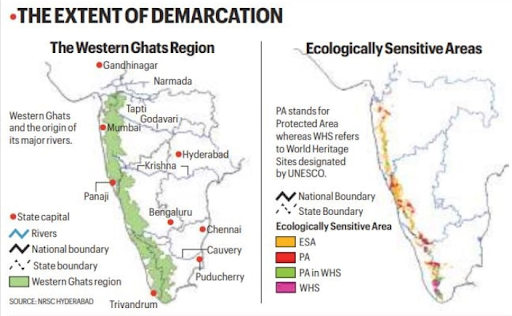
Western Ghats Biodiversity Hotspot: The 1,500-km mountain chain hosts over 30% of India’s plant, fish, bird, and mammal species. UNESCO Status: UNESCO inscribed the region as a World Heritage Site in 2012 for its unique ecosystems, including shola montane grasslands. Water Security: The mountains act as a "water-making machine," serving as the origin point for critical rivers like the Godavari, Krishna, Cauvery, and Periyar. |
Evolution of ESA Recommendations
Madhav Gadgil Committee (WGEEP): Proposed designating 64% (1,29,037 sq km) of the Western Ghats as an ESA, recommending a ban on hydroelectric dams, GM crops, and SEZs, while empowering Gram Sabhas.
Kasturirangan Committee (HLWG): Revised the proposal to 37% (approx. 60,000 sq km), utilizing LISS IV and AWiFS satellite data to distinguish between "natural" and "cultural" landscapes. The current government draft adopts this 56,825 sq km framework.
Key Features of ESA Notification
Mining Ban: The notification enforces an absolute ban on new commercial mining, sand mining, and quarrying.
Phased Exit: Existing mines in ESZ-1 must phase out operations within five years.
Pollution Control: The law prohibits new thermal power plants and ‘Red’ category industries.
Sustainable Development: Rules permit organic farming, rainwater harvesting, and traditional spice plantations.
Infrastructure Limits: The framework bans area development projects exceeding 50 hectares and townships with built-up areas over 20,000 square metres.
State Opposition and Challenges
Livelihood Concerns: Local communities fear "inspector raj" and bureaucratic extortion for basic activities like digging borewells.
Agricultural Impact: Kerala resists the inclusion of the Cardamom Hills, arguing that regulations on cash crops like rubber and tea paralyze productivity.
Federalism: Karnataka rejects the Kasturirangan report, asserting that its existing protection of 16,632 sq km renders the central mandate redundant.
Industrial Pressure: States like Goa and Maharashtra seek to exclude villages to facilitate iron ore mining.
Importance of ESA Conservation
Wildlife Protection: The region supports 30% of the global Asian elephant population and 17% of the world’s tigers.
Climate and Disaster Mitigation: Forest cover acts as a massive carbon sink and prevents mass-wasting events like the recent Wayanad landslides.
Endemism: Regulations protect critically endangered species such as the Nilgiri Tahr and the King Cobra (Ophiophagus Kaalinga).
Environmental Challenges
Anthropogenic Threats: Deforestation, land-use changes, and the replacement of native vegetation with exotic species like Eucalyptus loosen topsoil.
Habitat Fragmentation: Mega-infrastructure and hydroelectric projects dissect forests, increasing human-wildlife conflict.
Overtourism: Unregulated hotel complexes in areas like Wayanad and Mahabaleshwar degrade habitat value.
Supreme Court and ESA Protection
Precedents: The Court set legal standards in the Doon Valley case (1993) and the Sri Anand Arya vs Union of India (2010) case, which forced the government to publish ESZ guidelines.
Judicial Activism: The Court utilizes the Precautionary Principle and Sustainable Development Principle to penalize the political-corporate nexus, as seen in the condemnation of illegal tree felling in Jim Corbett National Park.
Way Forward
Participatory Conservation: Integrate traditional ecological knowledge and empower Gram Sabhas under the Forest Rights Act
Scientific Mapping: Use high-resolution geospatial technology to resolve land-classification disputes.
Financial Incentives: Implement Ecosystem Service Payment Mechanisms to compensate farmers for conservation efforts.
Cooperative Federalism: Negotiate grant-in-aid packages to support states bearing the economic burden of conservation.
Green Livelihoods: Invest in green upskilling, sustainable agriculture, and regulated eco-tourism.
Conclusion
Finalizing the Western Ghats ESA framework demands a participatory, scientifically precise approach that balances ecological security with the fundamental developmental and livelihood rights of populations.
Source: INDIANEXPRESS
|
PRACTICE QUESTION Q. Consider the following statements regarding the committees formed to demarcate Ecologically Sensitive Areas (ESAs) in the Western Ghats:
Which of the statements given above is/are correct? A) 1 and 2 only B) 2 only C) 2 and 3 only D) 1, 2, and 3 Answer: B Explanation: Statement 1 is incorrect: The Kasturirangan Committee (High-Level Working Group), not the Madhav Gadgil Committee (WGEEP), recommended designating roughly 37% of the total area of the Western Ghats as an Ecologically Sensitive Area (ESA). The Madhav Gadgil Committee recommended that the entire Western Ghats region (approx. 64% as formal zones) be treated as ecologically sensitive under different levels of protection. Statement 2 is correct: The Kasturirangan Committee introduced a broad distinction between "natural landscapes" and "cultural landscapes". It designated the natural landscapes as the ESA (37%) while deliberately keeping cultural landscapes—which include human settlements, agricultural zones, and plantations—exempt from the highly restrictive ESA regulations to prevent disrupting local livelihood. Statement 3 is incorrect: The Gadgil Committee (WGEEP) recommended a complete ban on new environmental mining leases in highly sensitive zones (like ESZ-1 and ESZ-2), and a strict phase-out in existing ones. Commercial mining is classified as a highly damaging activity and is heavily restricted or banned in sensitive zones rather than completely permitted. |
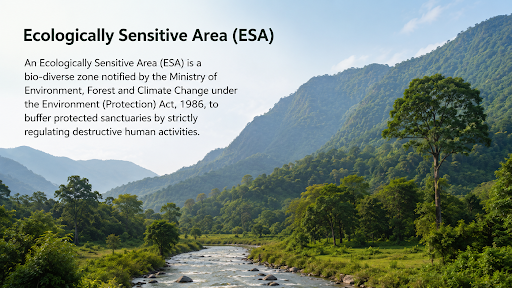
An Ecologically Sensitive Area (ESA) is a bio-diverse zone notified by the Ministry of Environment, Forest and Climate Change under the Environment (Protection) Act, 1986, to buffer protected sanctuaries by strictly regulating destructive human activities.
The Gadgil Report recommended designating the entire Western Ghats (100%) as an ESA with absolute local panchayat veto power, whereas the subsequent Kasturirangan Report proposed a pro-development compromise, restricting the ESA to just 37% of the total area and dividing the landscape into cultural and natural zones.
State governments strongly oppose the final ESA notifications because they fear the stringent environmental compliance will completely stall major infrastructure projects like highways and dams, trigger mass displacement of local farming communities, and paralyze local economic growth.
The draft rules enforce a complete prohibition on highly destructive industries—including commercial mining, stone quarrying, sand mining, the establishment of highly polluting "Red Category" factories, and the construction of massive new townships.



© 2026 iasgyan. All right reserved