Babu Jagjivan Ram transformed India’s socio-political landscape through his 50-year parliamentary career. As a visionary leader, he pioneered labor rights, spearheaded the Green Revolution to secure food independence, and masterminded India’s 1971 military victory, cementing his nation-building legacy.
Why In News?
The Ministry of Social Justice and Empowerment organizes nationwide events to commemorate the 40th Death Anniversary of Babu Jagjivan Ram on July 6, 2026.
Who Was Babu Jagjivan Ram?
Early Life and Background: Born on April 5, 1908, in Chandwa, Bihar, into a marginalized Dalit family, he faced severe societal stigma and caste prejudice during his early years.
Educational Struggle: He faced institutional discrimination while pursuing higher education at Banaras Hindu University (BHU) and the University of Calcutta, solidifying his resolve to dismantle untouchability.
Unprecedented Parliamentary Career: He holds a unique world record for serving as an uninterrupted parliamentarian for 50 years (1936–1986).
National Leadership: He rose to the position of Deputy Prime Minister of India (1977–1979) under the Morarji Desai government, guiding the nation back to democratic stability post-Emergency.
What Were His Major Contributions?
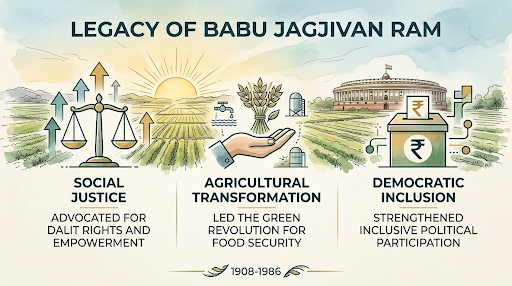
Advancing Labor Rights: As India's first Labour Minister (1946–1952), he piloted the Industrial Disputes Act (1947), the Minimum Wages Act (1948), and the Employees' Provident Fund Act (1952) to institutionalize social security.
Masterminding the Green Revolution: As the Food and Agriculture Minister (1967–1970), he adopted High-Yielding Variety (HYV) seeds during severe droughts, escalating Indian wheat production from 11 million tonnes in 1966 to 17 million tonnes in 1968.
Achieving Food Self-Sufficiency: He expands the Food Corporation of India (FCI) and strengthens the Public Distribution System (PDS), shifting India from a "ship-to-mouth" dependency to food self-sufficiency.
Securing National Victory: As Defence Minister (1970–1974), he orchestrates the historic liberation of Bangladesh during the 1971 Indo-Pak War and ensures the surrender of 93,000 Pakistani soldiers under humane conditions.
Defending Democracy: He opposes the Emergency, fights mass arrests under the Maintenance of Internal Security Act (MISA), and secures 28 Lok Sabha seats in 1977 through a strategic alliance with the Janata Party.
His Legacy Relevant for Contemporary India
Expanding Financial Inclusion: His strategy of deploying priority sector lending to shield rural farmers from exploitative moneylenders serves as a modern blueprint for financial inclusion.
Promoting Intersectional Representation: Placing Dalit leaders in supreme executive roles (Defence, Agriculture, Deputy PM) injects critical empathy into national policy-making.
Safeguarding Federalism: His 1977 revolt against centralized control acts as a permanent reminder to safeguard federalism and inner-party democracy.
Empowering the Subaltern: He inspires the marginalized masses to utilize the ballot box as a weapon against systemic abuse, deeply entrenching democratic habits.
Source: THEHINDU
|
PRACTICE QUESTION Q. Consider the following statements regarding Babu Jagjivan Ram: 1. He served as the Defence Minister of India during the 1962 Sino-Indian War. 2. He founded the All India Depressed Classes League in 1935. 3. He launched the Congress for Democracy (CFD) party to oppose the Emergency in 1977. Which of the statements given above is/are correct? a) 1 and 2 only b) 2 and 3 only c) 1 and 3 only d) 1, 2, and 3 Answer: b) Explanation: Statement 1 is incorrect: Babu Jagjivan Ram did not serve as Defence Minister during the 1962 Sino-Indian War; instead, he led the Ministry of Defence during the 1971 Indo-Pak War. Statement 2 is correct: He was instrumental in founding the All India Depressed Classes League in 1934/1935 to promote social equality and voting rights for the underprivileged classes. Statement 3 is correct: He resigned from the Union Cabinet during the 1975–77 Emergency and launched the Congress for Democracy (CFD) political party to oppose it. |
Babu Jagjivan Ram was a prominent Indian freedom fighter, a highly revered Dalit icon, and a visionary statesman. He holds the world record for being a parliamentarian for 50 uninterrupted years (1936–1986) and played a foundational role in shaping modern India's labor, agriculture, and defense policies.
He is recognized as a champion of social justice because he fought to include Article 17 (abolition of untouchability) in the Constitution, secured voting rights for Dalits via the Hammond Commission, and actively shifted focus from theoretical debates to the statutory enforcement of labor rights by passing laws like the Minimum Wages Act (1948).
During his expansive career, he served as India’s first Labour Minister, the Minister of Food and Agriculture (where he spearheaded the Green Revolution), the Defence Minister (leading India to victory in the 1971 Indo-Pak War), and the Deputy Prime Minister of India (1977–1979).
His legacy remains highly relevant because his governance model seamlessly merged economic growth with equitable wealth distribution. His strategies—such as advocating for priority sector bank lending, protecting civil liberties against authoritarianism, and enforcing strict labor protections—continue to serve as blueprints for tackling modern inequality and inclusive development.


© 2026 iasgyan. All right reserved